
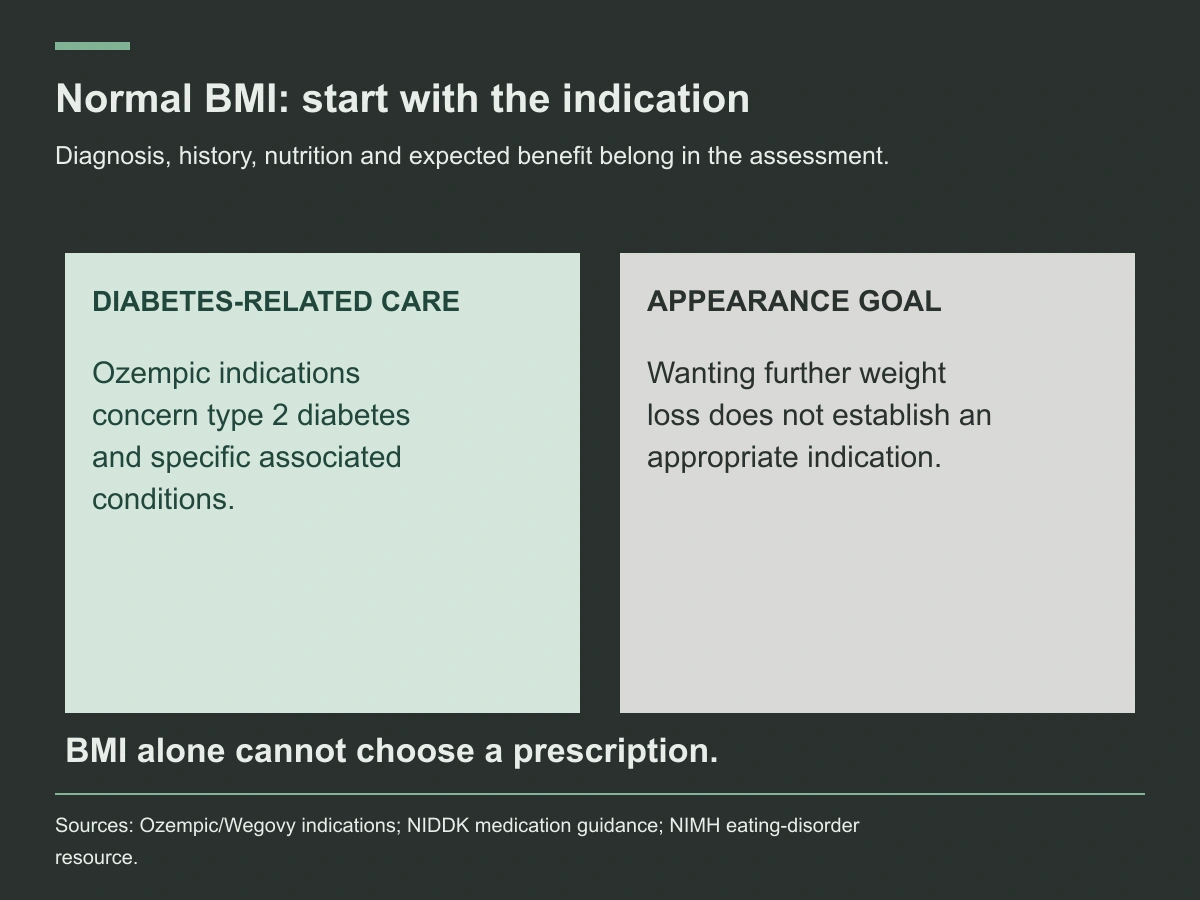
Ozempic at a normal BMI is not one clinical situation. A person may have type 2 diabetes and a valid reason to discuss diabetes treatment without having obesity. Another person may want appetite suppression only to change appearance. Those questions need different assessments. BMI alone cannot establish that Ozempic is appropriate, and looking thin cannot establish a person’s diagnosis.
The first questions are what condition is being treated, what benefit is expected, and whether the person’s history and nutrition make the proposed treatment suitable. There is no universal rule that everyone below a particular BMI should take Ozempic, or that every person with a normal BMI is automatically excluded from diabetes care.
What Ozempic is approved to treat
The current Ozempic U.S. prescribing information lists three type 2 diabetes-related indications: improving glucose control in adults alongside diet and exercise; reducing major cardiovascular events in adults with type 2 diabetes and established cardiovascular disease; and reducing specified kidney and cardiovascular outcomes in adults with type 2 diabetes and chronic kidney disease.
That is different from an approval for cosmetic weight loss. It also explains why a discussion of Ozempic cannot begin and end with a person’s BMI. The diagnosis and intended indication matter. A clinician needs the medical history and relevant assessment rather than a photograph or clothing size.
Our semaglutide and Ozempic comparison explains active ingredient and brand differences. Semaglutide also appears in Wegovy, whose approved indications and formulations differ. Sharing an ingredient does not make the products interchangeable or establish a personal treatment plan.
How weight-management criteria differ
NIDDK’s weight-medication guidance describes common adult consideration of weight-management medication at BMI 30 or higher, or BMI 27 or higher with a weight-related health condition. It stresses an individualized decision and says these medicines should not be used solely to improve appearance.
The current Wegovy label identifies its weight-management population and other specific indications. A clinician should use the actual product label and indication rather than treating a general BMI summary as a complete assessment. There are formulation and age differences as well.
The key distinction is the goal of care. Treating type 2 diabetes, treating obesity-related health, and trying to become thinner for an event are not the same indication. A medicine’s possible effect on weight does not mean it has an appropriate benefit-risk balance for every weight goal.
| Starting question | What needs assessment | What BMI alone cannot establish |
|---|---|---|
| I have type 2 diabetes and a normal BMI | Glucose care, relevant diagnoses, other medicines, and nutritional status | Which diabetes medicine fits best |
| I have a weight-related health concern | Exact diagnosis, product indication, history, and prior approaches | Automatic eligibility or a guaranteed result |
| I want to lose a few pounds for appearance | Goals, current intake, body-image concerns, and possible risks | A medical reason for appetite suppression |
| I am losing weight without trying | Symptoms, intake, medicines, and possible underlying illness | That further loss would be beneficial |
A normal BMI does not mean a complete health assessment
BMI compares weight with height. It does not directly measure nutritional adequacy, muscle strength, diabetes status, body composition, or the cause of a recent weight change. It can be useful within a broader assessment while leaving important information out.
Our BMI and waist-measurement guide helps readers understand what these numbers can and cannot tell them. A clinician may also consider blood pressure, relevant laboratory results, symptoms, family history, activity, and changes over time. Those findings should shape the actual care plan.
Avoid judging another person’s eligibility from appearance. A person who appears thin may have medical concerns you cannot see, and a person who appears larger does not automatically need a particular prescription. The clinical question belongs to that person’s history and assessment.
If you have a normal BMI and new unexplained weight loss, fatigue, gastrointestinal symptoms, or trouble eating, describe those changes before asking for weight suppression. A clinician can determine which evaluation is needed. Trying to accelerate an unexplained change may delay attention to its cause.
Appetite reduction can create a nutrition problem
Eating less is not automatically beneficial. When intake becomes inadequate, a person may struggle with energy, meal variety, hydration, and everyday function. The concern is especially relevant when the starting goal is further loss in someone who does not have an established weight-management indication.
Ozempic commonly causes digestive reactions, including nausea, vomiting, diarrhea, abdominal pain, and constipation. The label warns about severe gastrointestinal reactions and dehydration-related kidney injury. Repeated vomiting or difficulty keeping fluids down requires attention; it should not be accepted as a desirable way to lose weight. Ozempic prescribing information.
Our semaglutide side-effect guide separates product-specific evidence. The protein and muscle guide discusses nutrition and function during treatment. Neither supplies a universal protein target or permission to continue treatment through serious symptoms.
Ask how the team will assess intake, whether a dietitian would help, and how you should report weakness, ongoing poor intake, or changes in daily function. A plan should address those concerns before an automatic dose increase. More appetite suppression is not a useful goal when adequate eating is already difficult.

Contraindications and warnings still apply at a lower BMI
Being smaller does not remove product risks. Ozempic is contraindicated with a personal or family history of medullary thyroid carcinoma or MEN 2, and with a prior serious hypersensitivity reaction to semaglutide or an excipient. Its boxed warning reflects thyroid C-cell tumors in rodents; whether it causes these tumors in humans is unknown.
The label also addresses pancreatitis, gallbladder disease, severe gastrointestinal reactions, retinopathy complications in relevant diabetes populations, and hypoglycemia when used with insulin or insulin secretagogues. It is not recommended in severe gastroparesis. A clinician needs an accurate history and medication list to assess these concerns. Current label.
Seek prompt medical assessment for severe or persistent abdominal pain, particularly if it extends to the back, repeated vomiting, or significant dehydration. Breathing trouble, swelling of the face or throat, or signs of a severe allergic reaction require emergency help. Do not wait for a routine refill conversation to address serious symptoms.
Pregnancy plans also belong in the review. Diabetes control during pregnancy has its own risks and treatment needs, so coordinate changes with the care team rather than stopping essential diabetes care without a plan. Our semaglutide and pregnancy guide introduces product-specific questions.
What off-label prescribing does and does not mean
NIDDK describes off-label use as prescribing in a way that differs from FDA approval, such as using a medicine approved for another medical condition. The term describes the use; it does not by itself prove that a particular prescription is appropriate or that every proposed outcome is supported.
If off-label Ozempic is proposed for a weight goal, ask why that product is being considered, what evidence fits your circumstances, what alternatives exist, and how benefit and risks will be assessed. Ask whether an approved product for the intended condition would be more appropriate. NIDDK’s explanation.
An anecdote about another person cannot settle those questions. A compounded preparation adds separate product-quality and instruction questions. FDA says compounded drugs are not FDA-approved and should meet a medical need that an approved product cannot meet. FDA compounding guidance.
Do not treat a smaller amount, a microdosing advertisement, or an online units chart as evidence that risks disappear. An individualized prescription and appropriate follow-up remain necessary. There is no universal normal-BMI starting dose supplied by this article.
Body-image concerns deserve room in the appointment
Wanting to discuss appearance does not automatically mean someone has an eating disorder. However, severe restriction, compensatory behaviors, loss of control around eating, or distress that interferes with life should be discussed directly rather than hidden within a request for appetite suppression.
NIMH’s eating-disorder guidance explains that eating disorders affect people at many body weights, including those who appear healthy. A normal BMI does not rule one out. Effective care can include mental health support, medical monitoring, and nutritional counseling.
Describe what happens in daily life: skipped meals, fear of certain foods, exhaustion from exercise, avoiding social eating, or fixation on comparison photos. These details help a professional understand what support may help. You do not need to become underweight before asking for assistance.
Our celebrity weight-rumor guide explains why public images cannot reveal a regimen or justify copying it. Your care should focus on your health, symptoms, and priorities rather than reproducing another person’s appearance.

Questions for your clinician
- Which diagnosed condition are we treating, and what benefit should I expect?
- Does my recent weight change or nutritional intake need assessment first?
- Is this use within the product’s approved indications or off-label?
- What does my medical and family history mean for the choice?
- How do my current diabetes medicines affect low-glucose risk?
- How will we track eating, hydration, strength, and symptoms?
- What would lead us to reassess, change, or stop treatment?
The CoreAge Rx semaglutide page provides service information if you are exploring care. Confirm the exact preparation, clinical assessment, pharmacy, and follow-up. A product page cannot establish personal eligibility, and it does not make a compounded product approved Ozempic.
Frequently asked questions
Can someone with a normal BMI be prescribed Ozempic for diabetes?
They may have a reason to discuss it because the indications concern type 2 diabetes and specific associated conditions. A clinician still needs to assess suitability, alternatives, history, nutrition, and monitoring. Normal BMI alone neither approves nor excludes treatment.
Is Ozempic approved just to help a thin person lose a few pounds?
Its reviewed U.S. indications are type 2 diabetes-related, not cosmetic weight loss. An appearance goal is different from a diagnosed condition with an established treatment benefit.
Does not having diabetes remove side-effect risks?
No. Digestive reactions, dehydration, serious warnings, and contraindications remain relevant. Risk interpretation should use evidence from the appropriate product and study population rather than assume all people have identical risks.
Is a low dose automatically safe for me?
No. A smaller amount does not establish an indication, remove contraindications, or assess eating concerns. Do not share prescriptions, modify devices, or select a dose from another person’s regimen.
Should I use BMI as my only progress measure?
No. Discuss the intended health outcome, symptoms, adequate nutrition, function, relevant measurements, and follow-up. A lower number alone cannot establish a successful or suitable treatment plan.
Educational information for adults; individual treatment decisions require a qualified clinician. Sources reviewed October 2, 2026. Original AI-generated article images depict fictional people and objects, not patient outcomes. Other editorial images are illustrative. Graphics summarize the cited sources.