
Metamucil’s psyllium products can support stool regularity, and some research has assessed fullness or weight outcomes. That does not make every Metamucil product a weight-loss treatment or guarantee a particular result. The useful answer depends on the formulation, the outcome being measured, and how it fits with adequate meals and the rest of your care.
Short-term appetite research, a change in bowel contents, and sustained body-fat loss are different things. This guide explains the evidence, shows why package measurements matter, and covers the fluid, swallowing, and medication-timing questions to review before adding a fiber product.
What is in Metamucil?
Metamucil is a brand with different products, not one universal formula. Check the exact powder, packet, capsule, gummy, or other preparation. The brand name alone does not establish the fiber type, amount, serving measure, or directions.
The Procter & Gamble sugar-free orange packet label reviewed here identifies approximately 3.4 grams of psyllium husk in each 5.8-gram packet. Its Drug Facts describe use for occasional constipation. The amount of psyllium husk and the packet’s total weight are separate numbers.
Dietary fiber on a Nutrition or Supplement Facts panel is another measurement to read accurately. Do not assume that total powder weight, psyllium husk weight, and dietary fiber grams are identical. Flavoring and other ingredients can contribute to the product’s total weight.
Our fiber supplement guide explains these label distinctions. Comparing an actual package is more useful than treating every orange powder or capsule as interchangeable.
Can psyllium help you feel fuller?
Psyllium forms a gel when hydrated, and researchers have investigated its effects on fullness and hunger. An original 2016 study abstract describes two randomized, double-blind, placebo-controlled crossover trials using psyllium, identified as Metamucil, over three-day periods.
The trials measured hunger, desire to eat, and fullness between meals. They reported improvements in those satiety outcomes under their study conditions. The listed author affiliation included Procter & Gamble, which is relevant context when evaluating branded-product research.
Those findings concern short-term subjective appetite measurements. They are not a three-day demonstration of body-fat loss or a promise that every product and user will experience the same benefit. We reviewed the indexed abstract rather than the full original paper.
Our fiber and fullness guide provides additional context. Feeling fuller can be one practical outcome to discuss, while adequate nutrition and the overall eating pattern remain important.
What does research say about weight loss itself?
Research syntheses have not all produced the same answer. A 2019 meta-analysis abstract described 22 randomized trials and found no statistically significant pooled reduction in body weight, BMI, or waist circumference. Its search covered studies available through August 2018.
A 2023 meta-analysis abstract used narrower criteria involving weight-loss trials in adults with overweight or obesity lasting at least two months. It included six trials with 354 participants and reported a pooled body-weight difference of about 2.1 kilograms, with an average study duration of 4.8 months. Its authors’ affiliation was Procter & Gamble.
Different included populations, trial purposes, durations, and preparations can help explain why reviews differ. Neither abstract establishes that an individual will lose that amount, that all brand formulations are equivalent, or that an internet dosing routine reproduces the trials.
The practical conclusion is measured: psyllium may have a useful role for some people, but a branded fiber product is not a guaranteed slimming solution. Discuss the actual objective and evidence rather than treating either a positive or null pooled result as a personal prediction.
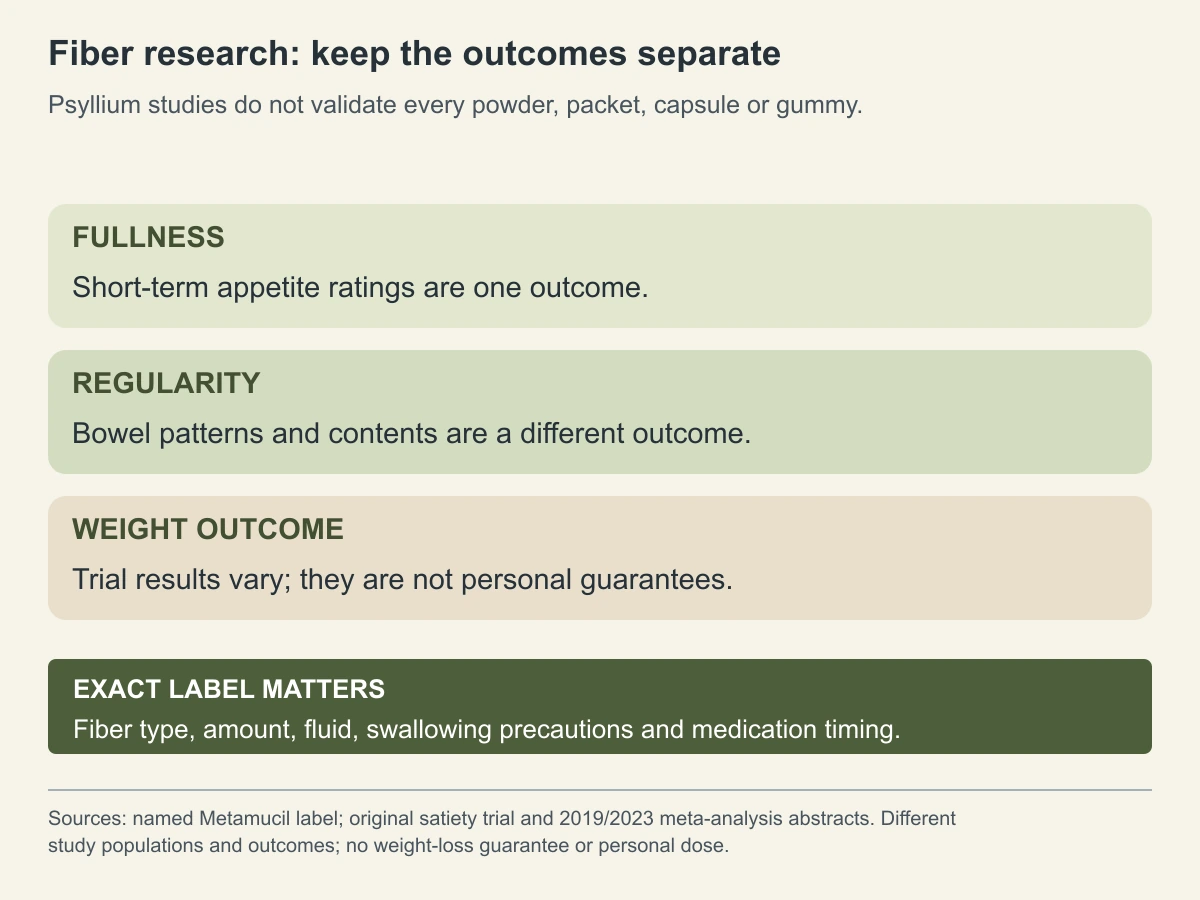
Fullness, regularity, and fat loss are separate outcomes
| Outcome | What it describes | What it does not prove |
|---|---|---|
| Fullness between meals | A subjective appetite experience | Sustained loss of body fat |
| Stool regularity | The bowel pattern and ease of passing stool | Removal of stored body fat |
| A short-term scale change | Weight at that moment | Which tissue or fluid changed |
| Trial-average weight change | A group result under specified conditions | The result for every product or person |
| Cholesterol or glucose-related claim | A separate health outcome | That the product is a weight-loss drug |
Passing a bowel movement can change digestive contents, but that should not be confused with deliberately burning body fat. Avoid using a laxative or increasingly restrictive intake to chase a short-term scale number.
Our water weight versus fat-loss guide explains another source of scale changes. The NIDDK’s weight-management program guidance instead emphasizes a repeatable eating and drinking pattern, activity where appropriate, support, and maintenance.
Why do sugar-free and real-sugar powders use different measures?
The manufacturer’s sugar-free orange powder page uses teaspoon measures, while the real-sugar orange powder page uses tablespoon measures. Those differences are a reason to read the exact package, not a conversion instruction.
A packet has its own measured contents, and capsules have their own labeled serving. Do not use a scoop from one preparation to reproduce another product’s amount. “One spoon” is not a reliable description when products specify different measures.
The intended purpose can also affect the manufacturer’s serving directions. An appetite-control statement and constipation Drug Facts may describe different instructions. Ask a pharmacist to reconcile the label with your goal rather than choosing the largest listed amount.
Sugar-free does not automatically mean calorie-free. Read the full nutrient panel, inactive ingredients, and warnings. The reviewed packet label also contains a phenylalanine warning relevant to people with phenylketonuria.

Fluid and swallowing precautions matter
The reviewed packet label instructs mixing a dose with at least 8 ounces of fluid and drinking promptly after stirring. Its warning explains that inadequate fluid can allow the product to swell and obstruct the throat or esophagus.
That is a product safety instruction, not a universal daily fluid prescription. People with fluid restrictions or relevant medical conditions should ask how a fiber product fits their care. Taking dry powder to avoid the fluid requirement is not an appropriate workaround.
The label says not to use the product if you have difficulty swallowing. Chest pain, vomiting, or trouble swallowing or breathing after taking it requires immediate medical attention. Do not try to manage those symptoms by simply adding another fiber serving.
Our fiber supplement and water guide explains practical preparation questions. If the mixture thickens before you drink it, follow the exact package instructions and ask a pharmacist when uncertain.
How should it be timed around medicines?
The reviewed Metamucil packet label advises taking the product two or more hours before or after other drugs and consulting a doctor or pharmacist when using another medicine. The manufacturer powder pages also provide medication-spacing advice.
Your other prescription may have its own food, fasting, or timing instructions. A generic two-hour interval should not be treated as proof that every combination is appropriate. Ask the pharmacist to review the entire schedule, particularly when several treatments are involved.
Write down prescription names, supplements, and the specific fiber preparation. An interaction question is easier to answer from those details than from “an orange drink in the morning.”
Our fiber and medication timing guide provides a checklist for that conversation. Avoid moving an important medicine or changing its dose independently to fit a supplement routine.
What about bloating or constipation that does not improve?
The label notes that bowel changes or minor bloating can occur as the body adjusts to increased fiber. More severe symptoms, persistent problems, or an uncertain diagnosis require a different assessment.
The reviewed packet label advises medical review for abdominal pain, nausea or vomiting, a sustained sudden change in bowel habits, rectal bleeding, failure to have a bowel movement, or constipation lasting more than seven days. Read the exact warnings for your own product.
Do not assume that every constipation problem needs more fiber. The cause, fluid intake, medicines, and symptom severity can affect the plan. Our fiber and bloating guide discusses how to describe tolerance and changes.
If symptoms interfere with eating, ordinary activities, or the ability to drink, say so. A product’s popularity does not make repeated discomfort something that should automatically be accepted.
Is it suitable while taking a GLP-1 medicine?
The manufacturer uses a “GLP-1 friendly” marketing description for some fiber products. That phrase does not establish suitability for every person, every symptom, or every GLP-1 preparation. Evaluate the actual ingredients, warnings, and care plan.
If semaglutide or tirzepatide has reduced appetite or caused gastrointestinal symptoms, discuss adequate food and fluid intake and the cause of constipation. The GLP-1 nutrition advisory supports individualized nutrition assessment during treatment.
CoreAge Rx’s semaglutide and tirzepatide treatment information provide separate assessment information. Ask the clinician whether a fiber supplement is appropriate and how to monitor symptoms, rather than adding one to suppress appetite further without reviewing intake.

Comparing food, Metamucil, and another supplement
Whole foods contribute more than one isolated ingredient. Our food fiber versus supplements guide and balanced meals guide help compare practical food choices with an actual supplement label.
CoreAge Rx’s Full House product information is a separate formulation to evaluate. It should not be represented as equivalent to the named Metamucil psyllium product or as having the same studied serving. Check its actual ingredients, fiber information, directions, and medication considerations.
Choose a product for a defined goal: supporting a bowel pattern, addressing a dietary gap, or another clinician-reviewed need. Ask what benefit to look for and when to reassess. A larger scoop or multiple overlapping products does not automatically improve that benefit.
Frequently asked questions
Does Metamucil burn belly fat?
No localized fat-burning effect is established by the research discussed here. Satiety, regularity, and trial-average weight outcomes should not be turned into a promise about a specific body area.
Can I use it instead of a meal?
A fiber product is not a nutritionally complete meal. If reduced appetite makes eating difficult, review adequate intake with the care team rather than replacing food with a supplement.
Are powders, capsules, and gummies interchangeable?
Do not assume so. Check the actual fiber type, ingredients, amount, serving measure, directions, and warnings. Research on one psyllium preparation does not validate every product with the same brand name.
Does the 2.1-kilogram trial result predict my weight loss?
No. It is a pooled group finding from selected trials with particular populations and durations. Other reviews differed, and the number is not an individual guarantee or a dosing instruction.
Educational information for adults; individual treatment decisions require a qualified clinician. Sources reviewed October 1, 2026. Original AI-generated article images depict fictional people and objects, not patient outcomes. Other editorial images are illustrative. Graphics summarize the cited sources.