
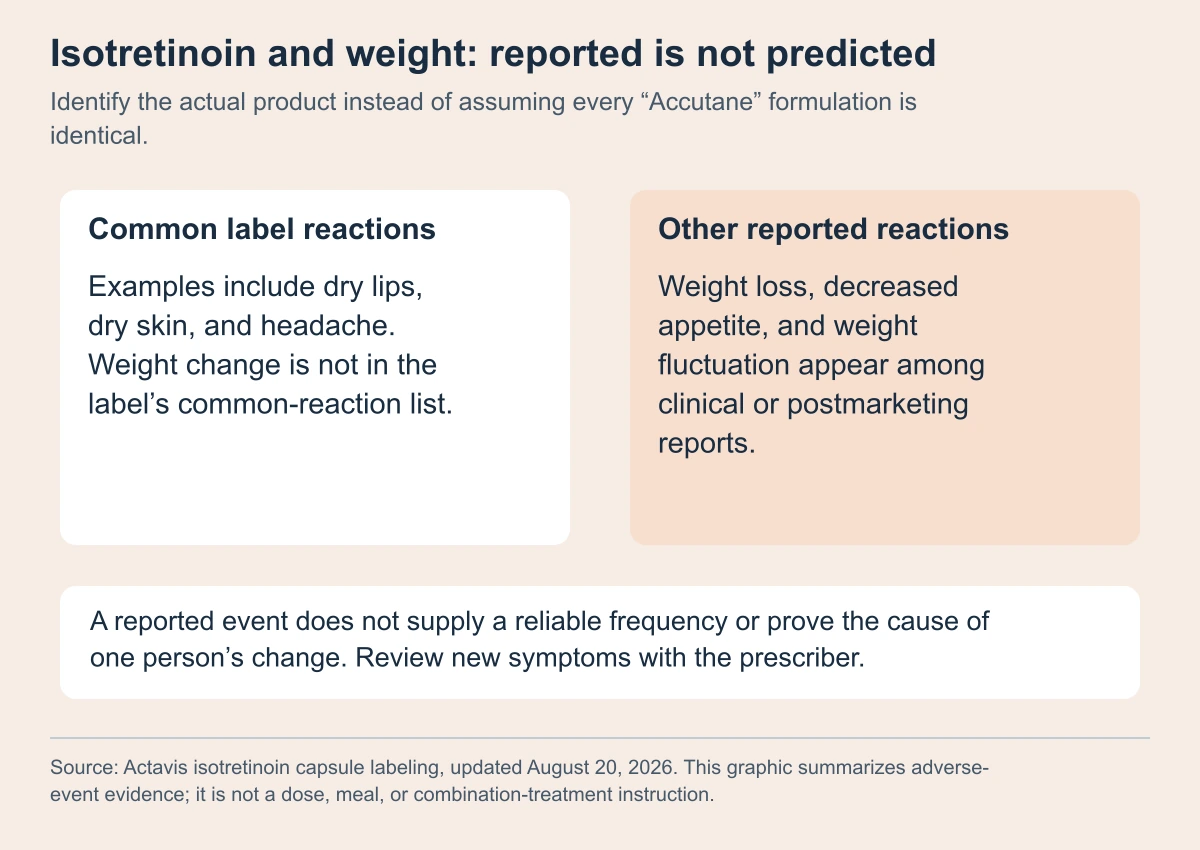
Isotretinoin labeling includes weight loss, decreased appetite, and weight fluctuation among reactions reported in clinical trials or after marketing. Those reports do not give a reliable personal prediction or establish that isotretinoin caused every reported change. Weight change is not included in the reviewed label’s list of common reactions with an incidence of at least 5%.
If you notice a change while taking a medicine you call Accutane, identify the exact isotretinoin product and contact your prescriber about the pattern. It is a treatment for specific severe acne, not a weight-loss medicine. This guide explains the evidence, monitoring questions, product differences, and why taking another medicine such as Ozempic requires an individualized review. Current isotretinoin capsule label
What does “Accutane” mean in this discussion?
People often use Accutane when referring to isotretinoin treatment. For a care decision, however, the actual product on the pharmacy label matters more than the name used in conversation. Products can have different labeling and formulation instructions.
The label reviewed here is for Actavis Pharma isotretinoin capsules, updated August 20, 2026. It indicates treatment of severe recalcitrant nodular acne in non-pregnant patients aged 12 and older, with specific limitations. It also states that the product is not substitutable with ABSORICA LD because their bioavailability and recommended dosage differ. Product identification and indications
This article focuses on adult questions and does not supply a dose, course length, meal requirement, or conversion between formulations. Ask your pharmacist which product you received and use its own instructions. Advice remembered from another brand or a friend’s course may not describe your prescription.
Does isotretinoin cause weight gain?
The reviewed label lists weight fluctuation among reported endocrine, metabolic, and nutritional reactions. It does not provide a separate reliable weight-gain frequency in that section or list weight gain among its common reactions. That makes a blanket “it never affects weight” answer too strong, while a claim that everyone should expect gain is also unsupported. Adverse reactions
If weight increases after treatment starts, describe when it occurred and what else changed. Your prescriber can review appetite, symptoms, activity, other medicines, and relevant medical findings. Timing helps organize that evaluation but cannot isolate the cause by itself.
Avoid assuming that a higher scale reading represents a specific amount of body fat. It also should not lead you to change an acne dose or begin a severe calorie restriction without review.
Does isotretinoin cause weight loss?
Weight loss and decreased appetite appear in the label’s broader reported-reaction list. The same section explains that some reactions are voluntarily reported from a population of uncertain size, so their frequency or causal relationship cannot always be established. Label evidence
That is different from a clinical weight-loss claim. The medicine is not prescribed to reduce body weight, and the report does not predict how much someone will lose. Unintended loss or difficulty eating deserves attention even if the scale change initially seems desirable.
NIDDK’s general weight-management information also does not make an acne medicine a treatment for obesity. Our calorie-intake guide explains why the reason for low intake matters and why a low total is not enough to establish a suitable plan. Weight-management overview
What does “reported reaction” actually tell you?
Drug labels contain different kinds of evidence. A common-reaction list describes reactions meeting particular reporting thresholds in the underlying studies. A broader clinical or postmarketing list may include events with uncertain frequency or causation. Those categories should not be combined into one invented percentage.
| Label information | What you can reasonably take from it |
|---|---|
| Common reactions in the reviewed highlights | Examples include dry lips, dry skin, headache, and several other reactions. |
| Weight loss and weight fluctuation in reported reactions | Weight concerns have been reported, but this section does not establish a reliable individual likelihood. |
| A personal change after starting treatment | The timing should be described to the clinician; it does not settle the cause. |
| A social-media account | It cannot substitute for the person’s product, medical history, other treatments, or clinical assessment. |
The label’s uncertainty should not be used to dismiss a symptom. It means that a medical review is more useful than trying to turn an online list into a personal diagnosis. Clinical and postmarketing information
Are changes in triglycerides the same as weight gain?
No. Triglycerides and cholesterol are measured in blood tests; they are not measurements of body fat or body weight. The isotretinoin label includes lipid abnormalities and recommends a fasting lipid profile before treatment, with monitoring during care. It also calls for liver-function testing. Laboratory and lipid warnings
A person can therefore need a laboratory review without noticing a scale change. Similarly, a scale change does not tell you what has happened to triglycerides or liver tests. Ask your prescriber which tests apply, when results are expected, and how the clinic communicates changes.
Do not treat an instruction to review nutrition, alcohol, or a laboratory result as a universal weight-loss target. The clinician should explain the actual finding and the specific plan for it.

Should your dose change if your weight changes?
The Medication Guide explains that the prescribed amount is chosen for the person and can depend on body weight. That does not give you permission to recalculate it from a new scale reading. Formulation, treatment response, adverse effects, and the clinician’s plan also matter. Medication Guide
Report a meaningful change and ask whether the prescription needs review. If you receive a different strength or product, confirm the instructions before taking it. Do not combine leftover capsules or transfer another person’s dosing schedule to your own course.
For an ordinary weight concern, contact the prescriber rather than automatically stopping or changing treatment. For symptoms covered by the product’s urgent warning instructions, follow those instructions and obtain the recommended medical care.
Can you take Ozempic and isotretinoin together?
This article cannot establish that the combination is appropriate for you. An absence of a named interaction in a brief online list is not proof that a combined treatment has been tested or is suitable in every situation.
Tell both prescribing teams and the pharmacist about both products, the reasons they were prescribed, other medicines and supplements, symptoms, and the monitoring plan. The isotretinoin Medication Guide asks patients to disclose prescription and nonprescription medicines, vitamins, and herbal supplements. Patient information
Questions worth asking include who is reviewing laboratory findings, how appetite or gastrointestinal symptoms will be assessed, and whom to contact if you cannot eat or drink normally. Our semaglutide questions guide and Ozempic diarrhea guide cover related symptoms; they do not confirm the safety of this combination.
If you are considering a separate weight-management service, the CoreAge Rx semaglutide page provides service information. Eligibility and compatibility with existing treatment require clinical assessment. Do not add a weight-management medicine simply to counter an unexplained change during acne treatment.
What about vitamins and supplements?
Bring the actual ingredients to the review. The isotretinoin label specifically advises avoiding concurrent supplements containing vitamin A and warns against concurrent tetracyclines because of the risk of intracranial hypertension. A supplement marketed for skin or wellness can therefore require attention even when it is available without a prescription. Drug-interaction section
Our supplement guide for people using GLP-1 treatment explains why an ingredient-specific review is more useful than assuming every supplement is harmless. It does not replace the interaction instructions for isotretinoin.
Which symptoms need prompt care?
The product has important warnings beyond weight. Its pregnancy warning is especially serious: isotretinoin is contraindicated in pregnancy because of the risk of life-threatening birth defects. If pregnancy occurs during treatment, the label directs immediate discontinuation and specialist evaluation. Follow your prescriber’s pregnancy-prevention and testing requirements. Boxed warning and pregnancy information
The label also gives specific instructions for symptoms suggesting pancreatitis, severe abdominal pain or diarrhea, rectal bleeding, severe skin reactions, vision problems, and psychiatric changes. For example, it directs stopping isotretinoin and promptly contacting the clinician if depression, mood disturbance, psychosis, or aggression develops. A body-weight change alone does not diagnose one of those conditions. Warnings and precautions
If you feel in immediate danger or have a severe reaction, obtain urgent medical help. Otherwise, describe new symptoms promptly to the prescribing team and follow the warning instructions supplied with the actual product.

Are the iPLEDGE requirements changing?
Isotretinoin is available through the iPLEDGE risk-management program. FDA approved modifications in February 2026, but its June update delayed implementation to November 15, 2026. As of this article’s September 30 review, approved future changes should not be described as fully implemented requirements. FDA iPLEDGE updates
FDA directs patients and clinicians to the program for current detailed requirements. Ask your prescriber about the requirements applying to you and how pregnancy tests, counseling, and dispensing authorization will be handled. Do not rely on an old article or assume that an announced change overrides your current instructions. FDA program questions
Questions people commonly ask
What should you bring to a weight-change appointment?
Bring the exact product and strength, the approximate timing and extent of the change, symptoms, laboratory reports, and a complete medicine and supplement list. Note whether you are eating differently or struggling with food or fluids. The information should help the clinician evaluate the change rather than force a particular explanation.
Should you start a restrictive diet during treatment?
First review the reason for the weight concern and any product-specific instructions. Our balanced-meal guide and protein guide explain how food variety and function fit into weight-management discussions. They are not instructions to combine severe restriction with acne treatment.
Can the weight change be permanent?
The reviewed label does not provide a reliable prediction for the duration or reversibility of an individual weight change. Ask the prescriber to review the cause and follow the pattern over time rather than assuming a fixed course from someone else’s experience.
What is the most useful next step?
Confirm which isotretinoin product you take and discuss unexplained weight or appetite changes with the prescribing team. Use the label’s reporting limits to frame the questions, while giving urgent warning symptoms and the current risk-program requirements the attention they need.
Educational information for adults; individual treatment decisions require a qualified clinician. Sources reviewed September 30, 2026. Original AI-generated article images depict fictional people and objects, not patient outcomes. Other editorial images are illustrative. Graphics summarize the cited sources.