
TRT cost includes more than testosterone. A useful budget accounts for the medical assessment, the exact medicine and supplies, and the visits and testing needed to follow treatment safely. Two clinics can advertise similar monthly prices while including very different services.
There is no single price that applies to every formulation, insurance plan, or patient. This guide explains how to compare actual quotes, what to ask before paying, and how CoreAge Rx’s current advertised offer fits into that comparison. Product information was checked September 26, 2026.
How much does TRT cost per month?
The most useful answer is the total for your prescribed care plan over a defined period. A pharmacy quote for one vial is different from a clinic subscription that includes medication, appointments, supplies, or selected laboratory work. Neither figure tells you the complete cost unless the included services are clear.
Start by asking for three amounts: the initial assessment cost, the expected recurring treatment cost, and any separately billed monitoring. Ask how many days or weeks of prescribed treatment the medication quantity covers. Do not assume that a vial, prescription fill, monthly membership, and calendar month all represent the same interval.
Compare prices only after a clinician has identified an appropriate treatment option. A less expensive formulation may be unsuitable for a particular person’s medical needs, routine, or ability to administer it. Our TRT guide explains the clinical decision before the shopping comparison.
What CoreAge Rx currently advertises
The CoreAge Rx TRT product page currently lists injectable testosterone cypionate at an advertised starting price of $129 per month. The same page says coming soon. That is an advertised starting figure for a service being introduced, not confirmation that treatment is available today or that every patient will pay exactly that amount.
The page describes a compounded preparation, delivery, no membership fees, and a clinical review with blood work. It does not establish that every initial test, repeat test, home blood draw, or additional appointment is included in the starting price. Ask for the current itemized terms and availability before making a commitment.
Also confirm the pharmacy, prescription quantity, billing interval, and how changes to the prescribed plan affect charges. A clinical assessment can result in a recommendation that does not include testosterone. Payment for an evaluation should never be interpreted as a guarantee of a prescription.
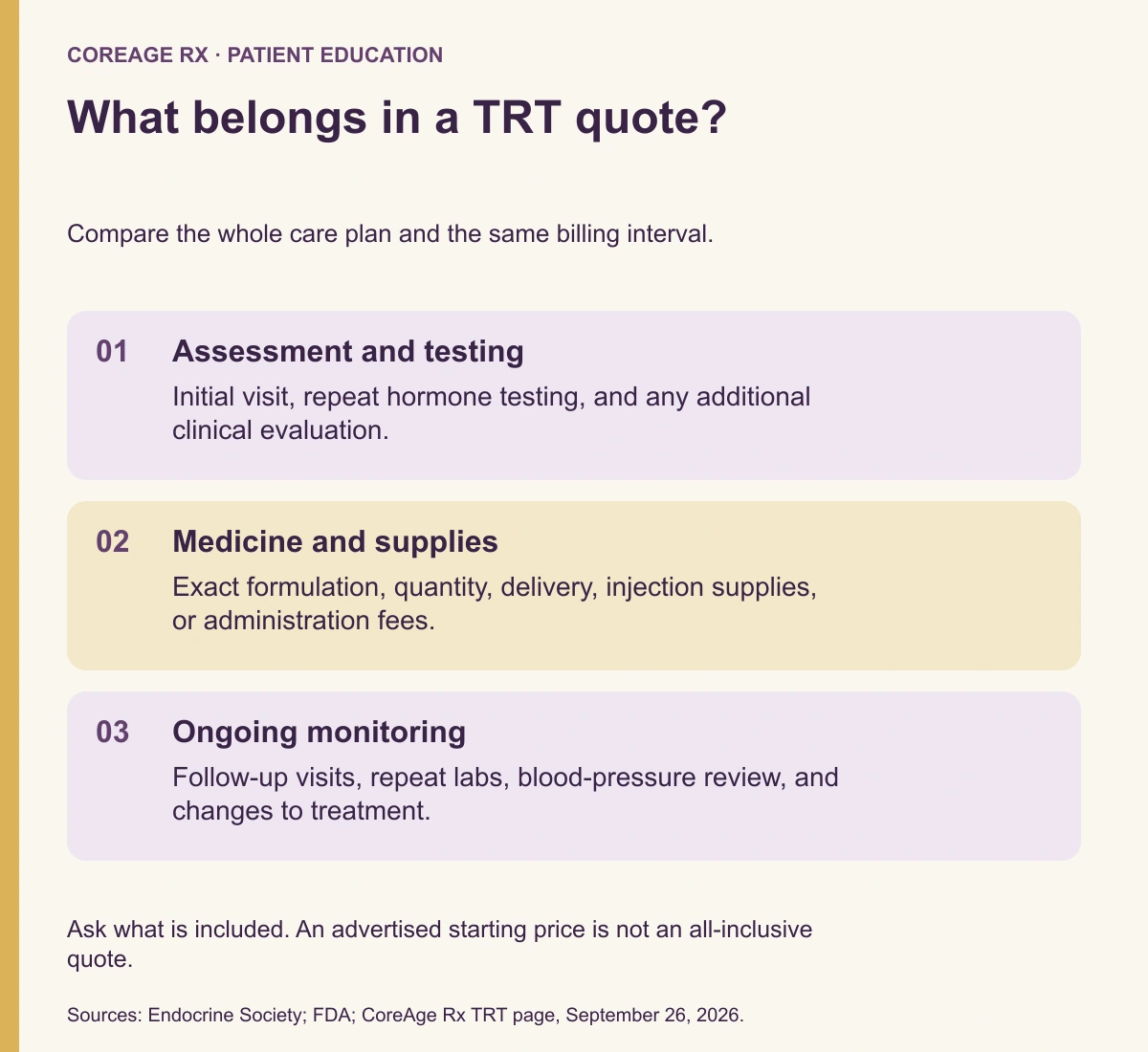
The three parts of a complete TRT budget
| Part of care | Charges to clarify | A useful question |
|---|---|---|
| Assessment | Consultation, diagnostic blood work, repeat hormone testing, additional evaluation when indicated | Which charges apply before a prescribing decision? |
| Treatment | Exact medication, formulation, prescribed quantity, supplies, delivery, or in-office administration | What will the actual prescription and its administration cost? |
| Follow-up | Repeat laboratory work, symptom review, appointments, blood-pressure monitoring, prescription changes | What recurring care is included, and what is billed separately? |
An included service still needs a clear scope. “Labs included,” for example, might mean a defined panel at a defined interval. Ask what happens if the clinician needs another test, if a result requires a repeat sample, or if your health history calls for a specialist assessment.
For a practical comparison, put each provider’s answers in the same three columns. Leave an unknown charge marked as unknown rather than treating it as zero. This makes it easier to see which offer is a firm quote and which still needs clarification.
Why the initial testing matters
Fatigue, reduced libido, changes in strength, and poor concentration can have several causes. Symptoms alone do not establish testosterone deficiency, and one result taken under uncertain conditions may not settle the diagnosis.
The Endocrine Society guideline recommends diagnosing hypogonadism in men with compatible symptoms and consistently low testosterone concentrations, with repeat morning fasting testing to confirm the result. It also recommends evaluating the underlying cause. The appropriate workup depends on the individual.
That means diagnostic testing is part of the care, not simply a checkout requirement. Ask whether the initial fee includes interpretation, discussion of alternative explanations, and a plan if testosterone is not recommended. Our low-testosterone testing guide explains the process in more detail.
Injections, gels, and other formulations have different costs
Compare the exact product and route rather than the word “testosterone.” An injectable medicine can involve needles, syringes, a sharps container, training, and possibly administration visits. A gel has its own prescription quantity, application routine, and precautions. Other formulations can involve different dispensing or clinical arrangements.
The medicine’s pharmacy price and the practical burden of using it are separate considerations. For example, a person receiving injections at a clinic may need to account for appointment charges and travel time. Someone using a prescribed home-administered product still needs training and a way to obtain the correct supplies.
Our TRT injections versus gel comparison covers the clinical and everyday differences. The prescribing team should help select an appropriate formulation before you use pharmacy prices to compare realistic options.

Does insurance cover TRT?
The answer depends on the exact plan, diagnosis, prescribed product, and provider. Ask the insurer or pharmacy benefit administrator to review the actual prescription. A clinic saying that it accepts insurance does not by itself establish coverage for its laboratory work, every formulation, or a separate membership fee.
Useful questions include:
- Is this specific product on the current formulary?
- What diagnostic documentation or prior authorization is required?
- Are the clinician, laboratory, and pharmacy in network?
- Does the deductible apply to visits, tests, medication, or several of these?
- Is an alternative formulation preferred under the benefit?
- Which charges would remain outside insurance?
Ask for a written explanation or reference number. If a prescription is denied, obtain the stated reason and review options. Do not assume that a coverage decision answers whether treatment is medically appropriate, or that a prescription automatically means the plan will pay.
How to compare self-pay and insurance prices
Request an actual pharmacy quote for the prescribed product, strength, quantity, and dispensing location. A price for a different package or amount may look cheaper while covering a different length of treatment.
For the clinic portion, ask about automatic renewals, cancellation deadlines, refunds, and whether follow-up access ends when a membership ends. Clarify who reviews results and answers medication questions between scheduled visits. The ability to reach the clinical team is part of understanding the service you are buying.
If you consider paying cash for a service that might also be insured, ask the plan how that payment would be treated. Do not assume it will count toward a deductible or out-of-pocket limit. Keep the comparison specific to your benefits and the actual billing arrangement.
Ongoing monitoring belongs in the price comparison
TRT is not a one-time laboratory result followed by indefinite refills. The Endocrine Society recommends follow-up to assess response, adverse effects, and use of the treatment. Monitoring may include testosterone levels, blood counts, and prostate-related assessment when appropriate to age and risk.
Blood pressure also deserves attention. In its 2025 testosterone labeling update, FDA required warnings about increased blood pressure while changing earlier cardiovascular warning language after reviewing additional evidence. That update does not remove the need for individualized risk assessment.
Ask who orders and reviews monitoring, when the team expects to reassess you, and what happens if a result is abnormal. Our articles on TRT blood counts, blood pressure and heart health, and side effects explain why these follow-ups can affect the care plan.
Fertility plans can change the treatment discussion
Tell the clinician if you want children now or in the future before starting testosterone. The Endocrine Society recommends against initiating testosterone therapy in men planning fertility in the near term. Treatment decisions in this situation require more than comparing monthly subscription fees.
Our TRT and fertility guide explains why the issue deserves an early conversation. A reproductive evaluation or another treatment approach may be appropriate. Do not purchase additional hormone products on the assumption that they automatically solve testosterone-related fertility concerns.
Compounded testosterone is a separate product category
CoreAge’s current TRT page describes a compounded preparation. A compounded medicine is not FDA-approved, even if an FDA-approved medicine contains the same active ingredient. Approval applies to the evaluated finished product; it does not transfer simply because an ingredient name matches.
FDA’s compounding overview explains that compounded drugs can serve individual medical needs but do not undergo the same FDA premarket review for safety, effectiveness, and quality as approved drugs. Ask the prescriber why a compounded preparation is being considered, which pharmacy will dispense it, and what approved alternatives are relevant.
Keep that distinction visible when comparing prices. A quote for compounded testosterone, a quote for an approved injectable product, and a quote for a branded gel are not automatically equivalent treatment packages.

Frequently asked questions
Is the cheapest monthly TRT offer the least expensive overall?
Not necessarily. Initial tests, follow-up care, supplies, or administration charges can change the total. Compare the same interval and list both included and separate expenses. Unknown costs deserve a follow-up question.
Are blood tests included in the advertised price?
That depends on the provider’s current terms. Ask which tests, how often, where the sample is collected, and whether additional testing costs extra. CoreAge’s starting price should not be assumed to include every possible laboratory charge.
Does a higher dose always cost more?
Pricing can depend on the product, package, quantity, pharmacy, and service arrangement. Ask how a clinician-directed prescription change would affect your bill. Do not change a dose or stretch the interval to fit a budget without discussing the treatment plan.
Can I skip monitoring to reduce costs?
Monitoring helps assess benefit and detect problems that symptoms alone may not reveal. Tell the clinician if the proposed schedule is unaffordable so the team can discuss an appropriate plan. Silently omitting tests can leave important information missing.
What should I bring to a first consultation?
Bring prior relevant laboratory results, a medication and supplement list, your main symptoms, fertility plans, medical history, and questions about total cost. The starting TRT checklist can help organize the conversation.
A clear quote should support a clear clinical plan
Before paying, you should understand what is being evaluated, which treatment may be prescribed, what monitoring is expected, and how each part is billed. If availability or included services are still uncertain, get those details clarified first.
You can review CoreAge Rx’s TRT page for current launch information. The next step is an appropriate clinical assessment and an itemized cost explanation, with a treatment decision based on your health needs.
Educational information for adults; individual treatment decisions require a qualified clinician. Sources checked September 26, 2026. Original AI-generated article illustrations depict fictional people and objects, not patient outcomes. Other editorial images are illustrative. Graphics summarize the cited sources.