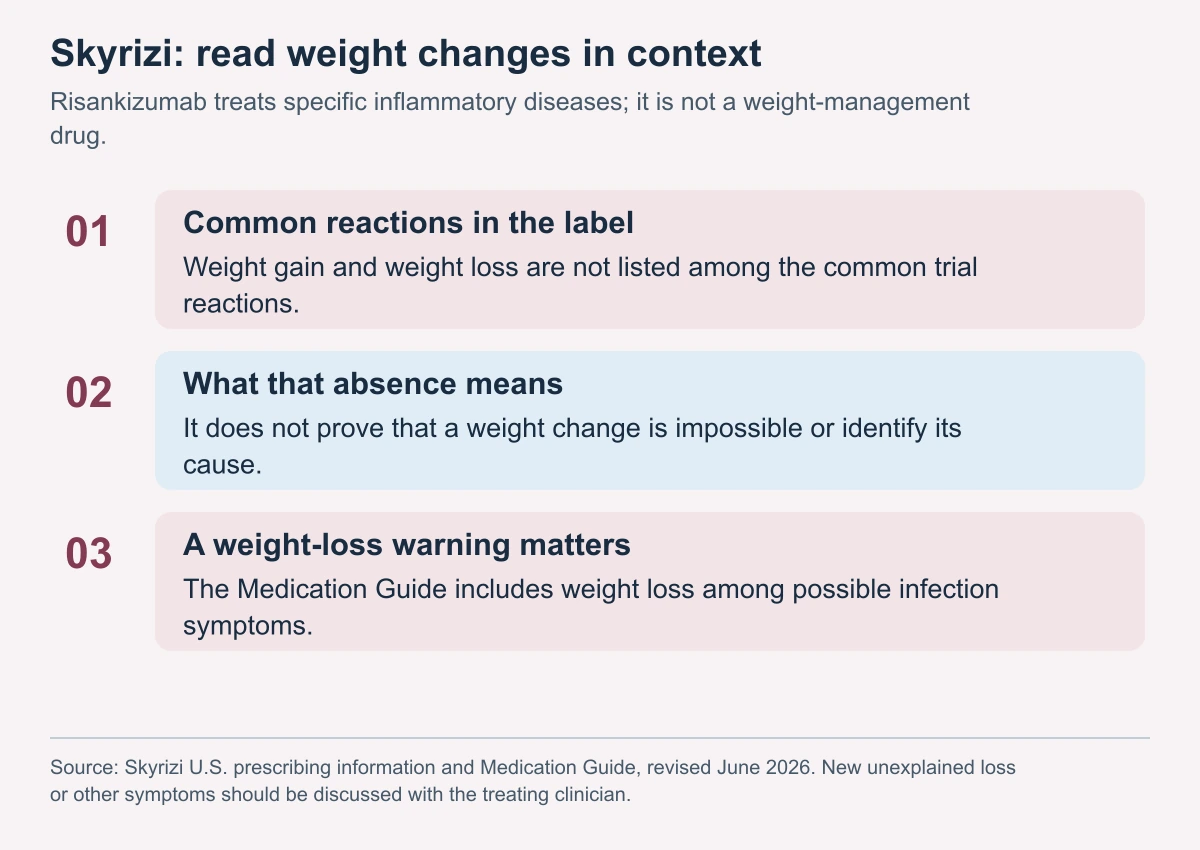
Skyrizi is not a weight-management medicine, and its current U.S. prescribing information does not list weight gain or weight loss among the common clinical-trial adverse reactions. That does not prove a weight change is impossible or identify the cause of a change in one person. New or unexplained changes should be reviewed with the clinician treating the underlying condition.
One detail is especially relevant: the Medication Guide includes weight loss among possible symptoms of infection. Weight loss during treatment should therefore not automatically be treated as a welcome side effect. This guide explains what the current label says, how inflammatory disease complicates the question, and what information can make a medical review more useful. Skyrizi prescribing information and Medication Guide
What is Skyrizi used for?
Skyrizi’s active ingredient is risankizumab-rzaa. The U.S. label revised in June 2026 lists treatment of moderate-to-severe plaque psoriasis, active psoriatic arthritis, moderately to severely active Crohn’s disease, and moderately to severely active ulcerative colitis, with indication-specific requirements.
The current label includes certain pediatric uses for plaque psoriasis and psoriatic arthritis from age six, while the Crohn’s disease and ulcerative colitis indications are for adults. This article focuses on adult weight questions. Adult trial findings should not be treated as a child’s personal risk estimate. Current labeled indications
The condition being treated matters. The label has separate trial safety information for psoriasis, psoriatic arthritis, Crohn’s disease, and ulcerative colitis. Combining those groups into one generic side-effect percentage would lose that context.
Does the label say Skyrizi causes weight gain?
Weight gain is not listed among the common adverse reactions in the current label’s clinical-trial summaries. Examples in the psoriasis and psoriatic arthritis information include upper respiratory infections, headache, fatigue, injection-site reactions, and tinea infections. The inflammatory-bowel-disease trial sections have their own reaction lists and treatment phases. Adverse-reaction sections
That supports a limited statement about what those label summaries report. It does not support saying that nobody can gain weight during treatment, that every change is unrelated to medication, or that one person’s experience can be explained without evaluation.
If weight gain begins after starting Skyrizi, the timing is useful information. It is not, by itself, proof of causation. Your clinician can review the pattern alongside symptoms, disease activity, other treatments, food intake, and relevant health findings.
Does Skyrizi cause weight loss?
Weight loss is also not listed among the common clinical-trial reactions in those summaries, and the medicine is not labeled as an obesity treatment. The Medication Guide’s infection warning, however, includes weight loss along with symptoms such as fever, cough, diarrhea, and stomach pain. The prescribing information warns that Skyrizi may increase infection risk. Medication Guide and infection warning
This makes the surrounding symptoms more relevant than whether you wanted the scale to move. Unexplained loss, particularly with signs of illness, needs discussion with the treating team. It should not be used as evidence that the medicine is an effective weight-loss strategy.
The same reasoning applies if someone online describes a weight change as a benefit. An anecdote does not establish why it happened, which condition the person had, which other medicines they used, or whether the change was medically appropriate.
How can the underlying disease affect the question?
NIDDK lists weight loss among common Crohn’s disease symptoms. Other symptoms can include diarrhea, abdominal pain, nausea, loss of appetite, vomiting, and fatigue. In ulcerative colitis, weight loss is more likely when the condition is more severe or affects more of the large intestine. Crohn’s symptoms, Ulcerative colitis symptoms
A person’s eating pattern and symptoms may change during a period of treatment. If someone can eat differently as symptoms change, weight might also change. That is a possible explanation to explore clinically, rather than proof that Skyrizi directly causes a particular gain or loss.
Conversely, continuing to lose weight does not establish that treatment is producing the desired disease response. Tell your clinician about food tolerance, bowel symptoms, pain, and appetite alongside weight. They can assess the condition using the appropriate clinical information.
For psoriasis or psoriatic arthritis, do not assume that another person’s inflammatory-bowel-disease experience applies to you. The indication, accompanying treatments, and relevant symptoms may be different.

Are changes in cholesterol the same as weight gain?
No. A laboratory lipid measurement and body weight are different measures. The Skyrizi label describes increases in lipid parameters in its Crohn’s disease safety information and discusses related findings in ulcerative colitis. Those findings should not be converted into an unsupported claim about increased body fat. Indication-specific safety information
Likewise, a stable scale reading does not interpret your laboratory tests. Ask the specialist how your actual results fit with the underlying condition and treatment. A clinician may need to review a laboratory change even when you do not notice a weight change.
Bring the results themselves, including dates and units, rather than relying on a remembered “high” or “normal” flag. That allows the discussion to address the finding that actually occurred.
What should you record before an appointment?
A brief account of the change can help without requiring constant weighing or tracking. The goal is to describe the pattern and symptoms, not to diagnose the cause at home.
| Information | Useful details |
|---|---|
| Treatment history | Why Skyrizi was prescribed, start date, and any recent changes. |
| Weight pattern | Approximate change and time span, using comparable measurements if available. |
| Symptoms | Appetite, bowel changes, abdominal pain, fever, cough, fatigue, or other new concerns. |
| Food and fluids | Whether you are eating less, tolerating more foods, or having difficulty keeping fluids down. |
| Other treatments | Prescription medicines, over-the-counter products, supplements, and recent changes. |
| Relevant results | Laboratory reports and disease-related assessments your specialist has requested. |
Do not leave out a medicine because it seems unrelated to the condition Skyrizi treats. The Medication Guide asks patients to tell their clinician about all medicines, vitamins, and herbal supplements. Patient information
When should you seek medical attention?
Follow the warning instructions supplied with your prescription. The Skyrizi Medication Guide advises contacting the health professional promptly for infection symptoms. Its serious-allergy instructions call for emergency help for symptoms such as trouble breathing, throat tightness, or swelling of the face, mouth, tongue, or throat. Medication Guide
For Crohn’s disease and ulcerative colitis, the label also includes a liver-injury warning and liver monitoring during the induction phase. The treating team should explain the monitoring plan and symptoms that require immediate attention. Do not reduce all new symptoms to a weight-management question.
If the change is gradual and you otherwise feel well, it still deserves discussion if it is unexplained or concerning. The urgency depends on the overall situation; a general article cannot decide that from the amount of weight alone.
Should you change the dose because of your weight?
Do not make a dose change based on a scale reading or advice for a different indication. Skyrizi has different treatment regimens and presentations for its labeled conditions. The Medication Guide directs patients to use it as their clinician instructs. Prescribing information
If you think a medicine is contributing to a new problem, contact the prescriber about the concern and follow the actual product’s warning instructions. Some urgent reactions require specific action, while a routine weight review may lead to a different plan. An article should not replace those instructions with a blanket rule to continue or stop.

Can you take a separate weight-management medicine?
That requires an individualized review with the clinicians involved. Skyrizi’s indication does not establish eligibility for another medicine, and the absence of a named interaction in a brief summary does not prove that a combination is suitable.
Discuss the reason for weight treatment, the inflammatory condition, current symptoms, nutrition, other medicines, and follow-up. Someone with ongoing gastrointestinal symptoms needs those symptoms considered rather than treating appetite reduction as the only goal.
NIDDK explains that prescription obesity medicines are selected with a health professional and used with healthy eating and activity. Our GLP-1 medication-choice guide, semaglutide questions guide, and tirzepatide questions guide offer related questions. NIDDK medication overview
If you are reviewing CoreAge Rx services with your care team, see the semaglutide and tirzepatide information pages. These links provide service information; they do not establish a tested or appropriate combination with Skyrizi.
Questions people commonly ask
Can improved appetite during treatment explain a gain?
It may be one factor to explore if symptoms and food tolerance have changed, particularly in inflammatory bowel disease. It is not proof of a direct medication effect. Describe the timing and the broader change in how you feel and eat to the treating clinician.
Does Skyrizi cause hair loss?
Hair loss is not listed among the common trial reactions in the reviewed label. That is a limited observation, not proof that every new hair concern is unrelated to treatment. Tell your clinician about the hair change, illness, eating pattern, and other medicines. Our minoxidil side-effects guide explains why starting a hair treatment has its own formulation and safety questions; a new hair concern first needs evaluation.
Should you start a restrictive diet to counter a gain?
First clarify the change and whether your eating plan fits the underlying condition. A restrictive diet can complicate an already difficult food-tolerance situation. Our balanced-meal guide and calorie-intake guide explain why individual needs and the complete pattern matter more than choosing the lowest intake.
Is every change after a dose caused by the dose?
No. A timeline helps the clinician investigate, but it does not isolate the cause. Report the pattern and symptoms rather than assuming a label must either confirm the change or make it impossible.
What is the most useful next step?
Bring a concise account of the weight change, symptoms, foods you can tolerate, and other treatments to your specialist. Use the current label to frame questions, while allowing the clinical review to determine what the change means for your health and treatment plan.
Educational information for adults; individual treatment decisions require a qualified clinician. Sources reviewed September 30, 2026. Original AI-generated article images depict fictional people and objects, not patient outcomes. Other editorial images are illustrative. Graphics summarize the cited sources.