
Mounjaro and Ozempic are prescription medicines used in type 2 diabetes care, but they contain different active ingredients and have different approved uses. Mounjaro contains tirzepatide, which acts at GIP and GLP-1 receptors. Ozempic contains semaglutide, which acts at the GLP-1 receptor. This comparison focuses on their injectable formulations and adult treatment decisions.
Both can lower blood glucose and affect body weight. Choosing between them requires more than comparing the largest weight-loss number online: the dose studied, diabetes history, cardiovascular and kidney conditions, side effects, and insurance coverage all matter.
Mounjaro versus Ozempic at a glance
| Question | Mounjaro injection | Ozempic injection |
|---|---|---|
| Active ingredient | Tirzepatide | Semaglutide |
| Receptor activity | GIP and GLP-1 | GLP-1 |
| Usual frequency | Once weekly | Once weekly |
| Diabetes indication | Glycemic control in adults and children aged 10 years and older with type 2 diabetes | Glycemic control in adults with type 2 diabetes |
| Cardiovascular indication | Major cardiovascular event risk reduction in adults with type 2 diabetes at high risk for these events | Major cardiovascular event risk reduction in adults with type 2 diabetes and established cardiovascular disease |
| Kidney indication in the current injection label | Do not assume the same indication as Ozempic | Specified kidney and cardiovascular outcomes in adults with type 2 diabetes and chronic kidney disease |
Sources: current Mounjaro prescribing information and Ozempic injection prescribing information. The cardiovascular populations are worded differently in the labels; neither entry means universal protection for everyone taking the medicine.
What did the head-to-head trial actually compare?
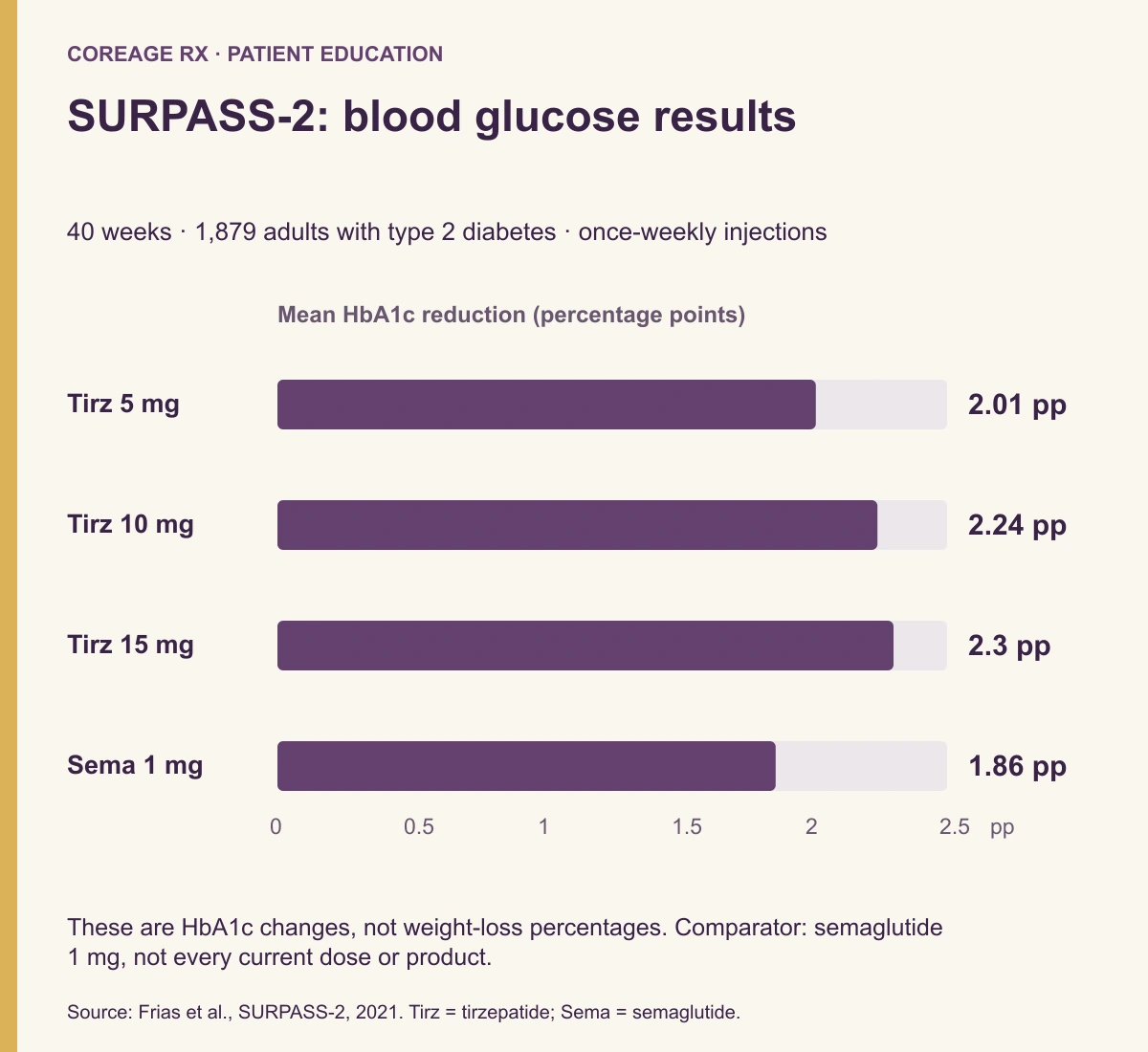
The SURPASS-2 trial enrolled 1,879 adults with type 2 diabetes and compared once-weekly tirzepatide at 5, 10, or 15 mg with once-weekly semaglutide at 1 mg for 40 weeks. It was an open-label trial, meaning participants and investigators knew which treatment was assigned.
The primary outcome was the change in HbA1c, a measure of longer-term blood glucose. Average HbA1c at the start was 8.28%. This was a diabetes study with a specified semaglutide dose, not a test of every current formulation or a promise about weight loss in people without diabetes. Source: SURPASS-2 trial report.
That distinction is especially important when a social-media post describes the study simply as “Mounjaro beats Ozempic.” A useful summary should tell you which patients were studied, which doses they received, what was measured, and how long the study lasted.
How did blood glucose change?
At 40 weeks, the reported average HbA1c reductions were 2.01, 2.24, and 2.30 percentage points in the tirzepatide 5, 10, and 15 mg groups, respectively. The reduction in the semaglutide 1 mg group was 1.86 percentage points. Tirzepatide met the trial’s statistical criteria for superiority at each studied dose.
These numbers describe percentage-point changes in HbA1c. They are not percentages of body weight lost. A reduction from 8% to 6%, for example, is a reduction of two percentage points; that illustration explains the unit and is not a predicted personal result. Source: SURPASS-2.
The higher-dose groups also do not establish that every person should receive the highest dose. Prescribing decisions consider response, tolerance, other diabetes medicines, and the product’s escalation instructions. Starting doses serve a different purpose from the treatment doses compared in this trial.
What did the trial show about weight?
Weight reduction was greater with tirzepatide than with semaglutide 1 mg in this study. The reported between-group differences were 1.9 kg, 3.6 kg, and 5.5 kg favoring tirzepatide at 5, 10, and 15 mg, respectively.
Those are differences between treatment groups, not the total average weight lost in each tirzepatide group. Misreading a treatment difference as an absolute result changes what the trial says. Source: SURPASS-2 weight findings.
The comparison also does not answer how every tirzepatide regimen compares with Ozempic 2 mg, Wegovy injection regimens, or oral semaglutide. For obesity-focused evidence and a different study population, see our tirzepatide versus semaglutide results guide.
Are these the same as Zepbound and Wegovy?
Mounjaro and Zepbound contain tirzepatide, while Ozempic and Wegovy contain semaglutide. Sharing an ingredient does not make the brand names, approved uses, devices, instructions, or coverage interchangeable.
Zepbound and Wegovy have weight-management indications for defined populations. Mounjaro and Ozempic are not simply alternate names to put on a weight-loss prescription when an insurance plan excludes another product. The diagnosis and clinical purpose should be accurate. Sources: Zepbound label and Wegovy label.
Our Zepbound versus Mounjaro article explains the tirzepatide brand distinction. Our guide to choosing a GLP-1 medicine places diabetes treatment, weight management, route preference, and other health goals in the same discussion.

Do heart or kidney conditions change the choice?
They can. The current Mounjaro label includes cardiovascular event risk reduction for adults with type 2 diabetes who are at high risk for those events. Ozempic injection includes cardiovascular event risk reduction for adults with type 2 diabetes and established cardiovascular disease, and a separate indication covering specified kidney outcomes and cardiovascular death in adults with type 2 diabetes and chronic kidney disease.
These indications come from product-specific evidence and defined populations. They should not be reduced to a claim that one medicine is “best for the heart” for every patient, or transferred automatically to another brand containing the same ingredient. Sources: Mounjaro and Ozempic injection labels.
A clinician may weigh these outcomes alongside glucose control, adverse effects, existing therapies, and access. Bring the actual diagnoses and medication list to that conversation rather than relying only on a recent scale reading.
Which causes fewer side effects?
Digestive symptoms are common with both medicines. In SURPASS-2, nausea occurred in 17% to 22% of tirzepatide participants and 18% of semaglutide participants; diarrhea occurred in 13% to 16% and 12%, respectively. Vomiting occurred in 6% to 10% and 8%. Most gastrointestinal events were mild or moderate. Source: trial safety results.
Those ranges reflect different tirzepatide doses and one semaglutide dose. They do not prove that one drug will be easier for an individual to tolerate. Timing, escalation, concurrent medicines, and the nature of the symptoms affect the clinical review.
Persistent vomiting, inability to maintain hydration, or severe abdominal pain requires medical assessment. Severe or persistent abdominal pain can signal a serious problem, including pancreatitis. Do not keep increasing a dose while waiting for significant symptoms to become manageable. Read our Mounjaro diarrhea guide for a focused discussion of that symptom.
What medical history needs review?
Both labels include a boxed warning about thyroid C-cell tumors and contraindications involving a personal or family history of medullary thyroid carcinoma or MEN2. Both also require review of serious hypersensitivity, pancreatitis concerns, severe gastrointestinal disease, dehydration-related kidney problems, gallbladder disease, and other product-specific precautions.
Tell the clinician about diabetic eye disease, planned anesthesia or deep sedation, and other glucose-lowering medicines. Insulin or a sulfonylurea can change the risk of hypoglycemia and may require clinician-directed adjustments. Neither medicine substitutes for every other part of diabetes care. Sources: Mounjaro safety information and Ozempic safety information.
An article cannot screen someone for all contraindications. The practical goal is to make the medication review complete, including prescriptions, nonprescription products, supplements, and any recent treatment changes.
What about pregnancy and birth control?
Pregnancy plans should be discussed before starting or switching. Ozempic’s label advises stopping at least two months before a planned pregnancy because semaglutide remains in the body for an extended period. Diabetes treatment during pregnancy needs an individualized plan, so do not simply stop all treatment without contacting the care team.
Mounjaro can reduce the effectiveness of oral hormonal contraceptives through its effect on gastric emptying. Its label advises a nonoral contraceptive method or an added barrier method for four weeks after starting and for four weeks after each dose increase. Source: Mounjaro contraception guidance.
This instruction is specific to tirzepatide’s label. Do not assume every GLP-1-related product has the same interval or that a medication change resolves contraception questions automatically.

Can you switch directly between them?
There is no universal milligram conversion. The numbers printed on the packages measure different ingredients, and prior tolerance does not establish an equivalent starting dose of the new medicine. A switch should include instructions for timing, monitoring, side effects, and other diabetes medicines.
Our semaglutide-to-tirzepatide switching guide explains the questions to clarify. Avoid overlapping prescriptions or using a leftover dose while waiting for the new medication unless the prescriber has explicitly directed the plan.
If exploring CoreAge Rx tirzepatide care, verify the actual preparation, dispensing pharmacy, and follow-up arrangement. A care program’s ingredient name does not establish that its product is branded Mounjaro or that trial findings apply identically to a different preparation.
How should cost enter the decision?
Ask the plan about the exact product, indication, formulary status, prior authorization, pharmacy network, and expected refill cost. An initial coupon or cash quote may not describe the ongoing expense, and an approved prescription does not itself guarantee insurance coverage.
Our Mounjaro cost guide and GLP-1 insurance guide provide a practical starting point. The most useful choice is a clinically appropriate treatment with a workable monitoring and access plan, rather than a medicine selected from a single trial number.
Educational information for adults; individual treatment decisions require a qualified clinician. Sources checked September 27, 2026. Original AI-generated article illustrations depict fictional people and objects, not patient outcomes. Other editorial images are illustrative. Graphics summarize the cited sources.