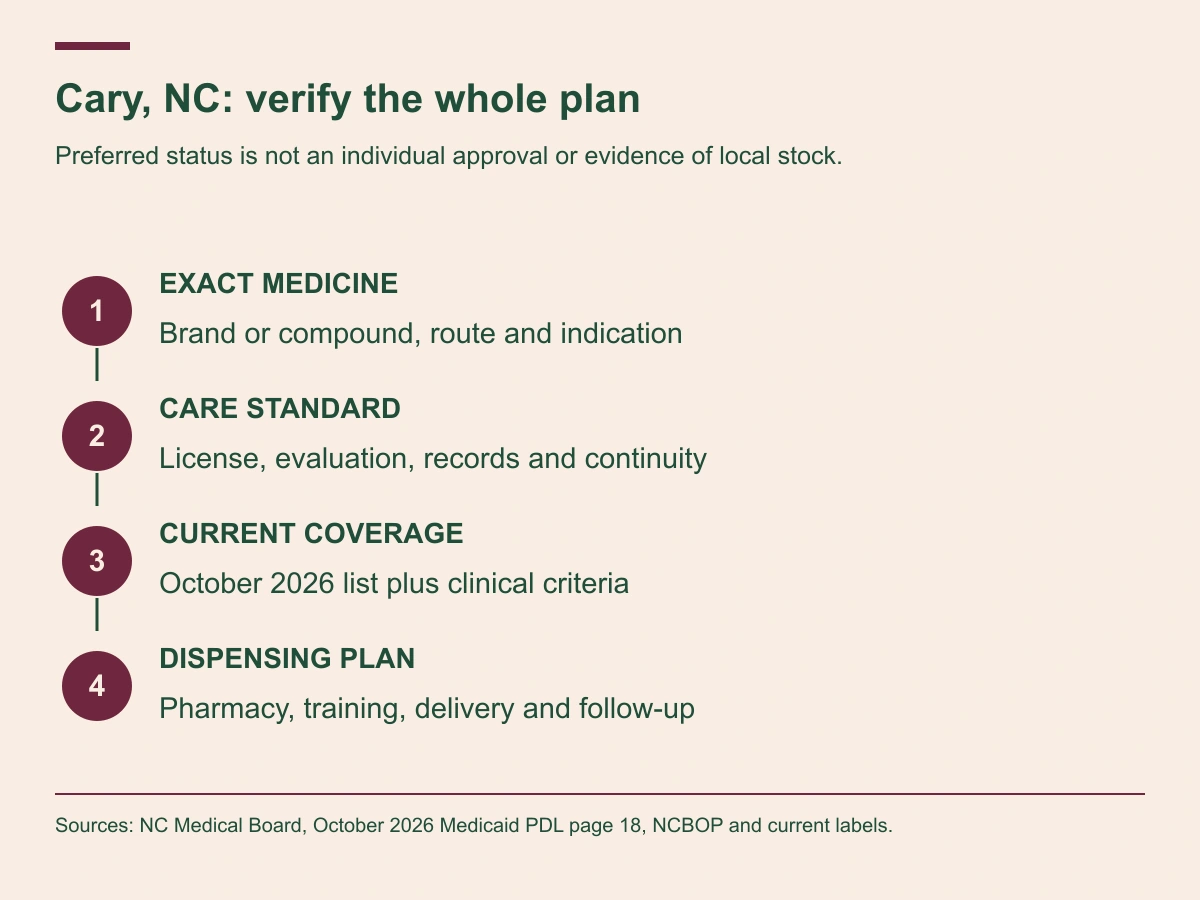
If you are looking for semaglutide in Cary, NC, start by identifying the exact medicine and the health concern it would treat. Then check the clinician, dispensing pharmacy, insurance rules, and follow-up arrangements. A telehealth advertisement, a formulary listing, and a pharmacy quote answer different questions; none alone establishes that treatment is appropriate or available for you.
North Carolina has public resources for these checks. This guide uses the Medical Board’s telemedicine statement and the current October 2026 Medicaid preferred drug list. It does not identify a verified Cary semaglutide clinic, promise local stock, or establish that a particular online service accepts North Carolina patients.
Semaglutide is an ingredient, not a complete prescription
The same active ingredient can appear in products with different indications, routes, devices, and instructions. Ozempic has type 2 diabetes-related indications. Wegovy has weight-management and other specific indications, with injections and daily tablets in its current labeling. A compounded semaglutide preparation is a separate product category and is not FDA-approved Wegovy or Ozempic.
The current Ozempic label and current Wegovy label provide the product-specific details. Ask a clinician to name the intended brand or preparation and explain which indication applies. “Semaglutide for weight loss” is not enough information to compare prescriptions or pharmacy claims.
Our semaglutide questions guide introduces assessment and follow-up. The oral semaglutide comparison explains why a tablet and a weekly injection are not interchangeable routines. A pharmacy or insurer may treat different formulations differently even when the active ingredient is shared.
What North Carolina’s telemedicine statement says
The North Carolina Medical Board’s telemedicine position statement, amended in March 2024, says care must meet the same standard as in-person practice. Its licensure discussion generally requires an appropriate North Carolina license when the patient is located in the state, subject to stated exceptions. It also emphasizes adequate evaluation, records, follow-up, and continuity.
The Board distinguishes a proper clinical evaluation from prescribing based solely on a static online questionnaire. It allows that different communication methods may establish a relationship when the standard of care is met. This is not a blanket promise that every form, video visit, or advertised service is adequate.
Ask who makes the treatment decision, how you communicate with that professional, how your history is assessed, and when an examination or tests would be arranged. Check the professional with the board that regulates their license type. This article is a practical starting point, not a legal determination about any provider.
For remote visits, tell the team where you are physically located. If you travel, ask whether care can continue from the destination. Do not assume that a website’s nationwide marketing settles licensing or service availability for each state.
Verify the pharmacy behind the platform
The North Carolina Board of Pharmacy’s public verification portal is linked from the Board’s official site. Check the actual dispensing pharmacy’s name, permit information, and address. A platform may arrange care while a different business dispenses the medicine; request both identities.
License verification is one check, not proof that a specific bottle is authentic or that a drug has been approved. FDA has reported false pharmacy details on some purported compounded GLP-1 products. If a label and service information conflict, contact the named pharmacy independently before using the preparation. FDA’s current concerns.
Ask for a pharmacist contact, written directions, the precise preparation, storage requirements, and a clear response pathway for an uncertain dose or damaged shipment. A service should explain how refill questions and clinical symptoms are routed. An administrative chat response is not always a pharmacist’s or prescriber’s clinical assessment.
Our semaglutide vial guide covers dispensing-label questions. The mg, mL, and units guide explains why another person’s syringe number cannot confirm your prescribed amount. The exact concentration and supplied measuring device matter.
North Carolina Medicaid: read the current list carefully
The October 2026 North Carolina Medicaid preferred drug list, in the weight-management GLP-1 class on page 18, lists Wegovy Pen/Tablet and Wegovy HD Pen among preferred entries. It also shows Zepbound presentations in the preferred column. The class notes say clinical criteria apply. A preferred entry does not guarantee approval for every person, indication, strength, or order. Current preferred drug list.
This matters because older materials may show a different classification. Use the effective date and the actual table columns, not a search snippet or a draft form found elsewhere. An older prior-authorization PDF marked draft should not be treated as today’s final criteria.
The list directs readers to the NC Medicaid Enterprise System and its Pharmacy Benefit Administrator area for criteria and forms. Ask your prescribing team and plan which current requirements apply to your exact product and indication. Do not infer that a preferred Wegovy entry covers Ozempic for the same purpose or covers a compounded preparation.
| What you find | What it tells you | What it does not settle |
|---|---|---|
| A current preferred product entry | Its placement in that dated list | Your individual clinical eligibility or approved claim |
| Clinical criteria and forms | Documentation requirements for the applicable request | That submitted information will meet them |
| A pharmacy’s claim response | How the particular order processes at that time | Clinical suitability or future refill cost |
| An older article or draft PDF | Historical or preliminary information | Current final coverage rules |
If you are enrolled in a managed care plan, confirm the current process with that plan and the care team. Record the precise formulation, indication, effective date, and reference number. This guide is not an individual benefits determination.

Commercial insurance and cash payment need separate quotes
People insured through different employers can receive different answers from the same insurer. Ask about the actual benefit, formulary, authorization criteria, network pharmacy, deductible, and supply interval. Our GLP-1 insurance coverage guide explains the sequence without assuming every policy includes weight-management medication.
For self-pay care, request the recurring total as well as any first-month offer. Confirm whether the advertised charge includes medicine, clinician visits, subscription fees, supplies, tests, and shipping. Ask about cancellation, refund terms if treatment is unsuitable, and charges during a supply interruption.
The Wegovy cost guide distinguishes manufacturer offers, pharmacy cash prices, insurance copayments, and compounded service charges. Eligibility and product terms can change. This article does not quote an actual Cary pharmacy transaction or promise a public offer will apply to you.
A useful comparison uses the same product and service period. A quoted monthly membership without medicine cannot be compared directly with a completed prescription fill. Likewise, an introductory charge does not reveal the ongoing total after the promotion ends.
Prepare for clinical assessment rather than automatic approval
Bring your diagnoses, current prescriptions and supplements, relevant family history, prior approaches, symptoms, pregnancy plans, and insurance details. Explain what you want treatment to improve: glucose management, weight-related health, function, or another diagnosed concern. Let the clinician assess whether the particular medicine is appropriate.
NIDDK’s weight-medication guidance describes an individualized decision based on possible benefits, risks, history, other medicines, and costs. It also explains that medication belongs alongside healthy eating and activity. Eligibility is not established simply because a person wants appetite suppression or has seen another person’s results.
Ask how adequate nutrition and fluids will be maintained if appetite changes. Our semaglutide first-month guide gives useful tracking questions, and the protein and muscle guide keeps everyday strength and function in the conversation. Severe symptoms or poor intake deserve assessment rather than an automatic escalation.
Plan local follow-up, delivery, and disposal
Know where testing, an examination, or urgent assessment would occur if needed. Ask how the remote team shares records with an established Cary-area clinician and who handles refill gaps. A continuity plan is especially useful if you move, travel, or change providers.
On delivery, check the named medicine, instructions, packaging, and storage information. FDA advises against using injectable GLP-1 products that arrive warm or with inadequate refrigeration. Contact the pharmacy about an unexpected shipment rather than inferring quality from an ice pack alone. Our semaglutide storage and travel guide explains product-specific questions.
For used injection supplies, obtain a sharps-disposal plan from the pharmacy or local authority. Do not assume that a general recycling or waste site accepts needles. Cary’s public convenience-center notice describes access changes beginning January 1, 2027, but the reviewed notice does not verify sharps acceptance. Check current local instructions through Cary’s official information service before choosing a disposal location. Cary convenience-center notice.

Exploring CoreAge Rx services
The CoreAge Rx semaglutide page provides current service information to discuss with the team. Confirm North Carolina availability, the exact preparation, clinician assessment, pharmacy, and continuing care charges. This article does not establish a local CoreAge office or guarantee a brand prescription.
If tirzepatide is discussed instead, the tirzepatide page introduces that separate service. Use the semaglutide and tirzepatide comparison to ask about evidence and treatment fit. A shared weight-management goal does not create a direct dose conversion or permission to overlap medicines.
Frequently asked questions
Can an online questionnaire alone establish appropriate care?
The NC Medical Board’s reviewed statement says prescribing solely from a static questionnaire does not meet its standard. Ask how a real evaluation, follow-up, and necessary testing are provided. Different communication methods are possible when appropriate standards are met.
Does preferred status mean NC Medicaid will pay for me?
No. The October 2026 list includes preferred weight-management GLP-1 entries and clinical criteria. Your exact order and circumstances must be reviewed through the current applicable process.
Is a semaglutide vial FDA-approved Wegovy?
No. The current Wegovy label identifies specific branded presentations; a compounded vial is not approved Wegovy. FDA says compounding should meet an individual medical need that an approved product cannot meet. FDA compounding guidance.
Can this article tell me which Cary pharmacy has stock?
No. Contact a dispensing pharmacy with the actual prescription details. A general national supply status, licensed listing, or formulary entry does not establish today’s local inventory.
What if the service cannot answer a dose or storage question?
Do not guess from online charts or another customer’s instructions. Contact the dispensing pharmacist and prescribing clinician with the exact label and supplied device. If symptoms are severe or an overdose may have occurred, seek prompt medical or poison-center advice.
Educational information for adults; individual treatment decisions require a qualified clinician. Sources reviewed October 2, 2026. Original AI-generated article images depict fictional people and objects, not patient outcomes. Other editorial images are illustrative. Graphics summarize the cited sources.