
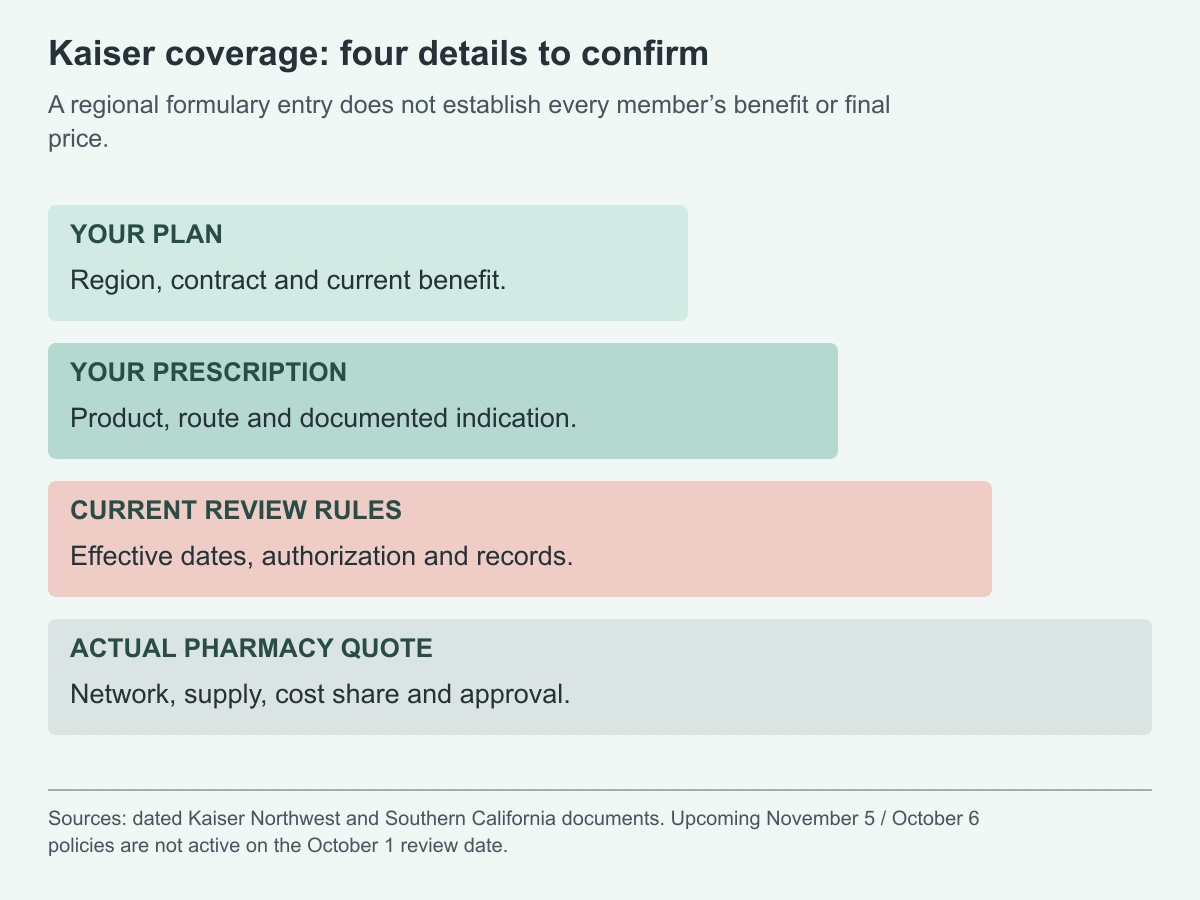
Kaiser Permanente coverage for Wegovy or another GLP-1 medicine depends on the exact plan, region, benefit, product, and reason it is prescribed. There is no single national yes-or-no answer. A medicine appearing in a formulary does not by itself guarantee that your prescription will be covered or tell you your final cost.
The most useful next step is to ask Kaiser about your specific prescription and current Evidence of Coverage. This guide explains how to separate a benefit exclusion from prior authorization, interpret dated regional documents, and prepare questions that can produce a usable answer.
Start with the exact medicine and treatment purpose
GLP-1 is a medication category, not a billing code that makes every product interchangeable. Wegovy and Ozempic contain semaglutide, while Zepbound and Mounjaro contain tirzepatide. Their approved uses and presentations differ.
The current Wegovy label distinguishes injection and tablet indications. Its injection uses include weight management, cardiovascular risk reduction in specified adults, and a particular noncirrhotic MASH population. Tablet uses are listed separately. Do not assume that a coverage rule for one route or purpose automatically applies to another.
The Ozempic injection label concerns type 2 diabetes and specified cardiovascular and kidney risk reduction. The Zepbound label includes weight management and moderate to severe obstructive sleep apnea in adults with obesity. A health condition appearing in an insurer’s eligibility criteria is not necessarily a new FDA-approved indication for that medicine.
When contacting the plan, use the brand, ingredient, route, strength, and prescribed indication. Our semaglutide questions guide and tirzepatide versus semaglutide comparison provide background for discussing those distinctions with a clinician.
Benefit coverage and prior authorization are separate questions
A benefit is what your contract includes. Prior authorization is a process for confirming that a prescription meets the plan’s criteria. Both can matter, and satisfying a clinical criterion does not necessarily create a benefit that the contract excludes.
For example, a regional document may require an existing benefit for weight-loss medications before its clinical review criteria apply. Someone can have obesity and a valid prescription yet still need a different payment or treatment discussion if that benefit is absent.
| Term or response | What to clarify |
|---|---|
| “Excluded benefit” | Is the exclusion for this indication, product, or the entire weight-loss medicine benefit? |
| “Prior authorization required” | Which current criteria and documents must the prescriber submit? |
| “Nonformulary” | Is an exception process available under this specific plan? |
| “Step therapy” | Which prior treatments count, and how are intolerance or contraindications documented? |
| “Covered” | What pharmacy, quantity limit, cost share, authorization period, and renewal requirements apply? |
Ask for the answer in writing or for the relevant plan document. A short phone statement such as “GLP-1s are covered” may omit the indication or presentation that determines whether it applies to you.
The GLP-1 insurance guide explains these terms in more detail. Keeping the benefit and clinical-review questions separate can save time for both the member and the prescriber’s office.
What do Kaiser’s public regional documents show?
The public documents reviewed for this article illustrate why location and dates matter. They are useful evidence about the stated region and document period, rather than a substitute for a current member-specific determination.
An earlier Northwest Wegovy document, revised September 11, 2025 and effective November 6, 2025, says weight-loss coverage requires the member to have the applicable medication benefit. Its adult criteria and pediatric criteria are separate. An adult should not copy a pediatric BMI threshold into their own eligibility checklist.
An upcoming Northwest injectable Wegovy document, revised September 10, 2026, lists an effective date of November 5, 2026. That effective date is in the future as of this article’s October 1, 2026 review. It also makes the weight-loss medication benefit a condition and contains additional clinical criteria.
The Southern California commercial HMO formulary reviewed here was updated October 1, 2026 and says it becomes effective October 6, 2026. It explicitly directs members to their Evidence of Coverage for the applicable formulary and cost sharing. This is another upcoming document, not proof of every member’s current coverage on October 1.
A January 2026 Washington provider newsletter includes a regional statement about oral Wegovy coverage for commercial plans at that time. It should not be expanded into a current rule for all Kaiser regions, all plan types, or injectable Wegovy. Its expired promotional pricing is also unsuitable as a current quote.
How to use document dates correctly
Look for the revision date, effective date, region, plan type, product, and indication before reading the criteria. A recent upload or revision can describe a policy that has not yet taken effect. An older document may still offer context while requiring confirmation that it is the version applicable to your plan.
This distinction matters when planning a refill or a future appointment. Ask which policy applies on the expected dispensing date and whether an existing authorization carries forward. Do not delay necessary care or assume a future formulary change guarantees approval.
Public search results can also display a snippet without the surrounding benefit notes. Read the actual document and ask Member Services which version governs your prescription. A copied cutoff from a blog can lose the age, diagnosis, region, or benefit condition that made it meaningful.
Keep a copy of the relevant policy, the date of the response, and any reference number. If you later receive a different answer, that record makes it easier to identify what changed and who should review it.

Which information should you have ready?
Bring the plan name and member details to your own secure Kaiser communication channel. You do not need to post insurance cards or personal medical records in a public comment to obtain general information.
Have the prescription details available, along with the intended pharmacy and the clinical reason documented by the prescriber. Ask the clinician which diagnosis and history are relevant rather than choosing a code merely because it seems more likely to be covered.
If prior treatment history is required, the office may need dates, doses, duration, response, or the reason a medicine was unsuitable. An undocumented statement that “another medicine did not work” may not answer a specific review requirement.
Ask about renewal before the first authorization expires. Coverage for an initial period and coverage for continued treatment may involve different documentation. The plan can explain what it needs; this article cannot determine whether an individual has satisfied those requirements.
What should you ask Member Services or Pharmacy Services?
A focused request can be phrased this way: “Please confirm coverage for this named product and route, prescribed for this documented indication, under my current plan.” Then ask:
- Is the relevant medication benefit included or excluded?
- Which formulary and effective date apply?
- Is prior authorization, step therapy, or an exception needed?
- Which pharmacy must dispense it, and are outside prescriptions accepted?
- What quantity and days’ supply are covered?
- What would I pay after the claim is processed?
- What are the continuation and appeal requirements?
Ask who handles the next step: the prescriber, the pharmacy, the member, or a coverage-review team. A complete checklist is more useful than repeatedly asking whether Kaiser “covers GLP-1s.”
What if the request is denied?
Obtain the written reason. A missing document, a clinical criterion, a nonformulary request, and a benefit exclusion can call for different responses. Ask your plan how its review or appeal process applies to the actual reason and what deadlines must be followed.
Share the notice with the prescriber so the office can check whether the prescription and documentation were submitted correctly. Corrections should reflect the actual medical history and treatment purpose. An appeal is not a promise of approval.
If an interruption is approaching, contact the care team early. Our semaglutide missed-dose and restart guide explains why a prolonged gap needs a product-specific plan. Do not stretch doses or restart independently simply because an insurance review is pending.
Our Wegovy cost guide and Zepbound cost guide can help you compare payment questions. A manufacturer’s offer, a pharmacy discount, and plan coverage are separate routes with their own eligibility rules.

Does an outside provider or compounded preparation change coverage?
Ask Kaiser whether your plan accepts the outside prescription, requires a network clinician, or restricts dispensing to specified pharmacies. Paying an outside provider for a consultation does not establish that the resulting medication claim will be covered.
CoreAge Rx’s semaglutide and tirzepatide treatment information offer separate clinical-assessment information. Confirm the exact preparation, total cost, follow-up, and pharmacy. A private service price should not be described as a Kaiser insurance benefit.
The FDA states that compounded drugs are not FDA-approved. Coverage and evidence for a named approved brand do not automatically transfer to a compounded product containing the same ingredient. Ask the actual plan about any reimbursement question rather than assuming equivalence.
Frequently asked questions
Does Kaiser cover Wegovy in 2026?
The answer depends on the specific plan, region, presentation, indication, and effective policy. Public regional documents show conditional coverage pathways, but they do not establish a single national member benefit.
Does meeting a BMI threshold guarantee approval?
No. A clinical threshold can be one part of a larger set of criteria. The medication benefit, age, diagnosis, prior treatment documentation, and other requirements may also matter. Confirm the rules applicable to your plan.
Is injectable Wegovy coverage the same as tablet coverage?
Do not assume so. The products have distinct administration and indication details, and regional plan documents may address them separately. Ask about the prescribed route by name.
Is a formulary listing my final price?
No. Cost sharing, deductible status, the processed claim, quantity, and pharmacy rules may affect the amount owed. Ask for a quote for the exact prescription and supply.
Can I rely on a policy effective next month?
Use it to prepare questions about future care, while confirming what applies now and on the dispensing date. A future effective date is not evidence that the policy is already active or that a particular request will be approved.
Educational information for adults; individual treatment decisions require a qualified clinician. Sources reviewed October 1, 2026. Original AI-generated article images depict fictional people and objects, not patient outcomes. Other editorial images are illustrative. Graphics summarize the cited sources.