
Humana coverage for Wegovy, Ozempic, or another GLP-1 medicine depends on the exact plan, the reason for treatment, the pharmacy benefit, and any authorization requirements. The insurer’s name alone cannot establish that your prescription will be paid. Start with the plan documents and a claim or coverage inquiry for the specific product.
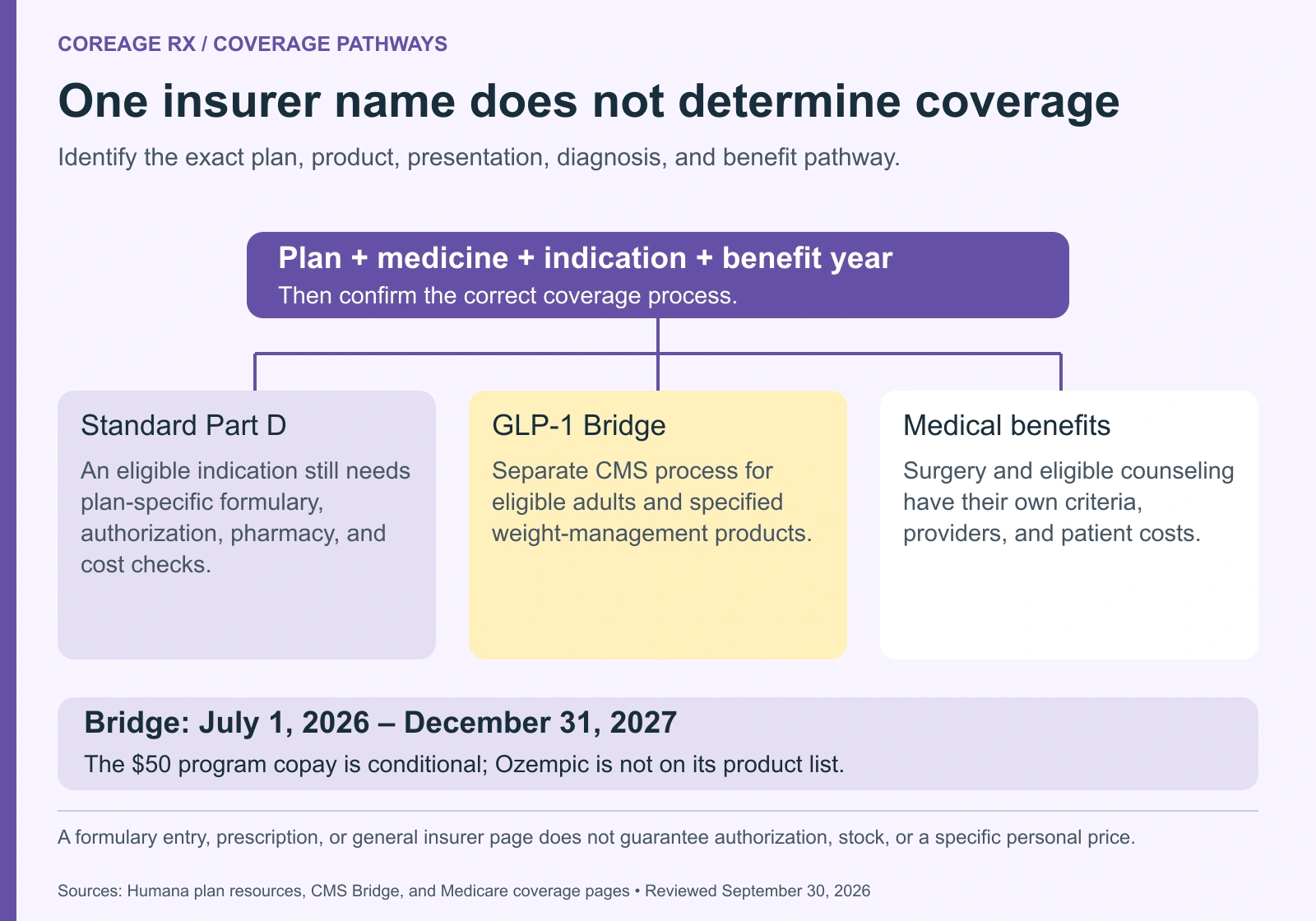
For Medicare members, there is an additional distinction in 2026: standard Part D coverage and the Medicare GLP-1 Bridge are separate pathways. The Bridge began July 1, 2026, and has its own eligibility and product rules. It is not a blanket guarantee that every Humana member can obtain a weight-loss medicine for the same price.
Identify the plan before asking about a drug
Have your member card and current plan name available. Establish whether your coverage is a Medicare Advantage plan with prescription benefits, a stand-alone prescription drug plan, or another type of coverage. Ask which organization administers the pharmacy benefit and which plan-year documents apply.
The Humana Medicare drug-list page provides a starting point for formulary information. A formulary is a list of medicines and related coverage rules. Use the list for your own plan rather than an unrelated plan, county, or benefit year.
Also distinguish a general website explanation from an individualized benefit determination. Humana’s public page about Medicare weight-loss medicines explains broad rules, but cannot confirm your diagnosis, authorization, pharmacy network, or cost. Source: Humana’s Medicare discussion.
Does Humana cover Wegovy for weight loss?
There is no universal answer for every Humana plan. For standard Medicare Part D, drugs used solely for weight loss remain subject to the statutory weight-loss exclusion. A different approved indication can lead to a different coverage analysis, and the separate Bridge can provide access for eligible beneficiaries seeking weight management.
Wegovy’s current label includes specific uses that differ by presentation and population. For example, cardiovascular risk reduction requires the relevant clinical history; it is not a label you can add simply to obtain coverage. The prescribing clinician should identify the actual treatment indication and the evidence supporting it. Source: current Wegovy prescribing information.
Ask the plan about the exact Wegovy product, route, strength, and diagnosis. A response about one presentation should not be assumed to apply to all others. Our Wegovy cost guide explains why insurance, manufacturer offers, and different presentations need separate comparisons.
Does Humana cover Ozempic for diabetes or weight loss?
Ozempic contains semaglutide, but its injection label is different from Wegovy’s. The current Ozempic label includes type 2 diabetes and specific cardiovascular and kidney indications in defined adult populations. It does not carry a chronic weight-management indication. Source: Ozempic prescribing information.
If the prescription is for an eligible diabetes-related use, ask your plan whether Ozempic is on the formulary, whether prior authorization or other restrictions apply, and which pharmacy can process the claim. A diabetes diagnosis does not by itself guarantee payment for every product or remove all plan requirements.
If the goal is weight management without an applicable covered indication, do not assume Ozempic will be paid because it shares semaglutide with Wegovy. Off-label prescribing and insurance coverage are separate questions. The clinician should document the real clinical circumstances rather than reshape a diagnosis around a preferred brand.
For the product differences, see semaglutide versus Ozempic. For payment questions, see our Ozempic cost guide.
What does the Medicare GLP-1 Bridge change?
The Bridge runs from July 1, 2026, through December 31, 2027. It provides access to certain approved products for eligible Medicare Part D beneficiaries when prescribed for weight management. It operates outside the ordinary Part D coverage and payment flow. Source: CMS program overview.
Eligible beneficiaries have a $50 copayment for the program supply. The Part D deductible does not apply to the Bridge benefit, and the copayment does not count toward Part D true out-of-pocket spending. Low-income subsidy rules do not reduce this Bridge copayment. These features make it important to distinguish the program from a normal Humana Part D claim.
Current included products are Foundayo, Wegovy injections and tablets, and the Zepbound KwikPen presentation. Zepbound single-dose pens and vials are not included. Ozempic and Trulicity are not on this Bridge product list. Source: CMS provider guidance.
Part D sponsors do not have to opt into the Bridge for eligible beneficiaries to access it. The central processor handles the program’s prior authorization and claims. Asking whether Humana “participates” is therefore less useful than asking whether you meet the program criteria and how your clinician should submit the request.
Who may qualify for the Bridge?
Eligibility includes enrollment requirements, an adult prescription consistent with the approved label, ongoing lifestyle modification, and specified clinical criteria. The provider guidance uses BMI at initiation of GLP-1 therapy, which may differ from your current BMI after treatment.
The current clinical criteria include these pathways:
| BMI at treatment initiation | Additional clinical requirement described by CMS |
|---|---|
| At least 35 | The other program requirements still apply |
| At least 30 | Heart failure with preserved ejection fraction, specified uncontrolled hypertension, or chronic kidney disease stage 3a or higher |
| At least 27 | Prediabetes, previous heart attack, previous stroke, or symptomatic peripheral artery disease |
This is a summary. The hypertension definition and other diagnostic details matter; your clinician should use the current CMS provider criteria and authorization form. A generic obesity diagnosis is not the complete eligibility test.
CMS directs beneficiaries whose indication is eligible for standard Part D coverage through that pathway. Its guidance specifically addresses type 2 diabetes, moderate to severe obstructive sleep apnea, and qualifying noncirrhotic MASH. Do not assume that satisfying a BMI threshold allows someone to choose the Bridge regardless of the actual covered indication.

What does prior authorization involve?
Prior authorization means the plan or relevant processor reviews information before approving payment. It may ask for the diagnosis, clinical history, previous treatment, or other evidence. A prescription alone may not be sufficient.
Humana’s prior-authorization page explains how members and prescribing teams can approach the process. For an ordinary plan claim, ask the plan which requirements apply to your exact medicine and indication. For Bridge access, use the central process described by CMS.
Before submission, establish:
- The exact product and presentation requested.
- The real diagnosis and clinical purpose.
- Which benefit or program should receive the request.
- What documents are required and who will send them.
- How you will learn whether the request is complete or decided.
- What the next step is if information is missing or payment is denied.
An authorization is a coverage decision under defined conditions. It does not guarantee the product is in stock, eliminate every cost, or establish that treatment is medically appropriate for every person.
Why can “covered” still mean a high pharmacy cost?
A formulary listing is only part of the answer. The prescription may need authorization, be subject to a deductible or coinsurance, or require a particular pharmacy. A claim can also fail because the quantity, product identifier, or authorization information does not match.
Ask the pharmacy to explain the actual claim response and supply period. If you receive a dollar amount, identify whether it is an insurance copayment, a cash quote, a discount-card quote, or a program-specific copayment. Those are different payment pathways.
Manufacturer commercial savings cards usually have eligibility exclusions that include government coverage. Do not assume that a Medicare member can use an advertisement intended for commercially insured patients. Our GLP-1 insurance guide and cost comparison provide a broader checklist.
What if Humana denies the prescription?
Get the written reason. A benefit exclusion differs from a missing authorization, a nonformulary product, an incomplete submission, or a rejected pharmacy claim. Each issue calls for a different next step.
Ask the prescribing team whether the clinical documentation is accurate and complete. Ask the plan about applicable exceptions, reconsideration, or appeal procedures and deadlines. An appeal does not guarantee approval, particularly when the problem is an excluded benefit rather than missing information.
If access remains uncertain, discuss clinically appropriate alternatives and a continuity plan. Do not stretch injections, split devices, or substitute an online product without the clinician’s guidance. Cost is a legitimate part of care, but an improvised dosing schedule is not a coverage solution.
Does Humana cover weight-loss surgery?
Surgery is a separate medical-benefit question. A pharmacy decision about Wegovy does not establish whether bariatric surgery is covered, and surgery coverage does not establish coverage for a drug.
Medicare’s bariatric-surgery page explains that some procedures are covered for eligible people under specified conditions. For your Humana plan, ask about clinical eligibility, authorization, participating surgeons and facilities, inpatient versus outpatient care, and the expected patient cost.
The surgical consultation should establish medical suitability and follow-up needs. Do not interpret a general insurer page as approval for a particular procedure, hospital, or date. Ask for the plan-specific requirements and a cost estimate once the proposed care is clear.

Does Humana cover weight-loss programs or counseling?
Counseling and commercial memberships are also different benefits. Medicare Part B covers eligible obesity screening and behavioral counseling in a primary care setting. Its public guidance specifies BMI of at least 30 and other conditions; the service costs nothing when the primary provider accepts assignment. Source: Medicare obesity behavioral therapy.
That benefit is not automatic reimbursement for every app, meal program, gym, online membership, or private clinic subscription. Ask Humana about the exact service, provider, setting, benefit rules, and any supplemental offerings described in your plan documents.
CoreAge Rx’s semaglutide and tirzepatide service pages describe its programs. Confirm the exact pharmacy product, whether the service works with your insurance, and which charges are separate. A program fee should not be assumed to be a Humana-covered benefit.
Does Humana cover Mounjaro?
The insurer name alone cannot establish coverage for your Mounjaro prescription. Use your specific current-plan formulary and ask about the actual indication, presentation, strength, authorization requirements and processed pharmacy cost. Humana explains that its drug lists are updated and that some medicines require prior approval; these general pages do not establish one Mounjaro tier or copay for every member. Mounjaro is a named tirzepatide medicine with current type 2 diabetes and specified cardiovascular indications, distinct from a generic weight-loss request. Have the clinician and pharmacy verify the plan-specific decision. Humana Medicare covered-drug lookup. Humana medication prior authorization. Mounjaro U.S. prescribing information.
Questions to use during your next call
Ask: “For my current plan, is this exact product covered for this diagnosis, and what authorization, pharmacy, and cost rules apply?” If Medicare weight-management access is the question, also ask the prescribing team which CMS Bridge criteria and process are relevant.
Keep the date, representative’s name or reference number, and written instructions. Clear documentation is more useful than a general internet answer that says Humana always covers—or never covers—a particular medicine.
Educational information for adults; individual treatment decisions require a qualified clinician. Sources reviewed September 30, 2026. Original AI-generated article images depict fictional people and objects, not patient outcomes. Other editorial images are illustrative. Graphics summarize the cited sources.