
Ambetter coverage for weight-loss surgery depends on the specific plan, benefit contract, procedure, and approval requirements. A bariatric surgery clinical policy describes medical-necessity criteria; it does not establish that every Ambetter plan includes the benefit. Start with your current Evidence of Coverage, then ask the plan and surgical team to confirm the requirements for the actual procedure and providers you are considering.
Why there is no single nationwide yes-or-no answer
“Ambetter” is not enough information to determine a personal benefit. Your state, plan year, plan identifier, network, and contract can affect the answer. A search result quoting one clinical policy may leave out a plan exclusion or an exception that changes how the benefit works.
The useful first question is specific: “Does my current plan cover this proposed bariatric procedure for my diagnosis, and where does my contract describe that benefit?” Have your member information available, but do not post it in a public comment or forum. Ask for the applicable document and section so you can review the answer with the surgical office.
Our GLP-1 insurance coverage guide addresses a separate benefit question. Coverage for a medicine does not prove coverage for surgery, and surgery coverage does not establish a pharmacy benefit.
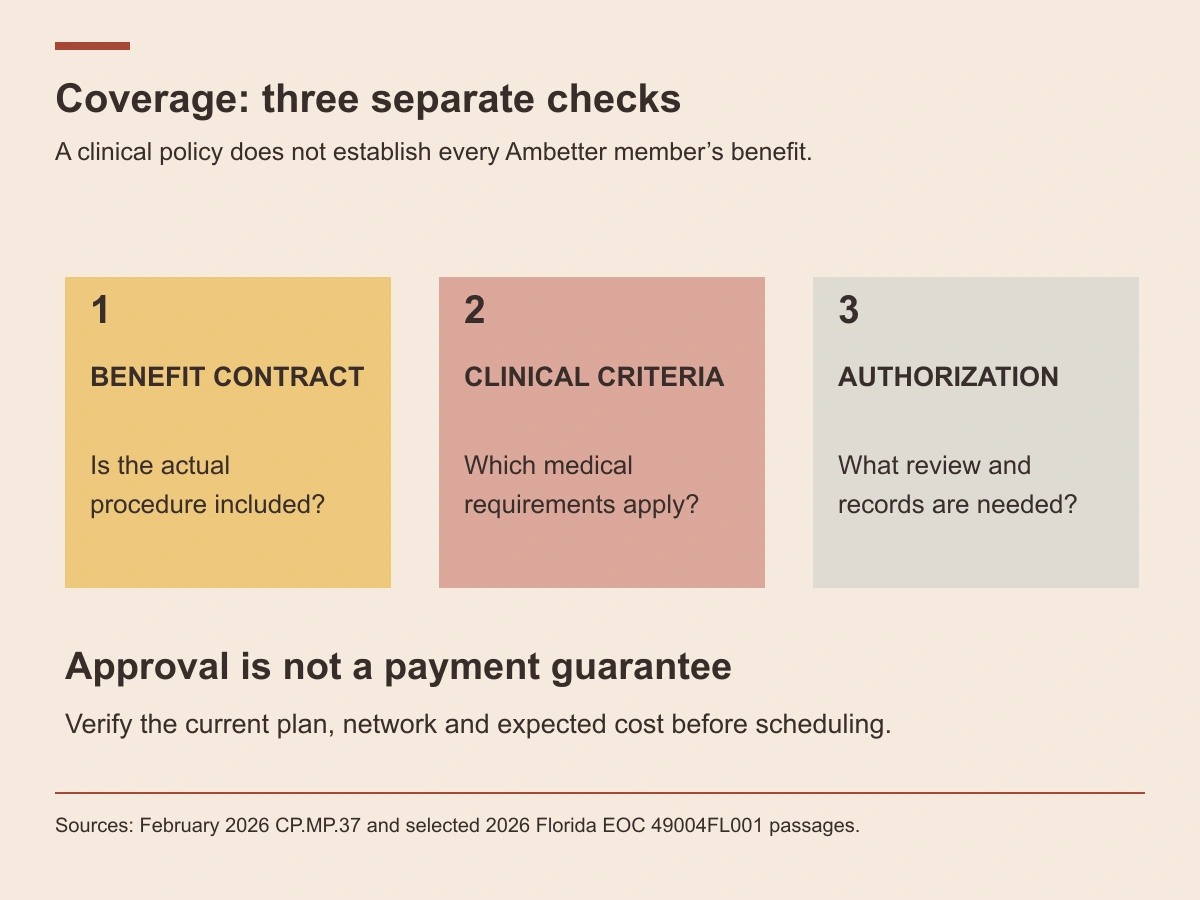
Separate the benefit, medical necessity, and authorization
Three decisions are easy to blur together. The contract determines whether a service falls within the plan’s benefits. A clinical policy can guide whether the proposed service meets medical-necessity criteria. Prior authorization is the process for obtaining a required review before treatment.
| Decision | The practical question | Document or person to consult |
|---|---|---|
| Benefit coverage | Is this service included, excluded, or subject to an exception? | Current Evidence of Coverage and plan member services. |
| Medical necessity | Does the proposed treatment meet the applicable clinical criteria? | The current policy and the treating surgical team. |
| Prior authorization | What must be submitted and approved before the service? | Plan requirements and the office handling the request. |
| Payment and cost | What will the processed claim and your responsibility be? | Network status, benefit terms, and a written estimate. |
A successful step does not automatically settle every other step. Keep these questions separate when speaking with the plan so that “the policy allows it” is not mistaken for a completed coverage decision.
What the current bariatric clinical policy shows
The reviewed Ambetter/Centene policy, CP.MP.37, has a February 2026 revision. It sets out criteria for named bariatric procedures, including clinical thresholds and preoperative evaluations. The document’s Important Reminder explains that benefit terms and other applicable requirements govern coverage. Reviewed bariatric surgery policy.
The criteria are more detailed than a simple “BMI 40, or 35 with a condition” slogan. The policy distinguishes circumstances involving diabetes and other conditions, uses different thresholds for specified Asian populations, and addresses whether nonsurgical treatment has produced adequate improvement. The correct criteria need to be read together for the proposed procedure and patient.
The preoperative requirements also involve evaluations beyond a scale reading. The reviewed passages address medical, nutrition, and psychological assessment and the management of relevant conditions. Ask the surgical office which requirements apply to your request and who will document them.
This article does not convert that policy into a universal checklist for all Ambetter members. A plan-specific answer requires confirming the benefit and which version of the policy applies at the time of care.
A 2026 Florida contract illustrates why wording matters
We also reviewed selected sections of the 2026 Florida Evidence of Coverage identified as 49004FL001. Its general exclusions discuss surgical treatment of obesity and bariatric surgery while retaining an exception for services specifically covered in the Major Medical Expense Benefits section. That exception is part of the statement and should not be discarded. Named Florida Evidence of Coverage.
This example does not establish that every Florida Ambetter plan covers or excludes bariatric surgery. It shows why quoting an exclusion without its exception can mislead a reader. The applicable contract and benefit section need to be evaluated together.
The same reviewed contract also explains that prior authorization does not guarantee payment; benefits remain subject to the contract. That is another reason to ask about network status and cost before scheduling. The contract example is a document review, not an individual determination about your claim.
Information to gather before calling
Start with the plan name, year, state, and identifier from your documents. Then ask the surgical team for the proposed procedure, diagnosis information, expected location, and the providers involved. A general inquiry about “weight-loss surgery” may not be specific enough for a reliable answer.
Ask whether the surgeon, facility, anesthesia team, and other anticipated services are in the required network. Do not assume that one in-network clinician means every component of the episode is treated the same way. Ask the plan how it handles the actual arrangement.
Keep a dated record of conversations, reference numbers, documents, and written responses. If two answers conflict, ask which contract provision or requirement explains the difference. A clear record helps the surgical office resolve the problem without restarting the entire discussion.

Questions for the surgical office
Ask who submits the authorization request, which records they need, and whether any evaluations must occur within a defined time frame. Clarify whether previous records can be used or need updating. The office should identify the requirements rather than expecting you to guess from a general web article.
Discuss the complete care plan, including follow-up, nutrition support, and management of existing medicines. Ask how the team will communicate with your primary clinician and any specialists. Approval paperwork is only one part of preparing for surgery.
If you take semaglutide or tirzepatide, tell the surgical and anesthesia teams well before the procedure. Our semaglutide and anesthesia guide explains why the exact product, symptoms, and procedure need review. Do not invent a holding schedule from an insurance article.
How to think about the cost estimate
A written estimate should identify the expected services and the assumptions used. Ask about the deductible, coinsurance or copay, network status, and any services that may be billed separately. Confirm whether the estimate assumes authorization and active coverage on the service date.
An estimate is not the same as a final processed claim. Changes in the procedure, providers, or benefit status can affect the outcome. Ask how unexpected changes will be communicated and whom to contact about a billing discrepancy.
Avoid using a stranger’s cost as a prediction for your own plan. Even two people in the same state may have different benefits or different progress toward their deductible. The most useful number is tied to your specific proposed care and current plan information.
What if the request is denied?
First obtain the written reason. A denial based on an excluded benefit raises a different issue from one based on missing documentation or a clinical criterion. Ask the office and plan to explain which type of decision occurred.
Use the appeal instructions in your own contract and denial notice. Deadlines, required forms, and submission methods should come from those documents. This article does not prescribe a nationwide appeal deadline or promise that an appeal will succeed.
If records are missing, ask whether the office can complete the file. If the denial concerns a clinical criterion, discuss the medical reasoning and the appropriate next step with the treating clinician. Keep copies of submitted information and subsequent decisions.
Surgery and prescription treatment are different pathways
People may consider several approaches to weight management, including nutrition support, activity, prescription treatment, and surgery. The appropriate comparison involves medical needs, expected benefits, risks, access, and long-term follow-up. Insurance coverage alone does not establish which choice fits you best.
Our tirzepatide-versus-semaglutide evidence guide helps frame a medicine discussion. Our balanced-meal guide offers practical planning questions. Neither replaces a bariatric team’s evaluation or establishes eligibility for surgery.
If medication cost is part of your decision, Wegovy cost and Zepbound cost explain why the prescribed product and payment method matter. Do not assume that an advertised cash price will apply to an insurance claim or that all weight-management treatments share one benefit.

Where CoreAge services fit
The CoreAge semaglutide and CoreAge tirzepatide pages describe prescription-dependent online intake pathways. They are separate from an Ambetter bariatric surgery determination. A consultation does not guarantee a prescription, an insurance benefit, or participation by a particular provider in your surgical network.
If you are already planning surgery, share every prescription with your surgical team rather than arranging a medication change in isolation. The teams need a coherent plan for treatment before and after the procedure.
Frequently asked questions
Does meeting the BMI criteria guarantee coverage?
No. A clinical threshold is only one part of a policy. The benefit contract, additional criteria, required documentation, network, and authorization can still matter. Ask the plan and surgical office to review the complete requirements for your request.
Is prior authorization the same as guaranteed payment?
No. The reviewed Florida contract explicitly keeps payment subject to contract terms. Confirm active coverage, benefit conditions, and the actual services involved. Keep the authorization and supporting documents, but do not treat them as the whole financial answer.
Does Ambetter cover every bariatric procedure?
This article cannot establish that. Ask about the precise proposed procedure and the current plan’s applicable benefit and policy. A policy for one procedure is not automatic proof for another.
Can I use a clinical policy from another state?
It may help you understand the kinds of questions involved, but it cannot determine your own benefit. Use your current plan documents and ask which policy applies to the service date and request.
Does coverage for Wegovy mean surgery is covered?
No. Pharmacy benefits and surgical benefits need separate verification. The reverse is also true. Ask about each proposed treatment rather than assuming one approval carries over.
What is the best first step?
Obtain the current Evidence of Coverage and ask member services where the proposed procedure is addressed. Then ask the surgical office to confirm the clinical and authorization requirements. That sequence produces a more useful answer than relying on a generic yes-or-no search result.
Educational information for adults; individual treatment decisions require a qualified clinician. Sources reviewed October 2, 2026. Original AI-generated article images depict fictional people and objects, not patient outcomes. Other editorial images are illustrative. Graphics summarize the cited sources.