
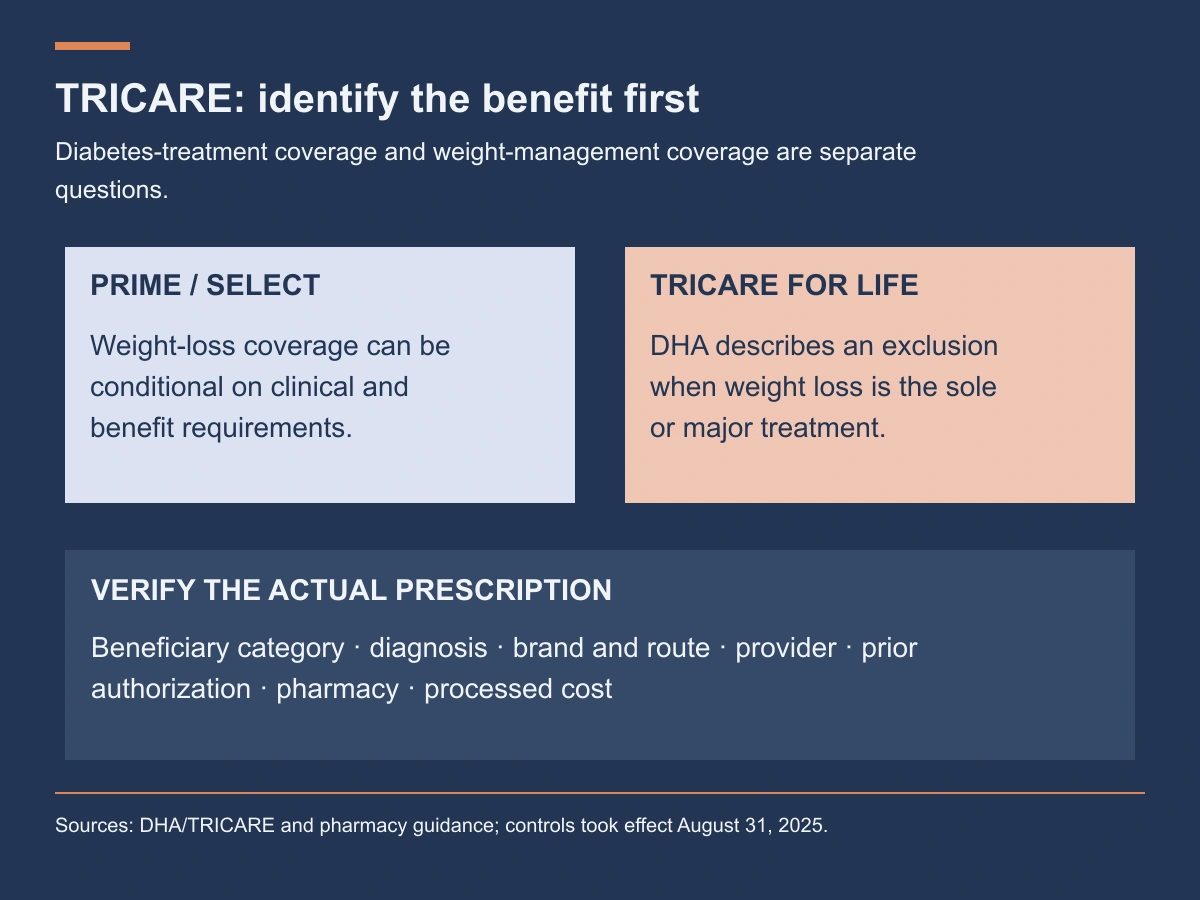
TRICARE can cover certain GLP-1 medicines, but the answer depends on the beneficiary category, the exact prescription, the condition being treated, and authorization requirements. Weight-management coverage under TRICARE Prime or Select is a different question from diabetes treatment or TRICARE For Life benefits.
Official TRICARE guidance reviewed October 2, 2026 describes regulatory controls that took effect August 31, 2025. Those dates should not be confused: the policy event occurred in 2025, while this article checks the currently served guidance. Use the current formulary and your own benefit information before relying on coverage for a specific fill. TRICARE coverage guidance, TRICARE Pharmacy coverage questions.
Start with your beneficiary category
Have the current plan or benefit category available when you call. TRICARE Prime, TRICARE Select, premium-based benefits, TRICARE For Life, and direct-care-only access do not all follow the same weight-loss medication rules. The word TRICARE on its own is not enough to determine the answer.
The Defense Health Agency guidance describes weight-loss medication coverage for eligible Prime or Select beneficiaries, including certain premium-based plans receiving those benefits, when clinical and authorization criteria are met. It identifies TRICARE For Life and direct-care-only beneficiaries among the groups excluded from weight-loss medication coverage under the described policy. DHA policy explanation.
Do not infer your category from a prescription’s previous approval or from another family member’s benefit. Ask which current rules apply to the person receiving the medicine and save the response or reference number.
Does TRICARE cover Wegovy or Zepbound for weight loss?
The reviewed official pages describe coverage in certain circumstances for qualifying Prime or Select beneficiaries with an approved prior authorization. This is conditional coverage, not an assurance that every prescription, dose, formulation, or pharmacy claim will be paid. TRICARE Pharmacy explanation.
The DHA page lists several requirements, including clinical criteria, a prescription from a TRICARE network provider, and a prior authorization form submitted by the provider. The pharmacy contractor’s FAQ also specifies an authorized provider, including military hospital or clinic providers, and a TRICARE network pharmacy. Verify the provider and pharmacy arrangements appropriate to your benefit rather than assume that any online prescription qualifies. DHA requirements, Pharmacy requirements.
The precise product still matters. Wegovy and Zepbound have different active ingredients and prescribing information. Presentations and approved indications can also change over time. Ask the formulary tool and provider about the actual brand, route, strength, and reason for treatment.
Does TRICARE cover Ozempic or Mounjaro?
The official guidance describes coverage for certain medicines used to treat type 2 diabetes, including Ozempic and Mounjaro, when medical necessity and prior authorization requirements are met. It distinguishes this pathway from weight-loss medication coverage. TRICARE diabetes-treatment guidance.
Do not treat Ozempic as simply another name for Wegovy, or Mounjaro as another name for Zepbound. Shared active ingredients do not erase differences in the product, approved uses, or benefit requirements. The actual diagnosis and prescription must be reviewed together.
The current Ozempic injection label includes specified type 2 diabetes, cardiovascular, and kidney indications. Mounjaro’s August 2026 label includes glycemic-control use and a cardiovascular-risk indication in specified adults with type 2 diabetes. A label indication and a payer’s authorization decision remain separate questions. Ozempic injection label, Mounjaro label.
A comparison of coverage questions
| Situation | Starting point in the reviewed guidance | What still needs verification |
|---|---|---|
| Prime or Select beneficiary seeking weight-management medicine | Conditional weight-loss coverage is described. | Clinical criteria, current product listing, provider, pharmacy, and authorization. |
| Eligible premium-based beneficiary receiving Prime or Select benefits | DHA includes certain such benefits in its explanation. | The exact beneficiary category and applicable current rules. |
| TRICARE For Life beneficiary seeking treatment principally for weight loss | DHA describes an exclusion under the policy. | Other clinically appropriate options and any separate benefit pathway. |
| Direct-care-only access and a weight-loss prescription | Listed among excluded groups in DHA guidance. | The person’s actual entitlement and alternatives. |
| Type 2 diabetes treatment with a listed GLP-1 medicine | Coverage is described when required criteria are met. | Current authorization, medical-necessity and dispensing rules. |
The table summarizes policy questions. It is not a coverage determination, a current drug-tier list, or a quote for a specific patient’s prescription.
What changed on August 31, 2025?
DHA describes implementing existing regulatory controls so prescription processing aligns with coverage requirements. Its TRICARE For Life explanation says certain obesity-medication authorizations became invalid for TFL and other beneficiaries outside the specified Prime, Select, or premium-based categories. A prior approval alone therefore cannot settle current weight-loss coverage. TRICARE For Life policy questions.
The change date should not be represented as a new October 2026 event. It is also not a reason to assume that every diabetes prescription became uncovered. The official guidance separately addresses type 2 diabetes treatment and its authorization criteria.
If you received a notice, bring it to the provider or benefit inquiry. Ask which prescription and indication it concerns and whether a current application or different clinical plan is appropriate. Do not stop a medicine abruptly solely because an old internet article describes a coverage change; obtain an individualized plan.

Why TRICARE For Life needs its own answer
TRICARE For Life provides Medicare wraparound coverage, but DHA explains that TFL and Medicare operate under different legal coverage authorities. Medicare coverage of a drug for a particular non-obesity indication does not automatically establish TFL payment under the same reasoning. DHA TFL explanation.
The reviewed TFL guidance states that weight-loss medication coverage is not authorized when obesity is the sole or major condition treated. It separately explains that certain GLP-1 medicines for type 2 diabetes can remain covered when prior authorization criteria are met, regardless of plan category.
Keep each payer’s answer separate. Ask what the prescription is being used to treat, which pharmacy benefit is processing it, and which written requirement applies. Do not assume that a broad statement about Medicare, a cardiovascular diagnosis, or sleep apnea resolves the TRICARE decision.
How should you use the formulary search?
A formulary search helps identify product-specific coverage and restrictions. Official TRICARE guidance directs beneficiaries to the TRICARE Formulary Search Tool and the relevant authorization forms. Search the actual medicine and presentation, rather than use an ingredient name as a substitute for every brand. Official formulary-check instructions.
Have the route, strength, quantity, and intended dispensing pharmacy available. Ask whether prior authorization, a medical-necessity form, or another restriction applies to your benefit and treatment reason. The DHA page notes additional medical-necessity form requirements for certain named diabetes medicines in relation to formulary copayment and military-pharmacy coverage. DHA form guidance.
Save the date and any document version. A search result describes a starting point, while the processed claim and clinical authorization determine the outcome for the actual prescription. Our GLP-1 insurance guide explains the distinction between a formulary listing, approval, and final pharmacy cost.
What does prior authorization mean?
Prior authorization is a review before coverage is approved under a benefit’s requirements. A clinician may need to submit information about the diagnosis, treatment history, and the medicine requested. The actual requirements come from the current form and benefit rules, not from a generic online checklist.
Ask who is submitting the request, what information is missing, how the decision will be communicated, and how long an approval lasts. If you change presentation, strength, or benefit category, ask whether the existing approval still applies.
An authorization is not a guarantee that every later claim will have the same price. Quantity, pharmacy, benefit changes, and other dispensing details can still matter. Our Wegovy cost guide and Mounjaro cost guide explain why a listed price and a processed patient quote are different.
Why provider and pharmacy status matter
A prescription can be clinically appropriate while still failing a benefit requirement about the prescriber or dispensing location. The reviewed DHA and contractor pages discuss network or authorized providers and network pharmacies. Verify the arrangement for your category before scheduling a visit solely to obtain a particular covered prescription. DHA provider requirement, Contractor pharmacy requirement.
Ask the provider’s office whether it can complete the relevant authorization and whether the prescribing arrangement fits your benefit. Ask the pharmacy to process the exact prescription or explain what prevents a claim from completing.
Do not assume that telehealth access, a licensed clinician, or a product page establishes TRICARE network participation. Our online prescription guide addresses clinician and pharmacy checks that remain separate from insurance approval.
What should you do after a denial?
Obtain the written reason and identify whether the issue concerns beneficiary eligibility, the treatment indication, missing information, the product, or the dispensing arrangement. Those problems may require different responses. A general message that says “not covered” is less useful than the specific decision.
Ask the provider and benefit administrator about the applicable review or appeal process and any stated deadlines. Keep records of submitted documents and decisions. Do not assume that submitting the same request repeatedly without addressing the reason will change the outcome.
If coverage remains unavailable, discuss clinically appropriate alternatives and the practical cost of any self-pay plan. A lower advertised price does not, by itself, make a different product or formulation an equivalent substitute. Our compounded GLP-1 guide explains why compounded preparations have separate quality and regulatory questions.

A concise checklist for the next call
Ask these questions together:
- What is my exact beneficiary category and current pharmacy benefit?
- Is this named product and presentation covered for my actual diagnosis?
- Which current clinical, authorization, and medical-necessity requirements apply?
- Does the prescriber and dispensing pharmacy arrangement satisfy the benefit?
- What will the processed patient cost be for this strength and quantity?
- What is the written reason and review process if the request is denied?
Record the date and reference number. Clear, current answers about your prescription are more useful than another person’s approval story.
Frequently asked questions
Does TRICARE cover every GLP-1 medicine?
No blanket conclusion follows from the medicine class. Check the exact product, indication, beneficiary category, and authorization rules. The reviewed pages describe different pathways for weight management and type 2 diabetes.
If Ozempic is covered for diabetes, is it covered for weight loss too?
That does not follow automatically. The actual condition being treated and product-specific benefit requirements matter. Ask about the prescription and diagnosis rather than substitute one brand’s coverage answer for another.
Does an old authorization prove my next fill is covered?
No. The reviewed policy identifies authorizations affected by the August 2025 controls, and current dispensing details still need checking. Confirm validity, scope, and the processed claim rather than rely only on the existence of an earlier letter.
Can CoreAge guarantee TRICARE payment?
This article does not establish CoreAge’s TRICARE network status or coverage for its services. If you are exploring the semaglutide or tirzepatide pages, ask about the actual formulation, provider arrangement, payment pathway, and follow-up. Confirm benefit requirements directly before relying on insurance payment.
Educational information for adults; individual treatment decisions require a qualified clinician. Sources reviewed October 2, 2026. Original AI-generated article images depict fictional people and objects, not patient outcomes. Other editorial images are illustrative. Graphics summarize the cited sources.