
Hydrolyzed hyaluronic acid is hyaluronic acid that has been broken into smaller fragments. The term can help describe an ingredient, but it does not tell you the exact molecular-size range or prove that a finished product works better than another HA formula. Smaller is not a complete performance claim.
For skin care, the useful questions are how the ingredient is formulated, what outcome was studied, and whether the product fits your skin and directions. In a prescription combination such as Time Out, the other active ingredients also remain important to suitability and use.
What molecular size means
Hyaluronic acid is a chain-like molecule, and preparations can contain chains of different lengths. Molecular weight is one way to describe their size. Research may report it in kilodaltons, abbreviated kDa.
A marketing term such as low molecular weight or multi-weight may not specify a precise range. Hydrolyzed indicates processing into smaller fragments, but the label alone may not disclose how small they are or how varied the mixture is.
If a product is being compared with a study, ask for the actual specification rather than assuming the terms match. Two formulas described as low molecular weight may still differ in meaningful ways.
Why size is discussed in skin research
Molecular size can influence how an ingredient behaves in a formulation and interacts with skin. That makes it a research question, not a simple ranking in which the smallest fragment always wins.
The complete vehicle, concentration, other ingredients, and application conditions also matter. A claim about delivery does not automatically establish a visible benefit, and a visible benefit does not by itself show exactly where the ingredient traveled.
Keep those questions separate: what is the ingredient, how is it delivered, and what outcome was demonstrated? A product description that answers only the first should not be treated as proof of the other two.
What the clinical study actually tested
A 2011 trial compared specific 0.1% HA creams with molecular sizes from 50 to 2,000 kDa in seventy-six women over sixty days. Hydration and elasticity improved compared with vehicle, while the 50 and 130 kDa groups showed significant improvement in measured wrinkle depth.
Those results are relevant to the tested formulations and conditions. They do not establish that every hydrolyzed HA product uses those sizes or that a different concentration and vehicle will reproduce the same effect. The study’s facial application area and participants also define its scope.
Use the findings to ask better product questions, not to assign an unverified molecular size to a label or to promise that a particular cream will reach a specific skin layer.
Concentration and molecular size are different details
A product can disclose an HA percentage without disclosing molecular weight. The percentage tells you one aspect of the formulation; it does not tell you the length of the chains. Conversely, a size claim does not necessarily tell you the amount present.
Do not multiply a study’s result because another product lists a higher percentage. Clinical effects are not assumed to scale linearly with concentration, especially when the formulation differs.
| Detail | What it tells you | What it does not establish alone |
|---|---|---|
| HA percentage | A concentration in the formula | Molecular size or clinical superiority |
| Hydrolyzed | The ingredient has been broken into fragments | The exact size distribution |
| A kDa range | A molecular-size specification | The result of the finished product |
| Multiple HA forms | More than one listed form is included | That the combination is better for every skin type |
| Clinical study | Outcomes under defined conditions | Identical effects for an unmatched formula |
Hydration remains the practical goal
For many users, the relevant outcome is improved comfort and a smoother-looking surface. HA is used as a water-binding ingredient, while other components may help smooth the skin and limit water loss.
A cream can therefore be useful even if the product does not disclose a sophisticated molecular-size story. The AAD’s moisturizer guide emphasizes selecting a formula suited to the skin’s needs. The whole product matters more than one technical phrase.
If a lightweight serum leaves the face tight, adding more of the same ingredient may not solve the problem. A different moisturizer texture or review of irritating treatments may be more useful.
Do not confuse topical HA with injectable filler
The shared ingredient name does not make a cream equivalent to an injection. The route, formulation, purpose, and risks differ. A topical hydrolyzed HA product should not be expected to reproduce an injected volumizing effect.
Likewise, the word penetration should not become a reason to use at-home needling, abrasion, or other methods to increase delivery. A routine cream is intended for the use described on its label, not for an improvised procedure.
The mature-skin HA guide explains hydration and fine-line appearance as distinct outcomes. A useful moisturizer does not need to borrow claims from a different treatment category.
Apply according to the finished formula
Generic advice often says to use HA on damp skin. That may fit some ordinary products, but it should not override a prescription combination’s directions. Confirm whether the supplied formula calls for clean, dry skin and where it belongs relative to other treatments.
Do not mix it with another product to alter concentration or create a homemade blend. A prepared combination has its own instructions, and separate layers also need a clear purpose.
If the routine pills, identify the textures and optional steps involved. Scrubbing the face or repeatedly reapplying products can make irritation more likely without answering the layering problem.
What Time Out discloses
Time Out lists hydrolyzed hyaluronic acid 0.5%, vitamin C 5%, and estriol 0.3%. The public ingredient summary does not disclose an exact HA molecular-size range. It should not be labeled as the same preparation used in the 2011 study without supporting information.
Ask the pharmacy about the ingredient specification if it matters to the comparison. More importantly, review the full prescription and the role of each active. Estriol is an estrogen, so the product is not simply a moisturizing HA cream.
The Time Out ingredient guide and estriol safety questions explain the additional medical discussion. A hydration ingredient does not remove the need for it.
Tolerance depends on more than molecule size
The base, preservatives, fragrance, other actives, and the skin’s current condition can all influence the experience. A small-molecule claim does not guarantee gentleness, and a larger-molecule claim does not automatically mean a product is ineffective.
Record the timing of any reaction and the other products used. Persistent burning, a spreading rash, swelling, or blistering after a new product warrants stopping it and obtaining advice. Severe facial swelling or breathing difficulty requires urgent care.
If the skin is persistently itchy or inflamed, ask whether a condition needs assessment. Molecular-size shopping should not replace diagnosis of a recurring problem.
Evaluate the product in ordinary conditions
Track how the skin feels during washing and between applications, and whether the target area looks smoother under comparable light. Note the timing relative to moisturizer, because a fresh surface finish can change photographs.
Keep other optional products stable when practical. If a harsh cleanser is removed at the same time a new HA cream is introduced, improvement may reflect both changes. That is still useful, but it does not isolate the molecular-size effect.
At follow-up, discuss whether the formula is comfortable, manageable, and helpful for the defined concern. You do not need to prove deeper penetration to decide that a moisturizer is useful.
Ask for useful specifications, not bigger claims
If a product makes a precise molecular-size or delivery claim, ask what specification or finished-formula evidence supports it. If that information is unavailable, keep the uncertainty visible rather than filling it with an assumption.
For most routine decisions, clear directions, a suitable texture, and a meaningful result are more practical than a technical label alone. The menopause dry-skin routine provides that broader framework.
Hydrolyzed HA is one formulation detail worth understanding. It should help you ask more precise questions, while the complete product, its evidence, and your skin’s needs remain the basis for the decision.
Explore Time Out™
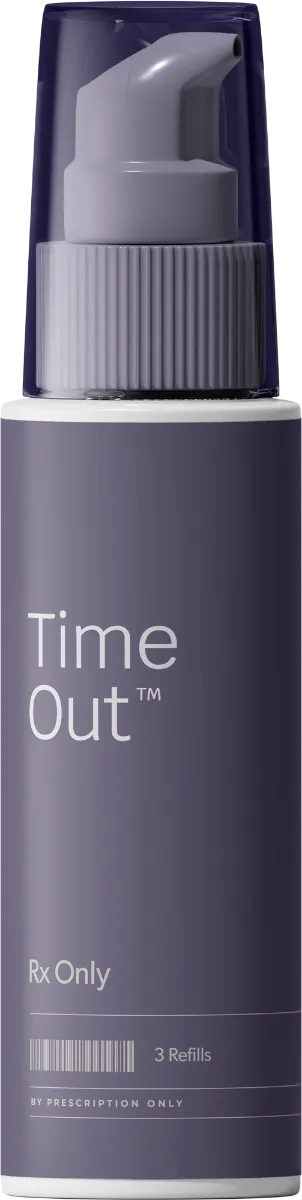
Time Out lists estriol 0.3%, vitamin C 5%, and hydrolyzed hyaluronic acid 0.5%. Estriol is an estrogen, so suitability and use require individual medical review. A facial formulation is not interchangeable with menopause hormone therapy or vaginal estrogen. Review the current Time Out™ page and bring your existing skin-care products to the provider discussion.
Related reading
- Menopausal Skin Care: Dryness, Firmness, and Treatment Questions
- Hyaluronic Acid for Mature Skin: Hydration and Fine-Line Appearance
- Dry Skin vs. Dehydrated Skin: Making Sense of Tightness and Texture
- Time Out Ingredients: Estriol, Vitamin C, and Hydrolyzed Hyaluronic Acid
- Tretinoin versus retinol: choosing a routine
Educational information; your prescription and clinician’s instructions guide individual care. Product details and linked sources checked September 15, 2026. Ingredient research does not establish identical results for a finished compounded formula. Photographs are illustrative and do not show treatment outcomes.