Craving cheese can reflect a familiar flavor, a satisfying texture, a routine, or a broader appetite pattern. The craving alone does not identify a calcium deficiency, prove addiction, or show that your body has a special biological need for white cheddar. Start by noticing when the craving happens and whether you are eating adequately and comfortably.
You can enjoy cheese while reviewing the pattern. The goal is to understand a useful signal about your day, not turn one food preference into a diagnosis or a reason for unnecessary supplements. Persistent distress, loss-of-control eating, or major changes in appetite deserve more support than a list of supposedly healthy substitutes.
Is a cheese craving different from hunger?
Hunger is a broader drive to eat, while a craving is an intense desire for a particular food. They can occur together. You might be hungry after missing lunch and specifically want cheese on toast, or feel interested in Parmesan while otherwise comfortably full.
A review of food-craving research explains why the distinction matters. Cravings can occur even when people are adequately fed, and imagining or encountering a familiar food can trigger them. The experience cannot be reduced to a simple nutrient shortage.
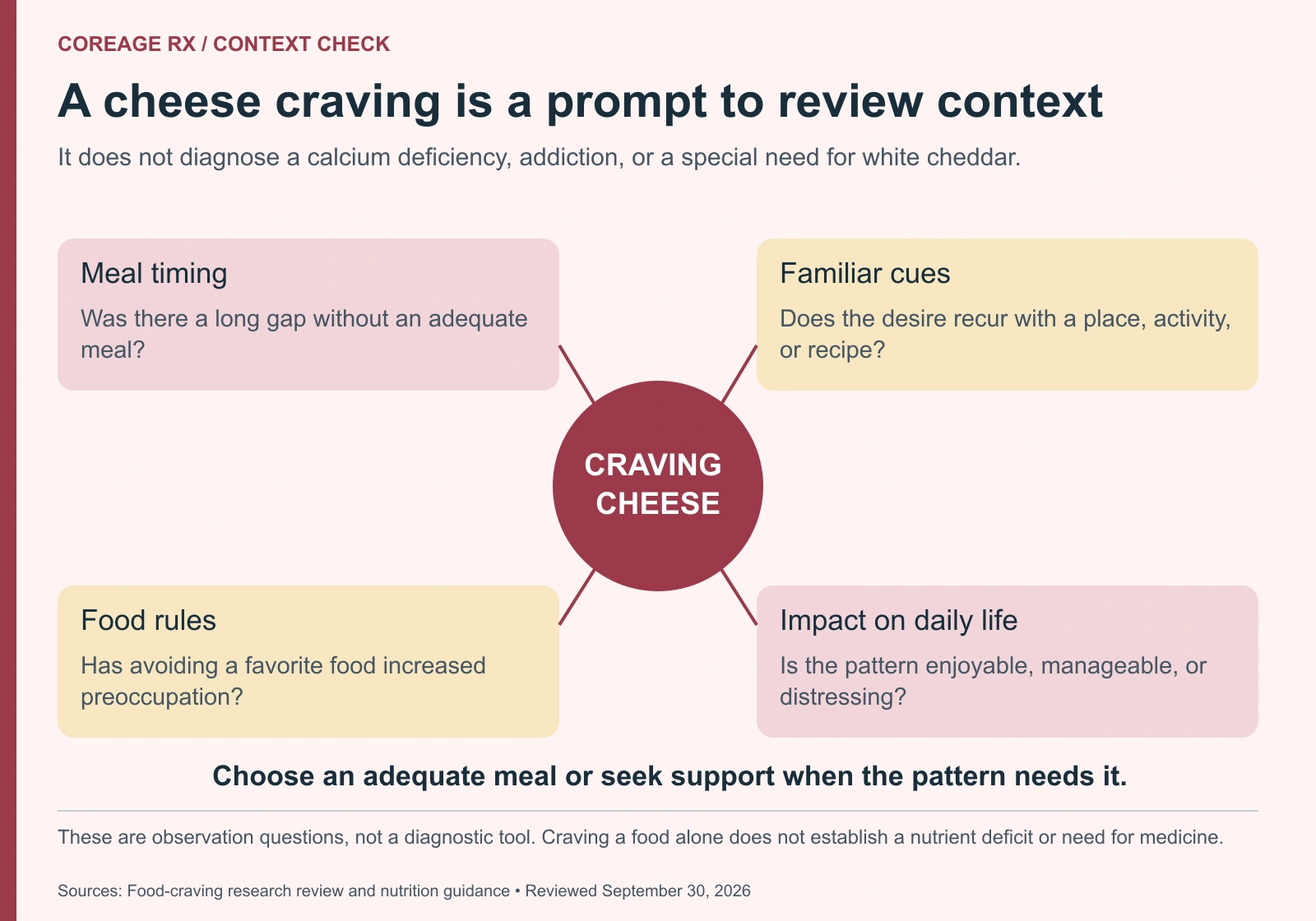
Ask yourself whether another suitable meal would be appealing, whether the craving follows a long gap without food, and whether it is linked to a recurring situation. These are observations, not a diagnostic test. Our food-noise and hunger guide discusses related experiences and when they become disruptive.
Why might cheese be especially appealing?
Cheese comes in many flavors and textures: sharp, salty, creamy, tangy, firm, or meltable. Your preference may be for a particular combination rather than for “dairy” in general. Familiar meals and routines can also make a specific food feel expected.
For example, a cheese craving while making pasta may be tied to the dish you usually prepare. Wanting cream cheese with a bagel may be connected with breakfast. Wanting cheddar while watching a favorite show may be associated with the setting or the snack routine.
Those examples illustrate possible contexts; they do not establish the cause in every person. Notice the pattern before deciding that a craving must have a biochemical explanation. Different circumstances may call for different responses, including simply choosing an enjoyable, balanced snack.
Does craving cheese mean you need calcium?
Not by itself. A specific craving is not a reliable test of calcium status or another nutrient deficiency. The food-craving review describes relatively poor evidence for the idea that ordinary food cravings are generally driven by nutrient deficiencies.
Cheese can contribute nutrients, but that fact does not turn a desire for it into a laboratory result. Cream cheese, aged cheddar, Parmesan, and other dairy products also have different nutrient profiles. A craving for one should not be interpreted as a precise request for a particular nutrient amount.
If your diet is limited, you have symptoms, or a clinician has identified a deficiency risk, discuss assessment and an appropriate nutrition plan. Do not start large doses of calcium, vitamins, or other supplements solely because an online chart links cheese cravings to a deficiency.
Our cream-cheese nutrition guide shows how the role of a food can differ from assumptions about the category. Its verified example provides modest protein and no fiber; “dairy” does not mean every dairy food makes the same contribution.
Do humans have a primal need for white cheddar?
There is no established clinical rule that people need white cheddar specifically. The phrase may sound scientific, but it does not identify a recognized nutritional requirement. A preference for cheddar is different from a requirement to eat that particular cheese.
The research discussed here supports a more practical interpretation: cravings can be shaped by cues, experiences, and food restriction, and a craving alone does not diagnose a nutrient deficit. It does not establish that white cheddar fulfills a unique biological need or that avoiding it harms health.
If cheddar is a food you enjoy, it can be considered within your overall eating pattern. You do not need an evolutionary explanation to include it, and you do not need to treat a preference as proof that your body is malfunctioning.
Can restricting cheese make you think about it more?
Sometimes. The review of food deprivation and cravings found that short-term selective avoidance can increase cravings for the avoided food. However, it also describes longer-term weight-management interventions in which cravings decreased. The relationship is more complex than “all dieting causes cravings.”
That means a rigid rule forbidding one favorite food may be worth reviewing if it creates persistent preoccupation. It does not mean that every dietary restriction is harmful or that eating the craved food is always the required response. Medical restrictions, allergies, and individual goals still matter.
An experiment might be to include an enjoyable amount as part of a regular meal and notice the experience. If the pattern involves significant distress or loss of control, work with a qualified clinician or dietitian rather than trying increasingly strict rules on your own.

What should you notice about your routine?
A short review can be more useful than constant tracking. Consider the context over several ordinary days:
| Observation | Useful question |
|---|---|
| The craving follows a skipped meal | Would a complete meal be more useful than a small substitute snack? |
| It appears in the same place or activity | Is a familiar cue or routine involved? |
| You are eating very little variety | Would a more varied, adequate pattern help? |
| You have recently forbidden the food | Is the rule creating preoccupation or making meals harder? |
| Eating feels out of control or distressing | Would professional support help assess the broader pattern? |
Also note recent changes in sleep, stress, medicines, and daily schedule when preparing for an appointment. They provide context; writing them down does not prove any one factor caused the craving.
Avoid turning the exercise into surveillance of every bite. The aim is a few useful observations that help you decide on a manageable next step.
How can you respond when you are genuinely hungry?
If you have missed a meal or are broadly hungry, a complete meal may be more useful than trying to suppress the craving with water, gum, or a tiny substitute. Cheese can be one component, while other foods provide additional protein, fiber, produce, or carbohydrate.
Examples include a cheese-topped bean dish, toast with a suitable protein food and vegetables, or crackers with a modest cheese portion and fruit. The amounts and ingredients should fit your needs and tolerance.
Our balanced-meal guide, protein breakfast ideas, and healthy-cracker guide offer flexible starting points. They do not prescribe a single portion for everyone or imply that cheese must always be replaced.
What if you crave Parmesan, cream cheese, or another type?
The same general approach applies. A specific taste or texture can be meaningful to the preference without identifying a particular deficiency. Parmesan in a pasta dish, cream cheese in a breakfast routine, and cheddar on a sandwich serve different culinary roles.
Consider how much you enjoy and what the complete food supplies. A sprinkle of Parmesan differs from a large cheese-heavy portion; a thin cream-cheese spread differs from a dessert filling. If nutrition is the question, use the actual product or recipe rather than assigning a standard value to “cheese.”
Our pasta guide discusses toppings and meal composition. The FDA’s Nutrition Facts explanation can help compare serving weights, sodium, saturated fat, and protein for packaged choices.
Is cheese addictive?
Enjoying cheese, thinking about it, or sometimes eating more than intended does not by itself establish a clinical addiction or another diagnosis. A dramatic online explanation should not replace an assessment of the actual pattern and its effect on your life.
More useful questions include whether you repeatedly feel unable to stop, whether eating causes substantial distress, and whether you compensate by severe restriction or other harmful behaviors. Those concerns deserve support regardless of which food is involved.
A clinician or qualified eating-disorder professional can help distinguish ordinary preferences from a pattern that needs treatment. Repeatedly switching brands or removing one ingredient may not address the underlying difficulty.
What if dairy causes symptoms?
Lactose intolerance and milk allergy are different conditions. A craving does not override either concern. Use the diagnosis and advice from your healthcare team when choosing whether and how to include dairy.
The NIDDK’s lactose-intolerance nutrition guidance explains that tolerance can vary and that some people can include smaller amounts of lactose. It does not establish that every cheese is suitable or that symptoms should be ignored. For a milk allergy, avoiding the relevant allergen remains essential.
If you use a nondairy alternative, check its ingredients and nutrient profile. A product designed to mimic cheese may differ in protein, saturated fat, sodium, and allergens. Choose it for the actual need and review the rest of the meal.

Can GLP-1 medicines change cheese cravings?
Some people describe changes in appetite or food thoughts during GLP-1 treatment, but individual preferences and cravings do not disappear on a predictable schedule. Continuing to enjoy cheese does not mean treatment has failed, and losing interest in a food does not prove the medicine is producing a better outcome.
If appetite decreases substantially, adequate nutrition still matters. The joint GLP-1 nutrition advisory emphasizes individualized assessment, food quality, and physical function. A few bites of a favorite food should not repeatedly replace the nutrition needed across the day.
See our GLP-1 food guide for related questions. CoreAge Rx’s semaglutide and tirzepatide service pages describe its programs; a cheese craving alone does not establish eligibility or a need for medication.
When should you seek more help?
Ask for assessment if the craving is part of persistent inadequate eating, unexplained weight change, major distress, or repeated loss-of-control eating. Mention new medicines or health symptoms rather than assuming the food preference explains them.
For an ordinary, enjoyable preference, a useful next step may simply be a balanced meal or a planned snack. The craving can guide attention to your routine without becoming a diagnosis, a supplement prescription, or a reason to fear a food you like.
Educational information for adults; individual treatment decisions require a qualified clinician. Sources reviewed September 30, 2026. Original AI-generated article images depict fictional people and objects, not patient outcomes. Other editorial images are illustrative. Graphics summarize the cited sources.