
Weight gain has been reported in observational studies of some adults receiving Dupixent for atopic dermatitis. Those reports deserve attention, but they do not prove that the medicine causes weight gain in every patient or establish a predictable amount. Weight loss is also a reason for individual assessment; Dupixent is not a weight-management medicine.
The current prescribing information and the research answer different questions. The label describes approved uses and established safety information. Small clinical cohorts can identify a possible signal that needs further investigation. If your weight changes during treatment, review the timing, symptoms, other medicines, and health changes with the prescribing team.
What is Dupixent used for?
Dupixent contains dupilumab, an interleukin-4 receptor alpha antagonist. It affects signaling involved in particular inflammatory conditions. Its current approved uses include conditions such as atopic dermatitis, specified asthma populations, and eosinophilic esophagitis, with eligibility depending on the condition and age. Source: current Dupixent prescribing information.
It is not a GLP-1 receptor agonist and does not have an approved weight-loss indication. Its effects should not be compared with semaglutide or tirzepatide simply because each is supplied as an injection.
This article focuses on weight questions in adults. The dose and eligibility for children can depend on age, condition, and body weight; the adult observational findings below should not be converted into a prediction for a child.
Is weight gain listed as a common side effect?
The current label’s common-adverse-reaction overview does not list weight gain or weight loss. For atopic dermatitis, the listed common reactions include injection-site reactions and several eye-related problems, among other events. The common-reaction profile differs across the treated conditions. Source: Dupixent safety and adverse-reaction information.
That absence does not prove an association is impossible. Labels and ongoing research can provide different levels of evidence, and uncommon or newly investigated effects may need further study. At the same time, it would be inaccurate to describe weight gain as an established common reaction with a known percentage based only on the studies discussed here.
The useful conclusion is narrower: a weight change should be evaluated, and the published observational signal should be described with its limitations.
What did the small 2020 study report?
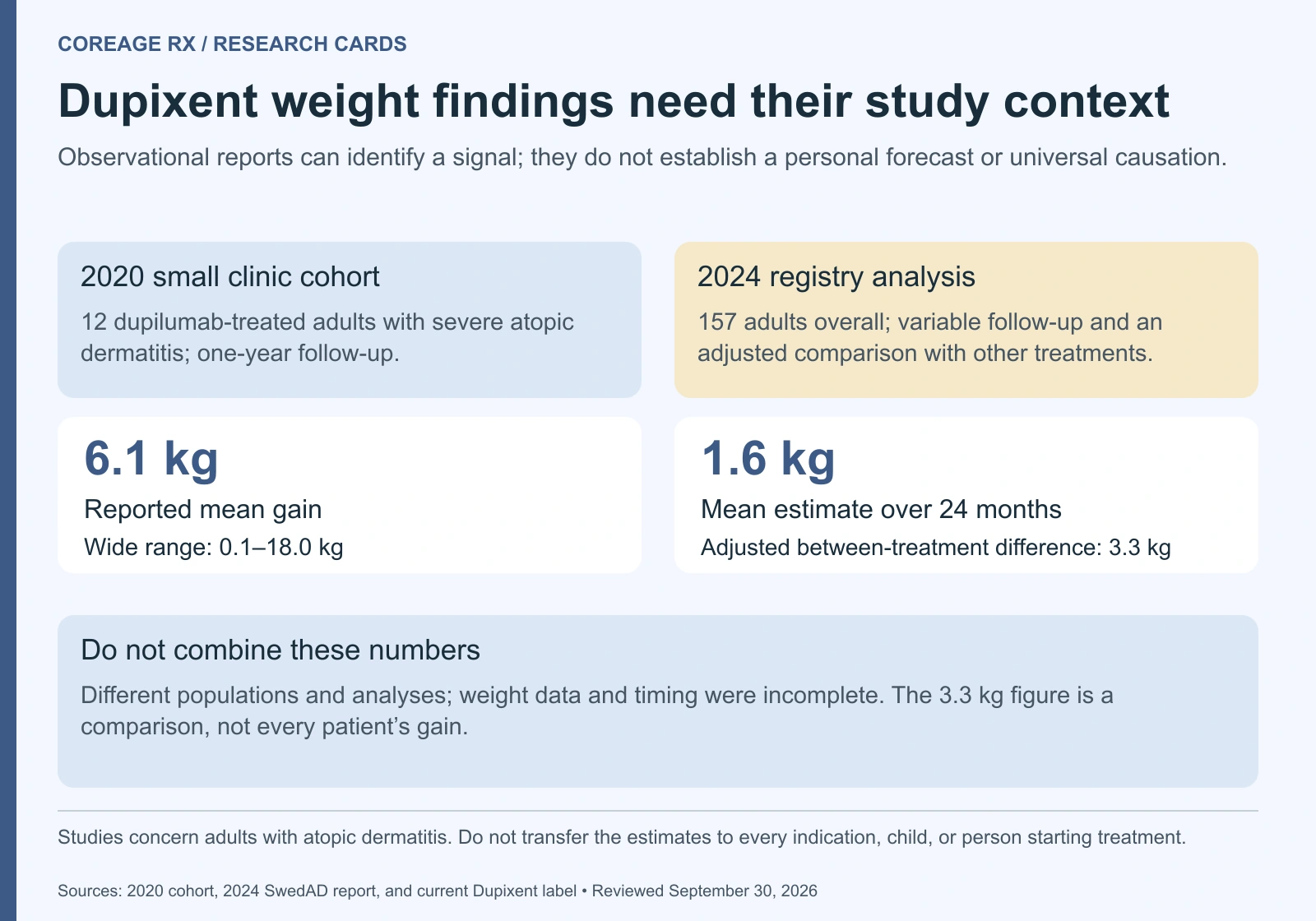
A 2020 clinical cohort report examined patients with severe atopic dermatitis at a Swedish dermatology clinic. Twelve patients treated with dupilumab had a reported mean weight gain of 6.1 kilograms after one year, with a wide range from 0.1 to 18.0 kilograms. Eight methotrexate-treated patients did not have a significant weight change in that report.
This was a very small observational cohort. Treatment was not randomly assigned, the comparison groups were small, and two patients contributed observations to both treatment groups at different periods. Patients without sufficient follow-up or weight data were excluded.
Those features prevent the mean from being a reliable forecast for everyone starting Dupixent. A wide range also shows why “the average gain” is not what every participant experienced. The authors described a possible association and noted that its extent and mechanism remained uncertain.
What did the larger 2024 registry analysis find?
A 2024 Swedish registry study included 157 adults with atopic dermatitis who had weight information at treatment initiation and at least one follow-up measurement. It compared dupilumab with other systemic treatments using prospectively collected registry data.
The analysis reported a mean gain of 1.6 kilograms over the first 24 months of dupilumab treatment. A multivariable comparison, adjusting for selected characteristics including age, sex, asthma, and starting BMI, associated dupilumab with 3.3 kilograms more weight gain than other systemic treatments.
These are different statistical results. The 3.3-kilogram number is an adjusted comparison between treatment groups; it is not the average amount every Dupixent patient gained. It should not be added to the 1.6-kilogram estimate or presented as a personal treatment forecast.
The registry also had important limitations. Weight measurements were not mandatory, follow-up timing differed, and the patients contributing data at each time point were not identical. Treatment selection can reflect a person’s clinical history, creating confounding by indication. Statistical adjustment for selected characteristics does not remove every possible difference between groups.
Why do these studies report different amounts?
The 2020 and 2024 reports involved different sample sizes, follow-up structures, and analyses. A small clinic cohort and a registry-based estimate do not measure precisely the same thing. The numbers should not be combined into a simple “expected gain” range for a new patient.
The studies also concern adults treated for atopic dermatitis. They do not establish the same association for every approved Dupixent indication, age group, or clinical situation. An adult receiving treatment for another condition should discuss the evidence with the relevant prescribing specialist.
This is a common research-reading issue: a study can raise a useful question without answering it definitively. The next step is more careful assessment and research, rather than either dismissing all patient reports or treating the largest reported average as established causation.

Does Dupixent change metabolism?
Researchers have proposed mechanisms involving inflammatory signaling and energy regulation. Some hypotheses draw on animal or laboratory findings involving interleukin pathways and fat tissue. Those ideas help frame further research; they do not establish the mechanism in a patient who notices a weight change.
The 2024 report investigated selected metabolic markers but did not establish a clear explanation for the weight signal. It also did not find an association between weight change and reported appetite, sleep loss from itching, or measured eczema improvement in its analysis. Source: registry study discussion and limitations.
Therefore, explanations such as “Dupixent always slows metabolism” or “better sleep automatically causes weight gain” go beyond the evidence. A person’s routine may change during successful treatment, but that possibility should be assessed in context rather than assigned as the universal cause.
What else should be reviewed when weight changes?
Bring the medication timeline and the broader health picture. The review can include:
- The treatment start date and any dose or schedule changes.
- Whether the change was gradual, sudden, persistent, or fluctuating.
- Appetite, eating difficulties, activity, and sleep changes.
- Other prescriptions, including corticosteroids and recent changes in them.
- New symptoms, swelling, or difficulty obtaining adequate nutrition.
- Whether the condition being treated is improving or causing new limitations.
A change that begins after a medicine is started is important information, but timing alone does not prove causation. Several factors can change together. The team may need to review another health problem or treatment rather than assume Dupixent explains the whole trend.
Our prednisone hunger and weight guide discusses a different medicine that can affect these experiences. Its findings should not be transferred to Dupixent, but it can help you prepare questions if corticosteroids are also part of your care.
Can Dupixent cause weight loss or help you lose weight?
There is no approved Dupixent weight-loss indication or established weight-management expectation from these studies. A subgroup association or a patient’s anecdote does not make the medicine a weight-loss treatment.
If you lose weight, consider whether eating has become difficult, symptoms have changed, another medicine has been added, or the underlying condition is affecting intake. For example, people treated for eosinophilic esophagitis may have condition-specific swallowing and nutrition issues that deserve specialist follow-up.
Unintentional or persistent weight loss should be discussed even if you also have a weight-management goal. The purpose is to maintain health and adequate intake, not accept every lower weight as beneficial. Our balanced-meal guide provides flexible food ideas, but does not replace evaluation of trouble eating or unexplained loss.
Should you stop Dupixent if you gain weight?
Do not make that decision from a scale trend or an online article alone. Contact the prescribing team to discuss the amount, timing, accompanying symptoms, and treatment benefits. The decision may involve monitoring, reviewing other causes, or changing the care plan.
Also avoid abruptly changing corticosteroids or asthma medicines yourself. The Dupixent label specifically warns against abrupt corticosteroid reduction and advises people with coexisting asthma not to adjust asthma treatment without consultation. Source: Dupixent precautions.
If a serious allergic reaction occurs, seek urgent medical help and follow the label’s guidance about discontinuation. That is a different situation from a gradual weight trend that needs a planned review.
Which symptoms deserve faster attention?
Do not wait for a routine weight-management appointment if a weight change accompanies severe symptoms. Difficulty breathing, major swelling, fainting, or signs of a serious allergic reaction require urgent assessment. The current label describes hypersensitivity reactions including anaphylaxis and angioedema.
New or worsening eye symptoms should be reported promptly because the label includes eye-related precautions. A concern about weight should not distract from another potentially important adverse effect.
When contacting the team, describe the symptoms directly rather than only saying the medicine caused weight gain. Clear information helps determine how urgently you need care and what evaluation is appropriate.

Can you use a weight-management medicine while taking Dupixent?
That requires an individualized assessment of diagnoses, medications, nutritional intake, and treatment goals. A possible weight signal is not by itself a reason to add semaglutide, tirzepatide, or another medicine.
The NIDDK prescription weight-management overview explains that medication eligibility and suitability depend on clinical criteria and a health review. Make sure each prescribing team knows the complete treatment list and who will coordinate follow-up.
Our BMI and waist-measurement guide explains the limits of common screening measurements. A weight change alone does not determine the appropriate treatment or replace an assessment of health, symptoms, and function.
CoreAge Rx’s semaglutide and tirzepatide service pages describe its programs. Confirm the exact pharmacy product and care plan. Those services do not establish that a combination is suitable or replace the specialist managing the inflammatory condition.
What information is useful at follow-up?
A brief, consistent weight record may help if the clinician recommends it. Include the measurement dates and relevant symptoms, without feeling obliged to weigh constantly or track every bite. Review the original condition’s response alongside weight and daily functioning.
Ask which changes should prompt earlier contact, whether other medicines need review, and how the team will evaluate the trend. That approach respects both the possible research signal and the benefits of treatment, while avoiding a claim that the cause is already known.
Educational information for adults; individual treatment decisions require a qualified clinician. Sources reviewed September 30, 2026. Original AI-generated article images depict fictional people and objects, not patient outcomes. Other editorial images are illustrative. Graphics summarize the cited sources.