
Papaya seeds do not have an established human weight-loss benefit. Research often cited online concerns parasites, laboratory findings, or animal experiments, rather than sustained fat loss in adults. Eating papaya fruit and using a concentrated seed remedy are also different exposures.
If you found this topic through a “how to eat papaya seeds” or cleanse video, start by separating ordinary food curiosity from a medical claim. This guide explains what the original human studies actually measured, why parasite clearance does not establish weight loss, and when digestive symptoms deserve testing instead of self-treatment.
Are papaya seeds a proven fat-burning food?
No human fat-loss result is established by the seed studies reviewed here. A substance affecting organisms in a laboratory, a parasite outcome in children, and a change in adult body weight are different questions. A headline can blur them without supplying the missing clinical evidence.
There is also no supported seed amount that this article can prescribe for weight loss. A fixed daily seed count, spoonful, or course taken from a video is not validated by the research simply because the plant is edible.
Be specific about the promised result. “Burns fat,” “cleanses the gut,” “removes parasites,” and “reduces bloating” are not interchangeable outcomes. A bowel change after taking something does not demonstrate a reduction in body fat.
Our weight-loss basics guide and realistic-goals article offer a broader starting point. A useful plan should be built around health, adequate food, and sustainable behavior rather than an unverified single ingredient.
Papaya flesh and papaya seeds are not the same food reference
The orange flesh and the black seeds are different parts of the fruit. A nutrient table for papaya flesh should not be presented as a measured seed Nutrition Facts panel. Serving sizes and preparation also matter.
This review does not have a verified current seed panel from which to assign a precise fiber, calorie, or protein amount to a spoonful. Describing an ordinary fruit portion as part of a meal is different from declaring seeds a high-fiber weight-loss supplement.
If you enjoy papaya, the fruit can fit into a varied eating pattern. That does not require using the seeds medicinally. Our balanced-meal guide explains how fruit, protein foods, and other meal components can fit together without giving one food special fat-loss powers.
For people managing diabetes, portion and the overall carbohydrate pattern may be relevant. The NIDDK nutrition guidance emphasizes an individualized eating plan. A seed claim should not distract from the actual meal or replace glucose-management advice. NIDDK diabetes eating guidance
What did the often-cited 2007 study test?
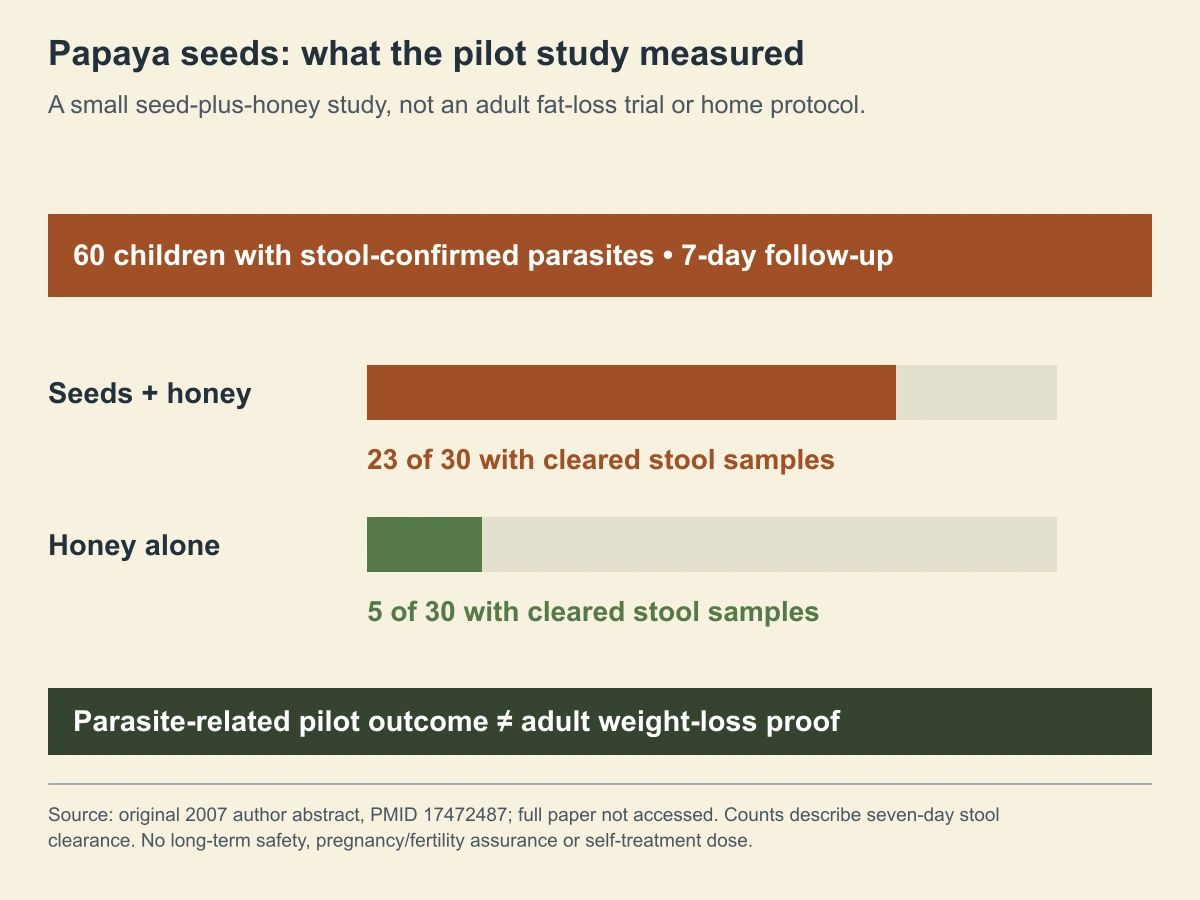
The original abstract describes 60 asymptomatic Nigerian children with intestinal parasites detected through stool microscopy. Thirty received a preparation of dried papaya seeds with honey, and thirty received honey alone. Researchers repeated stool examinations seven days later. Original 2007 papaya-seed pilot-study abstract
The reported stool-clearance result was 23 of 30 children in the seed-plus-honey group, compared with 5 of 30 in the honey group. That is a parasite-related outcome in a small selected group of children. It is not a study of fat loss in adults.
The abstract reported no harmful effects during the study. A short pilot study cannot establish long-term safety, safety during pregnancy, fertility effects, or suitability for every person. The full paper was not accessed for this review, so details absent from the abstract should not be invented.
The authors’ favorable wording is not the same as current clinical guidance endorsing a home remedy. They called for further larger research. The preparation and setting should not be converted into a seed-eating protocol for a reader who has not had a parasite diagnosis.
What does a later human study add?
An original 2018 study in Kenyan schools evaluated papaya-seed-fortified porridge, plain porridge, and an albendazole-plus-porridge comparison over two months. It involved children, with one school assigned to each study arm. The researchers measured intestinal parasite egg counts and other outcomes. Original school-based porridge study
The study reported a reduction in Ascaris egg counts in the seed-porridge group. Egg-count reduction is not identical to parasite cure and is not a fat-loss outcome. The food also contained a micronutrient premix, so nutritional findings should not automatically be attributed only to the seeds.
The three-school design leaves important limits: differences between schools can affect a comparison when only one school represents each treatment. Not all enrolled children contributed complete follow-up data. The abstract and methods also report different enrollment totals, so this review does not use an unresolved headline sample size.
This is meaningful human research context, but it still does not establish a daily seed routine for adult weight management. Neither human study makes parasite treatment and fat loss equivalent.
Why do laboratory and animal findings need a separate label?
A laboratory experiment can help researchers explore a mechanism or identify a compound worth studying. An animal experiment can address another stage of investigation. Neither automatically establishes an effective or safe human remedy at a food-sized amount.
Preparation matters. An extract, dried powder, fortified food, and a seed eaten with fruit may differ in concentration and exposure. The name of the plant alone does not make those experiments match a household serving.
If a claim says an ingredient “kills parasites” or affects a metabolic pathway, ask where the finding came from. Was it observed in a dish, in animals, or in people? What was the actual outcome? Was the formulation the same one being sold?
These questions also apply to supplements generally. The NIH Office of Dietary Supplements explains that many products need more study and that effectiveness is not established by premarket FDA evaluation of supplements. NIH supplement evidence guidance

Should you use seeds for a parasite cleanse?
Digestive symptoms do not prove a parasite infection. Bloating, bowel changes, nausea, or fatigue can have many causes. Appropriate evaluation depends on symptoms, travel and exposure history, medical conditions, and relevant testing.
CDC’s parasite-care information directs people toward diagnosis and appropriate clinical care. The type of infection matters because organisms and treatments differ. A generic online “cleanse” does not identify what is being treated or whether treatment is needed. CDC parasite-care guidance
Tell a clinician about persistent symptoms, recent travel, exposure concerns, and any remedies already taken. If testing is appropriate, follow the collection instructions. Do not assume that something visible in stool after a cleanse proves a parasite was removed.
Severe abdominal pain, persistent vomiting, significant bleeding, fever with worsening illness, or dehydration warrants timely care. A seed remedy should not delay evaluation or replace a prescribed antiparasitic treatment.
Does a cleanse help with weight loss?
NCCIH describes detox and cleanse evidence as limited, with many small or low-quality studies and no established long-term benefit. Restrictive diets and some cleansing products can also cause adverse effects, including fluid and electrolyte problems. NCCIH detox and cleanse guidance
A short-term scale drop after diarrhea or eating very little does not establish sustained fat loss. Fluid loss, reduced intake, and changing bowel contents can affect weight. Those changes may reverse and can occur alongside illness.
This distinction is especially relevant for someone taking a GLP-1 medicine. Gastrointestinal symptoms or poor intake should be assessed rather than intensified by a cleanse. Our Wegovy thirst and dehydration article explains why fluid loss deserves attention.
If constipation is the concern, read our GLP-1 constipation guide and discuss the actual symptoms. A treatment plan for constipation is different from a parasite cleanse and should not be chosen by a fat-burning claim.
How should you approach eating the seeds as food?
Separate a culinary choice from a therapeutic regimen. If you are considering seeds in food, there is no evidence-based weight-loss schedule supplied here. You do not need to keep the seeds in order to benefit from eating the fruit as part of a varied diet.
Avoid escalating the amount because the scale has not changed. Larger amounts, concentrated extracts, and repeated medicinal use raise different questions from an occasional food exposure. The reviewed studies do not establish that “more seeds” produces more benefit.
If a packaged seed powder or extract is involved, read its actual label and ingredient list. A product with additional herbs or laxatives is not equivalent to the fruit. Quality claims do not demonstrate an adult weight-loss effect.
People who are pregnant, breastfeeding, planning pregnancy, giving a product to a child, or managing significant medical conditions should seek qualified advice before concentrated or medicinal use. The absence of long-term safety data should not be turned into reassurance about pregnancy or fertility.
Do all seeds need to be avoided with diverticulosis?
No universal ban is supported by current NIDDK guidance for most people with diverticulosis or diverticular disease. That general food advice is different from endorsing concentrated papaya-seed remedies. NIDDK diverticular-disease nutrition guidance
An active diverticulitis episode can involve a temporary clinician-directed diet, which is a separate situation. Our Wegovy and diverticulitis article explains why long-term food guidance and acute-flare care should not be mixed.
If abdominal pain is present, identify the cause rather than alternating between a permanent seed ban and a seed cleanse. Neither extreme supplies a diagnosis.
Are supplements a substitute for fruit or meals?
No. A supplement should have a defined purpose and should not replace a varied eating pattern. CoreAge Rx’s Full House product page identifies a fiber-focused product; its category does not make papaya seeds an equivalent supplement or establish parasite-treatment benefit. Current Full House product identity
Likewise, the Green Scene product page describes a greens powder, not a complete fruit-and-vegetable meal or a parasite remedy. Current Green Scene product identity Compare actual labels and purposes rather than combining “gut health” claims into one assumed effect.
For everyday habits, our walking guide and sustainable weight-loss habits article offer practical options. These are components of a broader plan, not promises that one routine guarantees a particular weight change.
Common papaya-seed questions
How many seeds should I eat for weight loss?
No validated weight-loss dose is established by the reviewed human research. A parasite pilot study is not a dosing guide for that purpose.
Does the research prove seeds clear every parasite?
No. The studies used particular preparations, populations, and outcomes. A diagnosis and organism-specific care remain important.
Is the fruit’s nutrition panel the seed panel?
No. Do not assign flesh nutrient values to a spoonful of seeds.
Is a bowel change proof of fat loss?
No. Review symptoms and the broader pattern. The most useful conclusion is that papaya-seed claims need evidence matched to the actual outcome, not a shortcut from a small parasite study to a weight-loss promise.
Educational information for adults; individual treatment decisions require a qualified clinician. Sources reviewed October 1, 2026. Original AI-generated article images depict fictional people and objects, not patient outcomes. Other editorial images are illustrative. Graphics summarize the cited sources.