
Taking Ozempic with an ADHD medicine requires an individual review of the exact prescriptions, appetite, nutrition, symptoms, and treatment goals. A short interaction-checker result cannot decide whether Adderall or Vyvanse is appropriate for a particular person using Ozempic.
The main questions are distinct: could symptoms affect eating or hydration, could changes in digestion matter to an oral medicine, and what monitoring is needed? The current product labels help identify those questions, but they do not supply a universal spacing rule or a personal dose adjustment.
This article discusses Ozempic injection, the named Adderall XR extended-release capsule label, and the current Vyvanse capsule and chewable-tablet label. Other ADHD products and formulations need their own review. Our semaglutide questions guide provides the broader treatment context.
Start by identifying the medicines precisely
“Adderall” may be used casually to describe different formulations. The label reviewed here is Adderall XR, an extended-release mixed-amphetamine-salts capsule. Immediate-release Adderall and other stimulant products have different formulation details and directions. Tell the clinician which one you actually take. Adderall XR prescribing information.
Vyvanse contains lisdexamfetamine and is available in capsules and chewable tablets. It should not be assumed to behave identically to Adderall XR because both are stimulants. Likewise, a nonstimulant ADHD medicine requires its own product-specific review. Vyvanse prescribing information.
For Ozempic, identify the strength, weekly schedule, last dose, and any recent changes. A different semaglutide product or a compounded formulation should not be silently substituted in the conversation. If you are unsure which presentation you have, the Ozempic device guide explains why the dispensing label and instructions matter.
Bring one complete list rather than relying on two separate clinicians to know what the other prescribed. Include nonprescription products, caffeine-containing supplements, vitamins, and medicines used only occasionally.
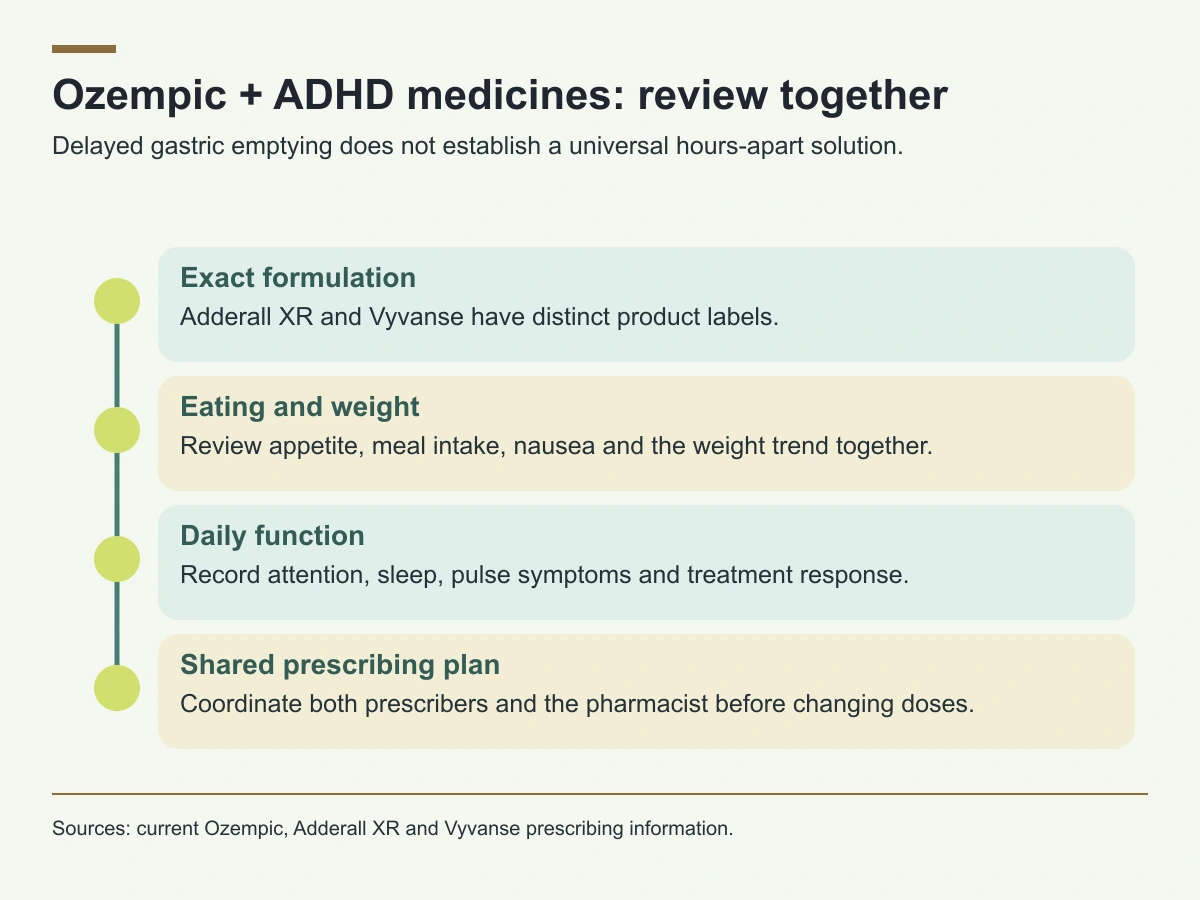
Appetite is an important shared question
For the ADHD medicine itself, our guide to ADHD medicines and weight changes discusses named Adderall and Ritalin formulations, adult eating concerns and pediatric growth monitoring without treating stimulants as weight-loss therapy.
Adderall XR’s adult adverse-reaction information includes loss of appetite, weight loss, nausea, and insomnia. Vyvanse’s ADHD trial information also includes decreased appetite and decreased weight among commonly reported reactions. Ozempic has gastrointestinal effects that can make eating difficult for some patients. Adderall XR prescribing information, Vyvanse prescribing information, Ozempic prescribing information.
These separate observations do not let you calculate the effect of the combination by adding side-effect percentages. They do provide a reason to discuss what happens to your actual intake and daily function.
Useful examples include forgetting meals, feeling too nauseated to eat, repeatedly leaving most of a meal, or finding that the time when you can comfortably eat has changed. Tell the clinician if you are losing weight faster than the agreed plan or struggling to maintain adequate nutrition.
Weight management should not become a contest to suppress appetite as much as possible. A stimulant prescription has its own treatment purpose. In particular, Vyvanse’s label states that it is not indicated for weight loss and that its safety and effectiveness for obesity treatment have not been established. Vyvanse prescribing information.
Eating, hydration, and maintaining function
If reduced appetite is interfering with regular meals, ask for a plan that fits both prescriptions and your daily routine. Record what you can tolerate, rather than guessing whether a medicine is “working harder” because you are eating less.
Our balanced meal guide and protein breakfast guide can help you organize nutrition questions. They do not establish a personal calorie or protein target. The right plan depends on your intake, health history, and clinical goals.
Ongoing vomiting or diarrhea changes the assessment. Ozempic’s label warns about dehydration-related kidney injury and advises monitoring when gastrointestinal reactions can cause volume depletion, especially during treatment initiation or escalation. Ozempic prescribing information.
If you cannot keep fluids down, are markedly weak or faint, or are urinating much less, seek prompt medical advice. Do not rely on an appetite diary to manage significant illness. The semaglutide nausea and vomiting guide explains warning signs and follow-up questions.
Does Ozempic change Adderall or Vyvanse absorption?
Ozempic delays gastric emptying, which creates a potential to affect the absorption of oral medicines. Its label reports that studied oral medicines were not affected to a clinically relevant degree in clinical pharmacology trials, while still advising caution with concomitant oral medicines. Ozempic prescribing information.
That statement should be kept within its scope. A result for the medicines evaluated in those studies does not predict the exact onset, duration, or effect of every ADHD formulation in every patient. It also does not prove that a change you notice in attention is an absorption problem.
Describe any change in when the ADHD medicine seems to take effect or wear off, when it began, and what else changed at the same time. Include sleep, food intake, illness, and adherence. Your prescriber can interpret those observations alongside the formulation and treatment history.
Do not compensate for a perceived delay by taking another capsule, crushing an extended-release product, or increasing the dose. Adderall XR has specific administration instructions, including directions for its capsule contents; those instructions should be followed as prescribed. Adderall XR prescribing information.

Is there a recommended number of hours between them?
The sources reviewed here do not establish a universal Ozempic–Adderall or Ozempic–Vyvanse spacing interval. Ozempic is a weekly injection; the ADHD medicine has its own schedule and formulation. Choosing an arbitrary gap does not guarantee that effects on digestion or tolerability disappear.
Follow the directions on each prescription unless the clinician changes them. Ask the pharmacist to confirm those directions if you have received new instructions, switched formulations, or are uncertain whether food affects how you should take the product.
A useful question is: “With my exact products and symptoms, should anything about my schedule change?” That gives the prescriber the information needed for a decision. “How many hours apart makes it safe?” assumes a universal answer that the reviewed labels do not provide. Ozempic prescribing information, Adderall XR prescribing information, Vyvanse prescribing information.
Our guide to Ozempic, Wegovy, chest pain and palpitations places emergency symptoms first and explains why trial averages do not rule out a serious personal problem.
Blood pressure, heart rate, and sleep deserve review
Adderall XR and Vyvanse carry warnings about increased blood pressure and heart rate, and their labels direct monitoring. They also describe risks in patients with serious cardiac disease. Tell the ADHD prescriber about your cardiovascular history and any new symptoms. Adderall XR prescribing information, Vyvanse prescribing information.
Ozempic’s label separately reports modest mean heart-rate increases in the studied injection groups. Those trial averages do not predict your response to a combination or establish that a new racing heartbeat is harmless. Ozempic prescribing information.
Report persistent palpitations, changes in sleep, anxiety, or other bothersome symptoms. Seek urgent help for severe chest pain, fainting, or breathing difficulty rather than assuming the episode is a routine stimulant effect.
Include caffeine in the review. FDA notes that sensitivity varies with the individual, medicines, and medical conditions; too much caffeine can cause palpitations, anxiety, and sleep problems. A general adult caffeine reference is not a personalized limit for someone taking a stimulant. FDA caffeine guidance.
What if you also use diabetes medicines?
The full list matters, particularly if it includes insulin or a sulfonylurea. Ozempic’s label warns that these combinations can increase the risk of low blood sugar. A clinician may need to review the diabetes plan when eating patterns change. Ozempic prescribing information.
Sweating, shakiness, hunger, dizziness, or confusion can be signs of a low. Follow the diabetes team’s established monitoring and rescue instructions. Severe symptoms need emergency help. Reduced eating during illness can also make glucose management more difficult. NIDDK low blood glucose guidance.
Do not assume an ADHD medicine cancels out Ozempic’s effects or protects against hypoglycemia. Do not independently alter insulin or another prescription to accommodate skipped meals. Share the real pattern of intake so the clinical team can make an informed plan.
For a related symptom discussion, see sweating during Ozempic treatment. That guide does not determine whether a stimulant caused an episode.

A coordinated follow-up checklist
| Question to review | Information to bring | Why it matters |
|---|---|---|
| Which products are involved? | Names, strengths, routes, formulations, and schedules | “ADHD medicine” or “semaglutide” is not a complete prescription |
| Has eating changed? | Meals missed, nausea, intake pattern, weight trend | Appetite effects need assessment through actual nutrition and function |
| Does ADHD control feel different? | Onset, duration, attention tasks, sleep, adherence | A subjective change does not identify an absorption mechanism |
| Are there cardiovascular symptoms? | Palpitations, available blood-pressure readings, relevant history | Stimulant labels call for monitoring and product-specific assessment |
| Who coordinates the plan? | Prescribers, pharmacist, and contact instructions | Both treatment teams should know the complete medication list |
Keep the record manageable. A few representative days and a clear account of what changed may be more useful than a long list of guesses about mechanisms.
Ask which symptoms should trigger a call, who should receive that call, and when the next review should happen. This is particularly useful if one service manages ADHD and another manages diabetes or weight treatment.
Questions people often ask
Can I take Ozempic with Adderall?
The answer requires your exact formulation, history, and prescribing plan. This article reviews Adderall XR information; it does not provide individual clearance for XR, immediate-release Adderall, or another stimulant. Ask the clinicians managing both prescriptions to review appetite, symptoms, and monitoring together.
Is Vyvanse the same interaction question?
It shares several practical issues, including appetite and cardiovascular monitoring, but it is a different medicine. Use its own label and prescription instructions. Do not transfer a dose or timing plan from someone taking Adderall XR.
Can the combination help me lose more weight?
Do not use an ADHD stimulant to intensify weight loss. Vyvanse is not indicated for weight loss, and stimulant misuse carries serious risks. Each medicine should be prescribed for its appropriate clinical purpose. Vyvanse prescribing information, Adderall XR prescribing information.
Should I increase my ADHD dose if it seems slower to work?
No unsupervised increase is established by that observation. Record the change and contact the prescriber. The formulation, meals, sleep, symptoms, and adherence all belong in the review.
Where can I start a treatment discussion?
Review the semaglutide questions guide and CoreAge Rx’s semaglutide service information. Bring the complete ADHD prescription and all other medicines to the clinical assessment, including the symptoms or concerns that prompted your question.
Educational information for adults; individual treatment decisions require a qualified clinician. Sources reviewed October 2, 2026. Original AI-generated article images depict fictional people and objects, not patient outcomes. Other editorial images are illustrative. Graphics summarize the cited sources.