
Adderall and Ritalin can affect appetite and weight, but they should not be treated as weight-loss tools. A change deserves review in the context of the exact ADHD medicine, formulation, treatment benefit, nutrition, symptoms, and age. Decreased appetite is not a goal that automatically makes treatment successful.
This guide addresses common questions about weight changes during prescribed ADHD treatment. It separates adult eating concerns from pediatric growth monitoring and explains what to bring to the prescriber. It does not rank stimulants by how much weight they might make a person lose or recommend changing a dose for that purpose.
Which medicine and formulation do you take?
For a separate ADHD medicine, our guide to Strattera appetite and weight changes reviews the current atomoxetine adult label findings, meal difficulties, medication coordination and the distinction from pediatric growth monitoring.
“Adderall” can refer to immediate-release tablets or Adderall XR extended-release capsules. Ritalin in the label reviewed here refers to methylphenidate tablets; other methylphenidate formulations have their own directions. Products with related names should not be assumed to share an identical daily schedule.
| Product discussed | What it contains or describes | Why the distinction matters |
|---|---|---|
| Adderall tablets | Mixed amphetamine salts, immediate-release presentation | Use the actual tablet prescription and directions. |
| Adderall XR | Mixed amphetamine salts, extended-release capsules | Do not substitute an immediate-release schedule. |
| Ritalin tablets | Methylphenidate hydrochloride | Another methylphenidate product may have different administration instructions. |
| Other ADHD medicines | A separate named product | They require their own review rather than a stimulant-wide assumption. |
Sources: Adderall tablet label, Adderall XR label, Ritalin label. Bring the dispensing label, not just a remembered brand name, when discussing effects.
Also record the prescribed reason, start date, dose changes, and other medicines. If several clinicians prescribe for you, each should know the complete list. The formulation matters when reviewing appetite patterns, sleep, perceived duration, and administration questions.
Can these medicines reduce appetite or weight?
Appetite and weight effects are described in the reviewed stimulant information. The current Adderall XR label includes decreased appetite and weight changes in its adverse-effect and growth context. Methylphenidate drug information also lists loss of appetite and weight loss. Adderall XR label, methylphenidate information.
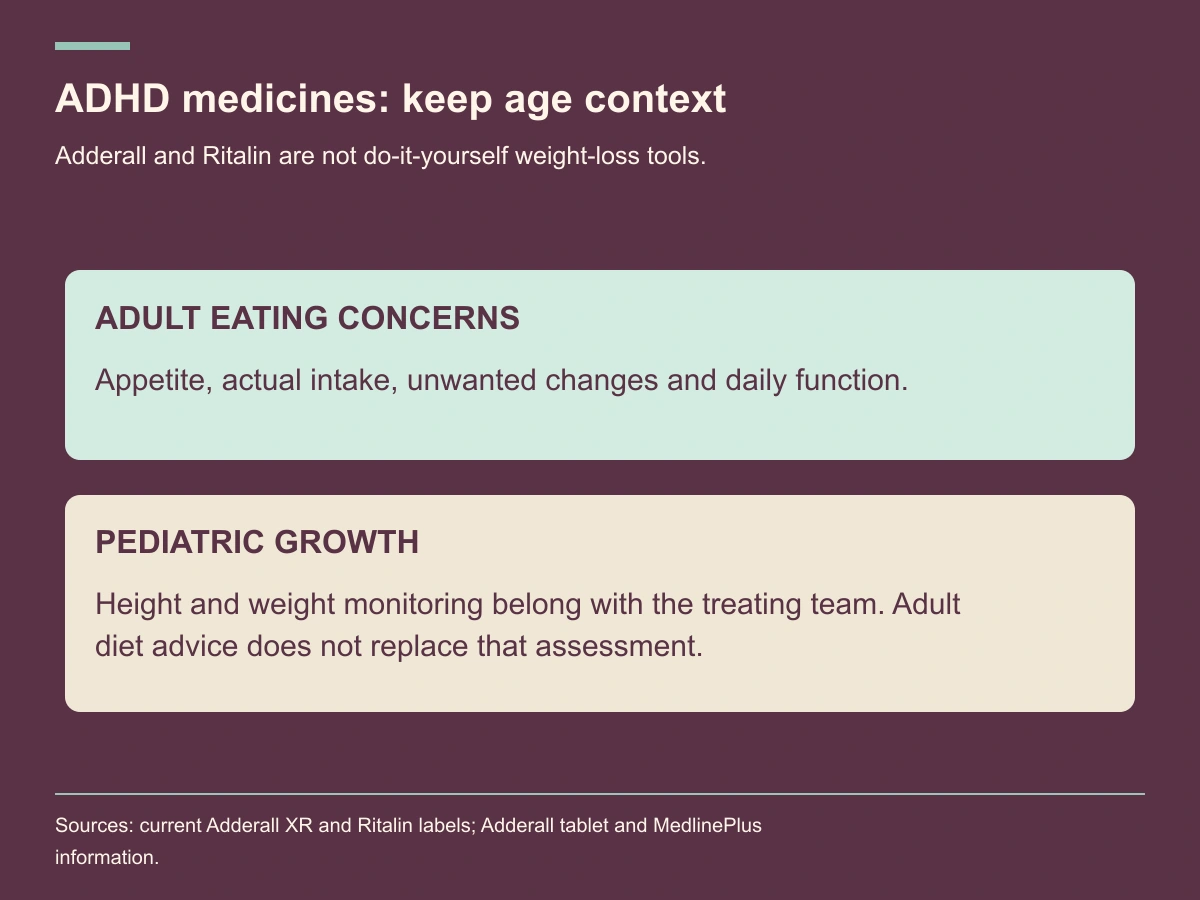
That does not mean everyone loses weight, that the effect continues at the same rate, or that more weight loss means better ADHD control. It also does not identify the cause of every change. Illness, mood, sleep, food access, other medicines, and routine can change during treatment.
Describe whether appetite is lower, meals are missed, food is unappealing, nausea interferes, or the workday simply passes without a break. Those are different practical problems. A record of what happened can help the prescriber review nutrition and treatment together.
Why weight loss is not a reason to misuse a stimulant
The current Adderall XR and Ritalin labels warn about abuse, misuse, and addiction, including overdose and death with misuse. Those risks are not removed by a weight-management goal. Adderall XR warning, Ritalin warning.
Use the medicine for the purpose and schedule prescribed. Do not take extra doses, use someone else’s prescription, or add another stimulant to make appetite lower. Do not alter an extended-release product to obtain a different effect. A side effect is not evidence that an unprescribed use is appropriate.
If you feel pressure to keep losing weight or fear eating when the medicine is active, say so to the clinician. Eating concerns deserve support. They should not be hidden because attention symptoms improved or because a lower weight is socially praised.
What should adults track?
Notice whether you can meet ordinary nutrition needs and function through the day. Useful observations include meals missed, times when eating is easier, hydration, digestive symptoms, sleep, and unwanted weight changes. You do not need constant weighing or a perfect food log.
Bring representative examples. “I forget lunch on workdays and feel weak by late afternoon” gives a more useful starting point than “the medicine suppresses appetite.” Explain whether weekends differ and whether a prescription change coincided with the pattern.
Our balanced-meal guide and breakfast ideas offer flexible food combinations. The PB&J article gives a convenient-meal example with actual labels. These are food ideas, not instructions to change stimulant timing or compensate with a restrictive diet.
Pediatric growth requires a separate review
Current stimulant labels emphasize monitoring height and weight in children. The Adderall XR label describes potential slowing of growth, and the Ritalin label similarly directs close monitoring. A clinician may need to reconsider treatment when a child is not growing or gaining weight as expected. Adderall XR label, section 5.5, Ritalin label, section 5.7.
An adult’s weight-management advice should not be applied to a child. Pediatric trial findings also should not be converted into a prediction of adult weight loss. Age, growth trajectory, treatment benefit, nutrition, and other medical factors belong in the pediatric assessment.
If you are a parent or caregiver, bring the growth and eating concerns to the child’s treating team. Ask how progress will be monitored and which changes warrant earlier contact. Do not create medication holidays, skip school-day doses, or increase food supplements without discussing the actual plan.

Can meal planning help without changing the prescription?
Practical support can make eating easier. Keep accessible foods available, plan a realistic break, and choose meals you can manage. A simple lunch you actually eat may be more useful than an elaborate plan you repeatedly miss.
Consider what fits the setting. Someone working away from home may need portable foods; someone with morning time pressure may benefit from preparing breakfast components the night before. A food reminder can address forgetting, while persistent nausea or inability to eat needs clinical review.
Do not assume one universal protein target or a supplement is required. Discuss individual needs with a dietitian, particularly with a medical condition or unwanted loss. The yogurt guide and fruit portions article provide label and pairing examples without establishing a prescribed intake.
What about strong hunger later in the day?
Explain the pattern rather than immediately calling it a failure of willpower or proof of a dosing problem. Include what you ate earlier, when the medicine was taken, sleep, and whether the experience began after a change. The prescriber can review the formulation and treatment course alongside the routine.
Do not take an extra dose to stop evening hunger or use fasting to compensate for eating. A day with little food followed by strong hunger deserves a review of regular intake. If eating feels out of control or distressing, ask for appropriate support instead of pursuing greater appetite suppression.
The goal is a workable pattern and effective ADHD care. An internet article cannot determine that hunger at a particular hour means you need a different product, a higher dose, or a medication-free day.
What if you also take semaglutide or tirzepatide?
Tell both prescribing teams. Lower appetite, gastrointestinal symptoms, and other treatment considerations need an individual review. Do not add an ADHD stimulant to intensify the effect of a weight-management medicine.
Our Ozempic and ADHD medicines article addresses the paired-prescription question separately, including exact formulations and oral-medication considerations. It does not establish a combination as safe for every person. The semaglutide nausea guide is useful if digestive symptoms interfere with intake.
Bring the actual product, dose history, diabetes medicines if relevant, and symptoms. If a treatment interruption is being considered, ask the respective clinicians how to manage it. Do not change several prescriptions at once to test whether appetite returns.
A useful appointment checklist
Record the exact medicine and formulation, prescribed schedule, recent changes, treatment benefit, meals you manage, and symptoms. Ask which monitoring is appropriate and when the plan will be reviewed. If weight tracking causes distress, discuss how the team can assess adequacy and health in another way.
Clarify who to contact for a missed dose, vomiting, a refill problem, or a new symptom. These are separate questions. A good plan should be usable on an ordinary work or school day, not dependent on guessing how much medicine remains active.
If the routine is not sustainable, explain why. Cost, scheduling, sleep, and food access can all affect care. A clear description gives the team more options than simply asking for stronger appetite suppression.
Which symptoms need earlier help?
Chest pain, breathlessness, fainting, or a fast or irregular heartbeat needs prompt medical assessment; severe symptoms warrant emergency care. New hallucinations, marked psychiatric changes, or thoughts of self-harm also require urgent attention. Methylphenidate information, amphetamine information.
Contact the prescriber for persistent poor intake, unwanted weight loss, troublesome insomnia, or symptoms that interfere with ordinary functioning. A child’s growth concern should be reviewed with the pediatric treating team. Do not wait for a routine appointment if the person is becoming significantly unwell.

Frequently asked questions
Does Ritalin always cause weight loss?
No individual outcome is guaranteed. Appetite and weight effects are possible, but the treatment response and nutritional adequacy should be assessed together. A stable weight does not mean the medicine failed to treat ADHD.
Should I switch from Adderall to Ritalin to lose more weight?
Do not use that goal to choose or change a stimulant. The appropriate medicine depends on clinical assessment, treatment benefit, tolerance, and other factors. Comparing adverse-effect rates across different trials does not provide a safe weight-loss ranking.
Can I stop if I dislike the appetite effect?
Discuss the concern with the prescriber and obtain a plan. Do not independently change treatment, particularly after overuse. Amphetamine information warns about stopping after misuse and the need for clinical supervision. Drug information.
Related care information
Read balanced meals and Ozempic with ADHD prescriptions for related questions. The CoreAge Rx semaglutide page describes one weight-care service for eligible patients; it does not recommend stimulant combinations or replace your ADHD prescriber’s review.
Educational information for adults; individual treatment decisions require a qualified clinician. Sources reviewed October 3, 2026. Original AI-generated article images depict fictional people and objects, not patient outcomes. Other editorial images are illustrative. Graphics summarize the cited sources.