
A peanut butter and jelly sandwich can be part of a nourishing eating pattern. Its nutrition depends on the bread, nut butter, fruit spread, amounts, and other foods eaten with it. There is no single calorie count or universal judgment that applies to every PB&J.
This guide uses two named labels to show how to read the ingredients separately. It also explains portions, allergies, meal ideas, and questions that arise during weight management or GLP-1 treatment. The examples are illustrations, not a prescribed sandwich size or a promise of weight loss.
Begin with what is actually in the sandwich
Look at the bread package, peanut butter, and jelly, jam, or preserves you use. Note how much of each goes into the sandwich. Different bread slices and spreads can change calories, protein, fiber, sodium, and added sugar. A recipe copied from another person may not describe your lunch.
The food’s role matters too. A sandwich may be a quick breakfast, a packed lunch, an afternoon snack, or the only easy food available during a difficult day. Ask whether it meets that situation’s needs rather than assigning it one permanent label.
If you are comparing packaged sandwiches, read the whole product label. Do not add homemade ingredient estimates to an already complete packaged-sandwich nutrition panel. The FDA label guide explains how servings and product-specific information fit together.
A verified peanut-butter and preserves example
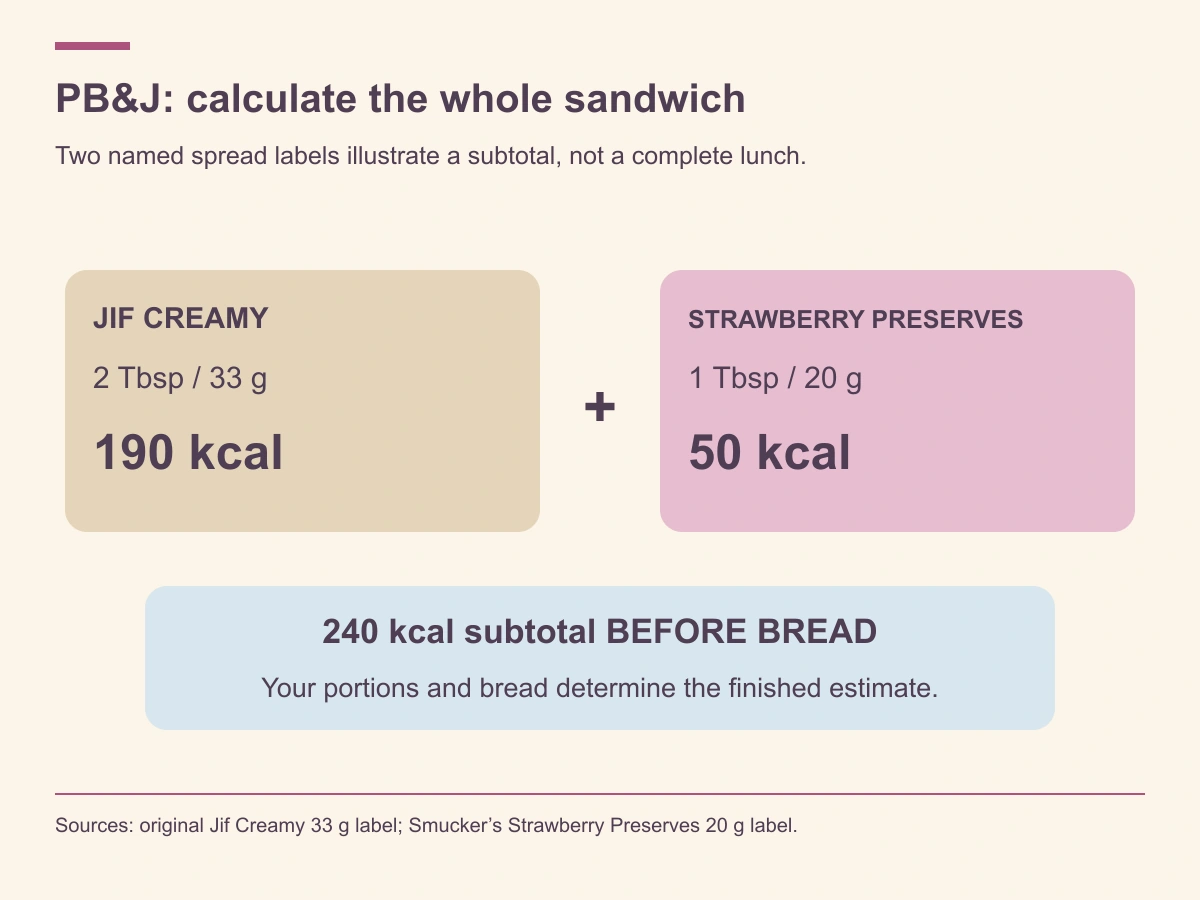
The reviewed Jif original Creamy Peanut Butter label uses 2 tablespoons, 33 grams. The Smucker’s Strawberry Preserves label uses 1 tablespoon, 20 grams. These are two different serving references. The preserves are an example fruit spread, not a label for every product called jelly.
| Nutrient | Jif Creamy Peanut Butter, 33 g | Smucker’s Strawberry Preserves, 20 g |
|---|---|---|
| Calories | 190 | 50 |
| Protein | 7 g | 0 g |
| Dietary fiber | 2 g | 0 g |
| Total fat | 16 g | 0 g |
| Saturated fat | 3.5 g | 0 g |
| Total carbohydrate | 8 g | 13 g |
| Total sugars | 3 g | 12 g |
| Added sugars | 2 g | 9 g |
| Sodium | 140 mg | 0 mg |
Sources: Jif original creamy label, Smucker’s preserves label. Packaging can change; use your actual package when it differs from the example.
At those stated amounts, the two spreads provide a 240-calorie subtotal before bread. That arithmetic is not the calorie count of a finished sandwich. It also does not say that everyone should use those amounts or that the subtotal is a meal target.
Why the bread belongs in the calculation
Check how many slices the bread label uses as a serving, the slice size, and the nutrition of the amount you actually use. Bread marketed with words such as “multigrain” or “artisan” still needs a label check. Compare similar amounts if you want a meaningful comparison.
For a homemade estimate, add the bread and the actual spread quantities. If you use a smaller amount than a label serving, a proportional calculation can help, but kitchen portions and label rounding limit precision. Do not present a loosely estimated sandwich as an exact laboratory measurement.
You can use the label without turning lunch into a weighing exercise. A consistent recipe may be enough for a practical estimate. If detailed counting is unhelpful or distressing, ask a dietitian for another way to review the meal’s adequacy and fit.
What does peanut butter contribute?
The named serving supplies protein, fat, and some fiber, along with other components on its label. Those features are part of why it is different from a fruit spread. They do not make it a complete meal by itself or establish that adding more always improves the sandwich.
Consider the amount you enjoy and what the rest of the meal contains. The sandwich might accompany fruit, vegetables, yogurt, milk, or another appropriate food. Allergies, dietary preferences, medical needs, and cost affect which pairing makes sense.
A spread can be nutritious and still add meaningful energy to a meal. That is not a contradiction or a reason to avoid it automatically. It is a reason to notice portions while keeping adequate intake and enjoyment in the picture.
Is the sugar in jelly or preserves a problem?
Read the actual product’s total-sugar and added-sugar lines. They are different label items. The reviewed preserves serving reports 12 grams total sugar, including 9 grams added sugar. That does not establish identical values for reduced-sugar spreads, no-added-sugar products, homemade jam, or fresh fruit. Preserves label.
Compare options you would actually enjoy and use. A smaller amount of your usual spread, a different product, or a fruit pairing may each suit different preferences. Do not assume an unfamiliar substitute is automatically better because of one number, or that it has the same taste, ingredients, and serving size.
If you have diabetes, ask how the complete carbohydrate-containing meal fits your care plan. The peanut butter does not cancel the bread or spread’s carbohydrates. An individual glucose (blood sugar) plan and the whole meal are more useful than a claim that one ingredient neutralizes another.

How can a PB&J become a more complete meal?
Use the sandwich as one component and ask what else is missing for the occasion. Fruit or vegetables add variety; another protein-containing food may be useful when the meal otherwise falls short of your needs. The combination should reflect appetite and access, not a universal rule that every lunch requires an identical set of sides.
Our balanced-meal guide explains flexible components. For breakfast, see meal and protein ideas. The yogurt guide and fruit and banana guide offer related label and portion discussions.
Try a sandwich with fruit and an appropriate dairy or nondairy option, or a sandwich with a vegetable side and another food you enjoy. These are ideas rather than measured recipes. If you regularly finish lunch hungry, look at the complete meal and your needs instead of assuming the sandwich must be removed.
What if the sandwich is convenient but repetitive?
Convenience can make regular meals easier. Keep useful foods available while considering variety across the week. You might alternate the fruit spread, bread, sides, or another lunch without treating every day as an opportunity to perfect nutrition.
A packed lunch that you actually eat can be more workable than an elaborate meal you cannot prepare or carry. Ask which small change improves the routine: keeping an appropriate side nearby, checking that a package contains enough food for you, or preparing ingredients in advance.
Do not turn a familiar meal into evidence of poor discipline. If fatigue, budget, appetite, or food access limits options, those are practical issues to solve. Our calorie-intake guide explains why eating adequately and understanding the overall pattern matter alongside estimates.
Peanut allergy requires a different decision
The reviewed peanut-butter label explicitly contains peanut ingredients. A confirmed peanut allergy is not addressed by choosing a smaller portion. Follow your allergy-care plan and review ingredient lists and cross-contact information for any alternative.
A seed or other nut spread is not automatically safe for every allergic person, nor does it necessarily share the example peanut butter’s nutrition. Read the exact package and ask a qualified clinician about appropriate substitutes when needed. Do not rely on the sandwich’s appearance or the absence of visible nuts.
For shared kitchens, schools, or workplaces, follow the applicable allergy arrangements. Those arrangements are separate from weight-management goals. A nutritious food for one person can be unsuitable for another.
Can I eat PB&J while using semaglutide or tirzepatide?
The question is how the meal fits your nutrition and tolerance. If a large or rich sandwich worsens nausea or reflux, describe the portion, ingredients, and symptoms to the care team. There is no universal ban on PB&J during GLP-1 treatment.
Do not solve persistent symptoms by repeatedly skipping meals. The semaglutide nausea guide discusses warning signs and questions for follow-up. If you cannot keep food or fluids down, need to avoid many foods, or become unusually weak, contact the team for assessment.
For reflux, personal triggers and meal timing may matter; NIDDK discusses high-fat foods among possible triggers and emphasizes an individual review. Reflux meal guidance. That does not mean the same peanut-butter amount causes symptoms in every person.
Pack the complete lunch safely
Follow package storage directions and consider every item in the lunch. A sandwich served with perishable foods such as dairy, meat, or certain prepared sides needs appropriate cold storage for the complete meal. USDA advises prompt refrigeration of perishable foods and warns against leaving them at room temperature beyond the appropriate window. USDA leftovers guidance.
Do not infer the safety of the whole lunch from one shelf-stable ingredient. If an ice pack or refrigeration is needed for a side, plan for that when packing. Preparation, clean utensils, and the actual ingredients matter alongside nutrition.

Frequently asked questions
Can PB&J help me lose weight?
One sandwich does not determine a weight outcome. It can fit an appropriate eating pattern, but portions, daily intake, medical needs, and sustainability matter. There is no weight-loss guarantee attached to peanut butter or jelly.
Is a 240-calorie PB&J realistic?
The example’s 240 calories covers only the two stated spreads. Bread and any other ingredients must be included for the finished sandwich. A different recipe or portion produces a different estimate.
Should I remove jelly completely?
That is not a universal requirement. Compare the amount, label, taste, and your goals. A practical change should fit your preferences and medical plan without making regular eating unnecessarily difficult.
Related care information
Read balanced meals and breakfast portions and ideas for broader planning. The CoreAge Rx semaglutide service page describes care for eligible patients; a sandwich label does not establish eligibility or replace a nutrition assessment.
Educational information for adults; individual treatment decisions require a qualified clinician. Sources reviewed October 3, 2026. Original AI-generated article images depict fictional people and objects, not patient outcomes. Other editorial images are illustrative. Graphics summarize the cited sources.