
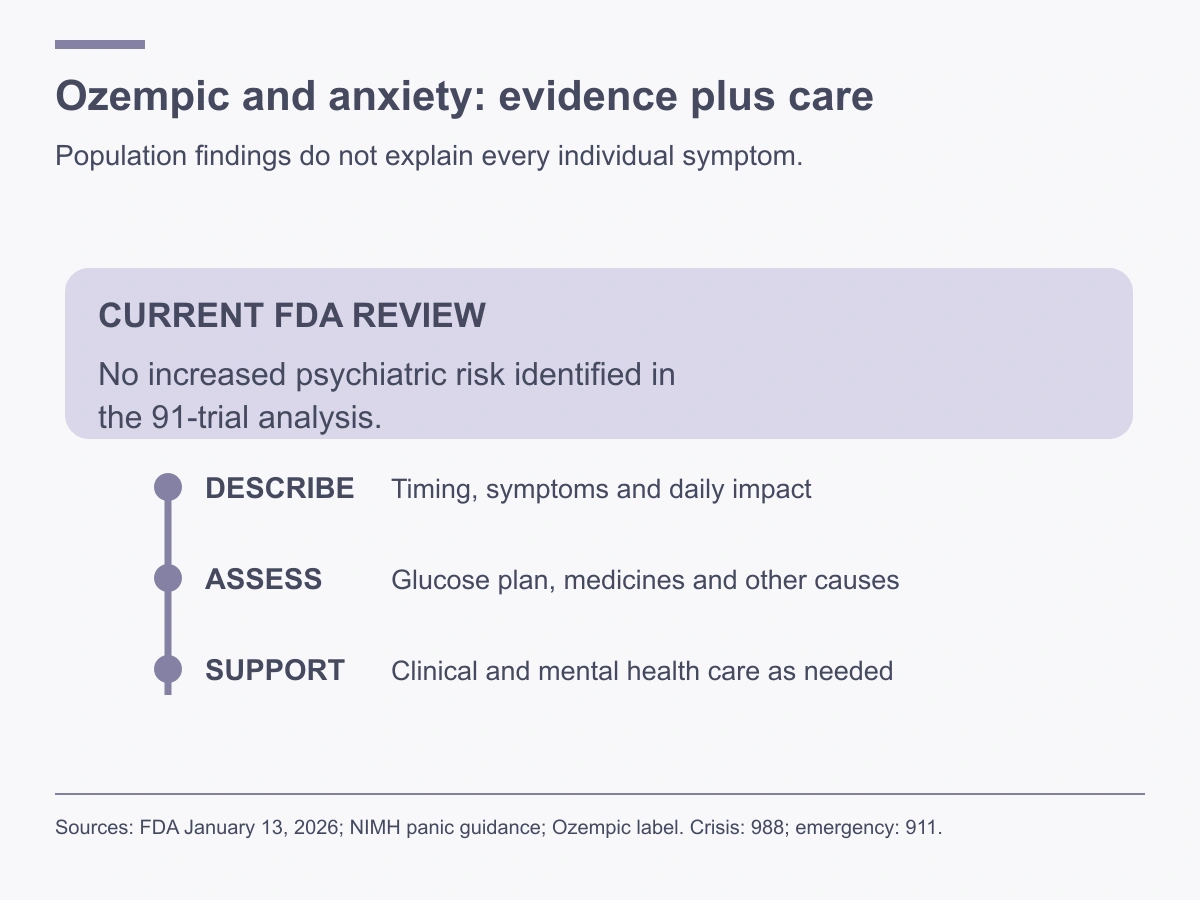
New anxiety or panic-like symptoms during Ozempic treatment deserve attention, but current evidence does not establish that Ozempic routinely causes panic attacks. In January 2026, FDA reported that its large GLP-1 review did not identify increased risk of suicidal thoughts or behavior or related psychiatric outcomes such as anxiety and depression. That population-level finding does not diagnose an individual episode or make new symptoms unimportant.
The useful next step is to describe what happened and review the full situation: glucose-lowering medicines, food intake, sleep, other prescriptions, previous anxiety, and the impact on daily life. Chest pain, significant breathing difficulty, fainting, or another severe symptom should not be assumed to be panic without medical assessment.
What did FDA’s current review find?
FDA’s January 13, 2026 communication describes a meta-analysis of 91 placebo-controlled GLP-1 trials involving 107,910 participants. It did not identify increased risk of suicidal thoughts or behavior, anxiety, depression, irritability, or psychosis. FDA also reviewed other evidence and requested removal of the suicidal-behavior warning from the weight-management labels that carried it. FDA’s January 2026 safety communication.
That update matters when older articles repeat earlier concerns as settled facts. It also has a defined scope: a class-level evidence review is not a guarantee that no person can ever experience a symptom while taking a medicine.
Ozempic’s diabetes labeling did not contain that suicidal-behavior warning. The FDA update should not be described as removal of a warning that Ozempic previously carried. Discuss concerns with the prescribing team while continuing treatment as directed, unless urgent care or the team gives different instructions.
Does “no increased risk” mean my symptoms are imagined?
No. A population comparison asks whether an outcome occurred more often in one study group than another. It does not explain every individual’s experience or determine what caused your symptoms.
Someone can develop anxiety during treatment because of an existing condition, another medicine, a physical problem, stress, or several overlapping factors. A clinician can also assess whether a possible medication association deserves investigation.
A helpful account does not need to prove causation before you seek support. Say when symptoms began, what changed around that time, what the episode felt like, and how it affected you. The care team should take those details seriously while avoiding an unsupported conclusion about the cause.
Our Ozempic and antidepressant guide addresses a related medicine-review question. It does not establish that anxiety is caused by one drug or that an antidepressant should be changed without a prescribing plan.
Anxiety, a panic attack, and panic disorder are different
Anxiety can involve ongoing worry or tension. A panic attack is a sudden episode of intense fear or discomfort with physical and emotional symptoms. Panic disorder involves a particular recurring pattern and ongoing worry or behavioral changes; one episode does not establish that diagnosis. NIMH panic-disorder guidance.
Physical symptoms can include a racing heart, sweating, trembling, dizziness, chest discomfort, or difficulty breathing. Those symptoms also have possible medical explanations, which is why a new episode should not automatically be labeled panic from an online checklist.
Describe the sequence. Did the physical sensation appear first? Was there intense fear? Was the episode unexpected? Has it happened repeatedly? A clinician may ask these questions alongside medical history and a physical assessment.
If you have an established panic-care plan, tell the clinician whether the current episode feels typical or different. A familiar diagnosis does not make every new chest or breathing symptom the same problem.
Could low blood glucose feel like anxiety?
Low blood glucose can occur with some diabetes treatments, especially insulin and medicines that stimulate insulin release. Reduced carbohydrate intake, missed meals, or other changes may also matter in a person whose treatment can lower glucose. NIDDK hypoglycemia guidance.
Ozempic’s label highlights increased hypoglycemia risk when it is used with insulin or an insulin secretagogue such as a sulfonylurea. This is a specific combination concern, not proof that every anxious feeling during Ozempic treatment is low glucose. Ozempic label, section 5.5.
If you have a glucose-monitoring and low-glucose plan, follow it and tell the care team about the readings and circumstances. Symptoms alone cannot establish the glucose level. Ask for an individualized plan if you do not have one.
Our Ozempic sweating guide discusses why sweating needs context. Our Mounjaro low-blood-sugar guide covers a different product and should not replace your own Ozempic care instructions.
Review intake, sleep, illness, and other medicines
A treatment change may coincide with smaller meals, nausea, altered sleep, or a new daily routine. These are useful details to discuss; they do not establish one universal pathway from Ozempic to anxiety.
Include other medicines and supplements, including products taken occasionally. Name recent starts, stops, or dose changes. Do not leave out a cold remedy, stimulant-containing supplement, or psychiatric prescription because it seems unrelated to weight or diabetes care.
Record whether anxiety occurs mainly on difficult eating days, after disrupted sleep, or around a particular medicine change. Patterns can help organize the assessment, but a diary is not a causal test.
Our semaglutide and insomnia guide and sleep and weight guide provide related questions for the care team. If appetite has changed substantially, the balanced-meal guide can help frame an intake discussion without prescribing an extreme restriction.

A practical review checklist
| What to record | Example of useful information | What it helps clarify |
|---|---|---|
| Episode timing | Start time, duration, and recurrence | The actual pattern rather than a vague impression |
| Medicine changes | Injection dose, recent changes, and other prescriptions | Which exposures need review |
| Physical symptoms | Sweating, palpitations, dizziness, chest or breathing symptoms | Whether medical assessment is needed |
| Glucose context | Readings and action taken under your existing plan | Whether hypoglycemia was documented |
| Daily impact | Avoided activities, missed work, or disturbed sleep | How much support is needed |
| Previous history | Earlier anxiety, panic care, and current mental health treatment | Continuity with established care |
Keep the record brief enough to maintain. One clear episode description is more useful than a long list of online theories. Include uncertainty honestly, such as not knowing the glucose level or the exact time a symptom began.
For urgent symptoms, seek care first. You do not need a completed diary before asking for medical help.
Should you stop Ozempic or change the dose?
Ask the prescriber about new or worsening symptoms and the next treatment step. A general article cannot determine whether to continue, pause, adjust, or switch your particular prescription.
FDA advises patients to continue medicines as prescribed and discuss concerns with their healthcare professionals. The team may need to review the underlying condition, other glucose-lowering treatment, symptom severity, and available alternatives. FDA patient guidance.
Do not abruptly stop a psychiatric medicine, use someone else’s anxiety treatment, or change several medicines at once to test a theory. Ask the relevant prescribing clinicians to coordinate the plan.
Our Ozempic alternatives guide explains why a change in diabetes or weight-management treatment needs an appropriate replacement and follow-up. The choice should respond to a clinical evaluation rather than a frightening search result.
What support is available for anxiety or panic?
NIMH describes established treatment options for panic disorder, including psychotherapy and medication chosen with a qualified clinician. Cognitive behavioral therapy is one evidence-supported approach. The appropriate treatment depends on the assessed condition and the person’s needs. NIMH treatment guidance.
If worry or fear is interfering with work, relationships, sleep, or ordinary activities, seek professional support even if the medication question remains unresolved. You do not have to establish that Ozempic caused the symptoms to receive care.
Tell a trusted person what is happening if that helps you seek support or manage appointments. Ask the care team for a clear plan: whom to contact, how follow-up will work, and what to do if an episode recurs.
Supportive daily routines may be useful alongside treatment, but they should not become a demand to “just relax” or a substitute for assessment. A respectful care plan addresses both the symptoms and the uncertainty about their cause.
When should you seek immediate help?
New severe chest pain, significant breathing difficulty, collapse, or a rapidly worsening physical episode requires urgent medical assessment. These symptoms can overlap with panic but should not be diagnosed from a web article.
For suicidal thoughts or a mental health crisis in the United States, call or text 988 or use the 988 Lifeline. Call 911 for an immediate life-threatening emergency. FDA and NIMH both direct people with concerning mental health symptoms toward appropriate professional care. FDA crisis guidance, NIMH help resources.
A reassuring population-level review is not a reason to delay individual crisis support. If someone cannot remain safe, obtain immediate help rather than waiting for the next routine prescription visit.

Questions people commonly ask
Can Ozempic cause a panic attack in an individual?
This article cannot determine the cause of an individual episode. The current FDA review did not find an increased psychiatric risk in the assessed trials. New symptoms still deserve an assessment of medicines, glucose, health history, and mental health needs.
Does semaglutide’s action in the brain prove it causes anxiety?
No. A proposed biological mechanism is not the same as evidence that treatment causes a clinical outcome. Do not use a mechanism explanation to override current trial findings or dismiss a person’s need for care.
What if the episodes started after a dose increase?
Tell the prescriber the exact dates and symptoms. The association in time is useful, but it is not proof of causation. Ask about the next dose and an appropriate review of tolerance and the rest of the regimen.
What if I already have an anxiety disorder?
Share your existing treatment plan and tell the clinicians whether symptoms changed. Maintaining coordinated diabetes and mental health care is more useful than treating the diagnoses as competing explanations.
Does this article apply to every semaglutide product?
Product and route still matter. The compounded GLP-1 guide and CoreAge Rx semaglutide information page can help identify the actual treatment pathway. Do not assume every preparation is branded Ozempic.
Do I need to wait until symptoms are severe to ask for support?
No. Recurrent episodes, escalating worry, avoidance, or an effect on everyday life are reasons to contact a clinician. Urgent symptoms and crises require immediate channels.
Bring the evidence and your experience together
The current FDA review is reassuring at the population level. Your own symptoms still deserve a careful description, medical assessment when needed, and appropriate mental health support. Ask the prescribing team for a coordinated plan rather than trying to prove or disprove the cause alone.
Educational information for adults; individual treatment decisions require a qualified clinician. Sources reviewed October 5, 2026. Original AI-generated article images depict fictional people and objects, not patient outcomes. Other editorial images are illustrative. Graphics summarize the cited sources.