
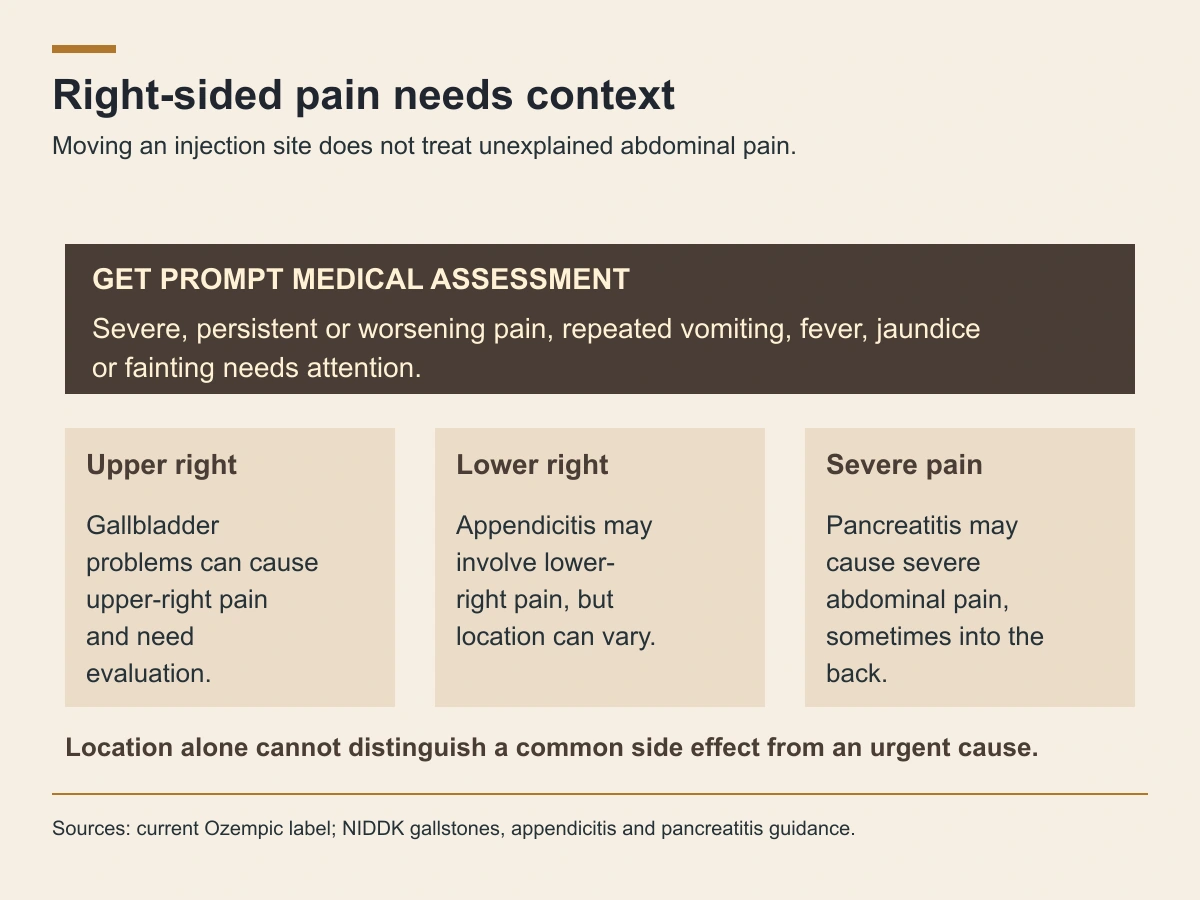
Right-sided abdominal pain while taking Ozempic should be assessed according to its severity, duration, and accompanying symptoms. The location alone cannot tell you whether the cause is a gallbladder problem, appendicitis, pancreatitis, constipation, or something else. Severe, persistent, or worsening pain deserves prompt medical attention rather than an assumption that it is a routine side effect.
Seek care right away if pain occurs with repeated vomiting, fever or chills, yellowing of the skin or eyes, fainting, breathing difficulty, or an inability to keep fluids down. Suspected appendicitis is a medical emergency. Ozempic’s prescribing information also directs discontinuation and appropriate management if pancreatitis is suspected. Ozempic prescribing information, NIDDK appendicitis guidance, NIDDK gallstone guidance.
This article explains the questions that help a clinician evaluate the symptom. It is not a way to diagnose abdominal pain at home.
Why “right side” is useful information but not a diagnosis
The right upper abdomen and the right lower abdomen are different locations. Tell the clinician which area hurts, whether you can point to it, and whether the pain has moved. Also describe whether it began suddenly, comes and goes, or is present continuously.
Several conditions can have overlapping symptoms. NIDDK notes that gallstone symptoms can resemble appendicitis, ulcers, pancreatitis, and reflux. Even a location commonly associated with one condition cannot confirm that condition without an assessment. NIDDK gallstone guidance.
The timing relative to Ozempic is another detail, not proof of the cause. A new prescription or dose change may be relevant, but an unrelated condition can occur during treatment. Waiting because “the medicine must be doing this” can delay care for a problem that needs another response.
If you are unsure how serious the episode is, contact a clinical service promptly. You do not need to identify the organ involved before asking for help.
Right upper abdominal pain and gallbladder questions
Gallbladder attacks commonly cause pain in the upper right abdomen. NIDDK describes episodes that may last several hours and often occur after heavy meals, in the evening, or at night. Those patterns help guide questions but do not prove that a particular episode is gallbladder disease. NIDDK gallstone guidance.
Ozempic’s current label reports acute gallbladder events, including gallstones and gallbladder inflammation, in GLP-1 receptor agonist trials and postmarketing reports. It states that suspected gallstones warrant gallbladder studies and appropriate clinical follow-up. Ozempic prescribing information.
Tell the clinician about fever, nausea or vomiting, jaundice, dark urine, or unusually pale stools. NIDDK identifies these as warning signs during or after a gallbladder attack. Pain lasting hours also needs attention. Do not wait for every sign to be present before seeking care.
Do not respond to suspected gallbladder disease by starting a “bile support” or gallbladder-cleanse product. A supplement cannot establish whether a duct is blocked or replace the assessment described in the product label and digestive-disease guidance.
Right lower pain and appendicitis questions
Appendicitis often involves pain that starts near the belly button and moves toward the lower right abdomen. NIDDK notes that the pain may worsen over hours and become worse with movement, deep breathing, coughing, or sneezing. Some people do not have the typical pattern. NIDDK appendicitis guidance.
Loss of appetite, nausea, vomiting, fever, or abdominal swelling may also occur. Constipation or diarrhea can occur too, so a bowel symptom does not automatically rule appendicitis out.
The key point is the need for assessment. Do not use an online location diagram, a change in bowel habits, or whether you recently took Ozempic to decide that appendicitis is impossible. NIDDK describes suspected appendicitis as a medical emergency requiring immediate care. NIDDK appendicitis guidance.
Avoid trying to reproduce the pain by repeatedly pressing the abdomen or testing movements. Describe what has happened and let a clinician decide which examination and tests are appropriate.
How pancreatitis fits into the discussion
Pancreatitis is inflammation of the pancreas. NIDDK describes upper abdominal pain that may spread to the back, along with symptoms such as nausea, vomiting, fever, a fast heartbeat, and a tender or swollen abdomen. Severe or worsening symptoms need prompt care. NIDDK pancreatitis guidance.
Ozempic’s prescribing information warns about acute pancreatitis and directs discontinuation if it is suspected, with appropriate management. The pain may be persistent or severe and may occur with or without nausea or vomiting. Ozempic prescribing information.
This warning does not mean every right-sided ache is pancreatitis. It also does not mean vomiting must be present before pancreatitis can be considered. Location, accompanying symptoms, history, and clinical findings must be assessed together.
If you have a concerning pain pattern, seek urgent assessment and tell the clinical team that you take Ozempic. They can provide medicine instructions as part of that assessment. Do not keep increasing the dose while waiting to see whether severe pain becomes a familiar side effect.

A comparison of questions, not a self-diagnosis chart
| Possible issue a clinician may consider | Details that can be relevant | Important limit |
|---|---|---|
| Gallbladder disease | Upper right pain, meal timing, fever, jaundice, dark urine or pale stools | Location or a meal trigger does not confirm a blocked duct |
| Appendicitis | Pain moving toward the lower right, worsening over hours, nausea or fever | Atypical symptoms occur; bowel symptoms do not exclude it |
| Pancreatitis | Persistent or severe upper abdominal pain, sometimes extending to the back | Vomiting is not required for the label warning to matter |
| Common gastrointestinal effects | Nausea, constipation, diarrhea, bloating, recent treatment changes | A known side effect does not explain every new or localized pain |
This is not a complete list of abdominal conditions. It illustrates why a clinician asks about the whole episode rather than matching one location to one diagnosis.
If bleeding is also present, read our guide to blood in stool during Ozempic treatment. It explains why visible blood should not be assumed to be a routine adjustment or automatically attributed to constipation.
Could it be constipation, gas, or another digestive effect?
Ozempic’s label lists nausea, vomiting, diarrhea, abdominal pain, and constipation among common adverse reactions. It also warns that gastrointestinal reactions can sometimes be severe and that the medicine is not recommended in patients with severe gastroparesis. Ozempic prescribing information.
For a mild, familiar digestive symptom, the clinician may ask about meals, bowel movements, fluid intake, and dose changes. That does not justify labeling worsening localized pain as “just gas.” A change in the pattern matters, especially when pain persists or appears with vomiting, fever, or significant abdominal swelling.
Our semaglutide nausea and vomiting guide explains useful symptom questions and warning signs. The existing GLP-1 constipation guide covers bowel-related questions. Neither guide should delay urgent assessment for a new concerning abdominal episode.
If you are unsure whether symptoms have crossed from manageable to concerning, describe the change to your clinician. How the pain affects sleep, eating, walking, or ordinary activity is relevant information.
Vomiting and poor fluid intake need their own attention
Abdominal pain is not the only issue if you are also repeatedly vomiting or unable to maintain fluids. Ozempic’s label warns about kidney injury related to volume depletion, often in people with nausea, vomiting, or diarrhea. It calls for monitoring when adverse reactions may cause dehydration, particularly during treatment initiation and escalation. Ozempic prescribing information.
Tell the clinical team if you are urinating much less, cannot keep drinks down, feel markedly weak or faint, or have other signs of significant illness. Severe symptoms need care rather than an attempt to solve everything with a different snack or drink.
If you use insulin or a sulfonylurea, explain that too. Illness and reduced eating can make diabetes management more complicated. Your clinicians should know the complete medication list when assessing pain and intake.
Once an urgent issue has been addressed, balanced meal planning and the semaglutide protein and muscle guide may help with longer-term nutrition questions. They are follow-up resources, not treatments for an undiagnosed acute abdomen.
Should you change or hold the next Ozempic dose?
There is no universal rule for every kind of right-sided pain. The response depends on what the clinician suspects, how unwell you are, and the product’s specific safety directions.
The label gives a clear discontinuation instruction for suspected pancreatitis. Other problems have their own assessment and management requirements. Contact the prescribing team or the service evaluating you for instructions; do not replace that conversation with a blanket internet rule to continue, stop, or restart. Ozempic prescribing information.
Do not take an extra dose, escalate sooner, or compensate for a held dose on your own. If a dose is missed or treatment is interrupted during evaluation, ask how to resume after the assessment. Our missed semaglutide dose and restart guide explains why the exact product and time gap matter.
The priority during severe or worsening pain is obtaining care. A question about the next weekly dose should not delay emergency evaluation.

Details to share when you contact the clinician
Have the following information available if you can collect it without delaying care:
- Where the pain began and where it is now.
- When it started, whether it is constant, and whether it is worsening.
- Whether it extends to the back or changes with movement.
- Fever, vomiting, jaundice, bowel changes, or difficulty maintaining fluids.
- The exact Ozempic strength, last dose date, and recent dose changes.
- Other medicines, previous gallbladder or pancreatic problems, and relevant medical history.
Bring the dispensing label if there is any uncertainty about the product. A pen, a prefilled syringe, and a compounded vial require their own identification; the name of the active ingredient alone does not describe all directions.
You do not need to decide which test to request. The clinician can determine the examination, laboratory work, imaging, and follow-up based on the findings.
Common questions about right-sided pain on Ozempic
Is upper right pain always the gallbladder?
No. It is a location associated with gallbladder attacks, but symptoms overlap with other conditions. Persistent pain or associated warning signs need assessment. NIDDK gallstone guidance.
Can constipation occur with appendicitis?
Yes. NIDDK lists constipation or diarrhea among bowel symptoms that can occur with appendicitis. A bowel symptom should not be used to dismiss a worsening lower-right pain pattern. NIDDK appendicitis guidance.
Will injecting into the thigh fix abdominal pain?
A permitted injection site is not a treatment for an unexplained abdominal symptom. Ozempic is injected under the skin; choosing a different approved site does not diagnose or resolve a gallbladder, pancreatic, or other abdominal condition. Follow the product’s site instructions and seek assessment for concerning pain. Ozempic prescribing information.
Does pain prove my dose is too high?
No. The dose and timing are useful information, but pain alone cannot establish the cause or the correct adjustment. Tell the clinician what changed and follow the instructions given after assessment.
Where can I read more about treatment follow-up?
Use the semaglutide questions guide and CoreAge Rx’s semaglutide service information for longer-term questions. Acute, severe, or worsening abdominal pain should be addressed through medical care first.
Educational information for adults; individual treatment decisions require a qualified clinician. Sources reviewed October 2, 2026. Original AI-generated article images depict fictional people and objects, not patient outcomes. Other editorial images are illustrative. Graphics summarize the cited sources.