Read a greens powder label from the serving size downward. The most useful information is usually in the Supplement Facts and other-ingredients sections, where you can see what one serving contains. Front-label words such as “daily wellness” do not tell you the amounts.
Step 1: identify the serving
Check how many scoops make one serving and how much powder that represents. Green Scene’s pictured label uses one 5.6 g scoop. Its container has 30 servings. Those numbers describe the product’s intended serving, not a recommendation to add extra scoops when you miss vegetables at lunch.
Use the scoop supplied with the product and the current directions. A scoop borrowed from protein powder or another greens blend is not a reliable substitute.
Step 2: separate blend weight from nutrients
Green Scene lists a 4.5 g proprietary greens blend. It separately lists less than 1 g dietary fiber, 20 calories, and 0 g added sugars. A 4.5 g blend does not provide 4.5 g of every ingredient, nor does it establish 4.5 g of fiber.
The FDA’s labeling guidance explains that a proprietary blend may show a total quantity while listing ingredients without individual amounts. This limits comparisons with studies that use a specified amount of one ingredient.

Step 3: read the other ingredients
The pictured label includes maltodextrin, natural fruit punch flavor, citric acid, malic acid, silica, and rebaudioside A, a stevia leaf extract. These details can matter for flavor preferences, sensitivities, and understanding why a product tastes sweet despite 0 g added sugars.
An “other ingredient” is not automatically a problem. The point is to know what is there rather than assuming the tub contains only dried vegetables.
Step 4: interpret quality claims precisely
Organic, FDA-registered facility, and third-party tested describe different things. Do not use one as proof of another. The FDA supplement overview explains that supplements are not preapproved for safety and effectiveness like drugs.
For independent testing, look for the specific certifier or a clear explanation of the testing performed. If you cannot verify the claim, keep it as an unanswered question rather than inventing a seal or certification.
Step 5: check directions and cautions
Green Scene’s pictured directions call for one scoop daily in 8–16 oz cold water or a favorite beverage. The label calls for cool, dry storage and consultation in relevant medical circumstances. Check your current bottle for changes.
Save a label photo with your supplement list. If you are comparing products, use the same five checks for each. Our organic and quality guide and greens-versus-multivitamin comparison help with the next step.
Read the panel in an order that prevents common mistakes
Start at the serving size, because every amount below it refers to that serving. Then move to the nutrient amounts, followed by the blend information and other ingredients. Finish with directions, cautions, storage, and manufacturer details. This order keeps the large front-panel claims from deciding the interpretation before you see the numbers.
A common mistake is to begin with the longest ingredient list and assume that more names mean more nutrition. Another is to see a large blend weight and record it as dietary fiber. Reading in a consistent order makes those errors easier to catch.
Keep a photograph of the complete panel when comparing products. A cropped image may show the attractive ingredient names while leaving out serving size or directions. If the information is difficult to read, ask the seller or manufacturer for a clearer current label rather than filling the gaps with assumptions.
Work through the Green Scene numbers
The reviewed serving is one 5.6 g scoop. Within that serving, the label lists a 4.5 g proprietary greens blend. It separately lists less than 1 g dietary fiber, 20 calories, and 0 g added sugars. Each figure answers a different question.
The 5.6 g number describes total powder weight. The 4.5 g number describes the combined weight of the seven blend ingredients. The fiber line describes the disclosed dietary-fiber contribution. None of these values should be substituted for another simply because all involve grams.
The difference between the serving weight and blend weight also does not allow you to calculate each other ingredient’s amount. A label can disclose some totals without providing the full formula by weight. Use the information available and keep undisclosed details identified as unknown.
Understand a proprietary blend without guessing its recipe
A proprietary blend provides a combined amount for listed ingredients while withholding individual amounts. That can identify what is included but limits how precisely each ingredient can be compared with research. The FDA labeling guidance explains the relevant labeling framework.
For Green Scene, dividing 4.5 g by seven would produce an arithmetic average, not the actual amount of each plant. The ingredients need not be present in equal quantities. Likewise, the first ingredient’s position should not be turned into an exact gram estimate.
This distinction becomes important when an article cites research on a particular plant extract. The study may have used a known amount, a different preparation, or a different population. A shared ingredient name is only the first step in a comparison, not proof that the blend supplies a matching dose.
Use the other-ingredients list as practical information
Green Scene’s reviewed other ingredients include maltodextrin, natural fruit punch flavor, citric acid, malic acid, silica, and rebaudioside A from stevia leaf extract. This information helps explain the product’s formulation and gives readers specific names to review for personal tolerances or restrictions.
The list should not be treated as automatically good or bad because it contains familiar or unfamiliar words. The practical questions are whether an ingredient matters to your allergy history, dietary restrictions, medicine review, or previous symptoms. Those questions may require manufacturer information or professional advice.
Also avoid assuming “0 g added sugars” means there are no flavoring or sweetening ingredients. The reviewed panel lists rebaudioside A, for example. A nutrient line and an ingredient list answer different questions and should be read together.
Separate manufacturing, certification, and effectiveness
| Claim type | What to verify | What it does not automatically establish |
|---|---|---|
| Organic | The applicable wording and certification | A specific clinical benefit |
| Facility registration | What facility and registration are referenced | FDA approval of supplement effectiveness |
| Independent testing | The test scope, product, and available documentation | That every possible contaminant or outcome was assessed |
| Ingredient research | The form, amount, population, and outcome studied | Equivalent results from an undisclosed blend |
| Finished-product research | Whether the exact formula was studied | Guaranteed results for every person |
This table can prevent several attractive claims from being blended into one vague impression of quality. Each claim deserves its own supporting information.
Read directions as instructions for this product
The reviewed Green Scene directions specify one scoop daily in 8–16 oz of cold water or a favorite beverage. They do not establish that two scoops replace more vegetables or that a larger amount works faster. Follow the current bottle rather than combining advice from unrelated powders.
Storage instructions also matter. A dry scoop, a closed container, and an appropriate storage location help preserve the intended handling conditions. If the product has been exposed to unusual heat or moisture, ask the manufacturer about the specific situation instead of assuming the printed expiration date answers every storage question.
When taking medicines or managing a medical condition, bring the full label into the review. A generic statement that you use “greens” is less helpful than the exact formula and daily amount.
Frequently asked questions
Can I calculate the amount of each plant from the blend weight?
Not from the reviewed label. Equal division would be a mathematical assumption, not a disclosed formula. Ask the manufacturer if a specific ingredient amount is important to your decision.
Does “less than 1 g fiber” mean I should record 1 g?
Keep the qualifier. The label states less than 1 g, not a full gram. If exact intake is important to a clinical plan, discuss how to record that information rather than replacing it with a more convenient number.
Does the order of ingredients prove a study dose?
No. Ingredient order does not provide the exact amount needed for a dose comparison. A research claim requires attention to the ingredient form, amount, and study conditions, not just whether the name appears on the panel.
What should I do if the website and bottle disagree?
Use the current bottle for the product you received and ask the manufacturer to clarify the discrepancy. Retain photographs and lot information. Do not average conflicting directions or assume the more generous serving is correct.
Explore Green Scene™
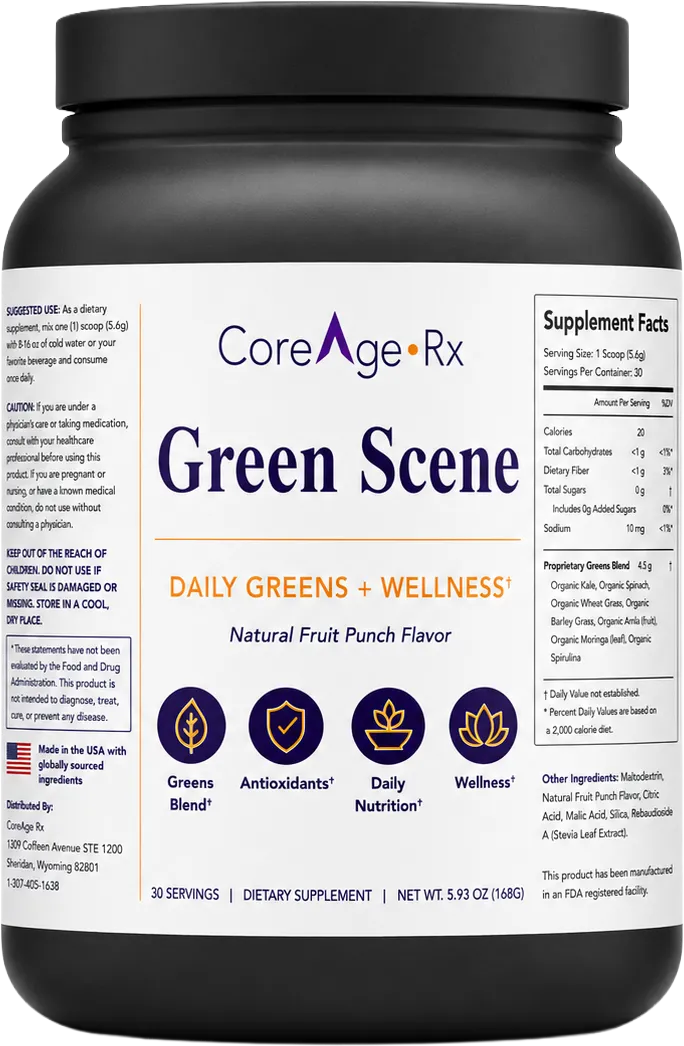
Green Scene is CoreAge Rx’s fruit punch greens powder. The pictured label lists a 4.5 g proprietary greens blend and less than 1 g of dietary fiber per scoop. See the current Green Scene™ page and check the bottle you receive before use.
Related reading
- Greens Powder: What It Can Add and What It Cannot Replace
- Greens Powder Ingredients: What Those Plant Names Tell You
- Do Greens Powders Have Enough Fiber?
- Fruit choices in a balanced weight-management plan
Educational information, not individualized medical advice. Product information and linked research checked September 15, 2026. Ingredient research does not establish identical effects for a finished supplement.