
Some greens powders contain fiber, but the amount varies by product. Read the “dietary fiber” line rather than using the total scoop weight or greens-blend weight. Green Scene’s pictured label lists less than 1 g of dietary fiber per scoop.
Three weights that are easy to confuse
| Green Scene label item | Listed amount | Meaning |
|---|---|---|
| Total serving | 5.6 g | Weight of one scoop of powder |
| Proprietary greens blend | 4.5 g | Combined weight of the blend ingredients |
| Dietary fiber | Less than 1 g | The disclosed fiber contribution |
Those numbers cannot be substituted for one another. The blend includes plant material; it is not a statement that the entire blend is dietary fiber. The FDA’s labeling guidance explains the distinction between a blend declaration and separately listed nutrients.
Put the amount in a daily context
The NIDDK nutrition guide gives a general adult fiber range of 22–34 g daily depending on age and sex, and recommends increasing intake gradually. Individual targets may differ, particularly with digestive conditions or clinician-directed diets.
Against that broad range, less than 1 g is a modest contribution. It cannot fill a substantial fiber gap by itself. Do not take several extra scoops to chase a daily fiber target; that changes the amounts of every ingredient and exceeds the pictured one-scoop routine.

What to do if you want more fiber
First look at the foods you already eat. Oats, beans, lentils, fruits, vegetables, nuts, and whole grains can supply fiber in different ways. Add manageable portions and pay attention to comfort, rather than making a sudden large change.
Use how much fiber per day for a food-focused planning approach. If you are considering a separate supplement, the fiber supplement guide explains why ingredient type and dietary-fiber grams matter more than capsule counts.
Greens and fiber supplements have different roles
A greens blend is often chosen for convenience or a preferred daily drink. A fiber supplement is evaluated for a different nutritional or digestive purpose. Even then, a fiber-containing blend with undisclosed amounts should not be assumed to match a studied dose of isolated psyllium.
Avoid stacking products simply because both use “gut health” language. Review the combined routine, water intake, and any medication timing with your care team when relevant.
A practical way to record it
If you track food intake, use the label’s “less than 1 g” information rather than entering 4.5 g. Keep the uncertainty visible instead of inventing a precise number. Check the bottle you receive for the current panel, and pair a greens drink with meals rather than treating it as a replacement for vegetables or a complete fiber plan.
Use the dietary-fiber line as the measurement
The simplest way to avoid confusion is to ask which number is explicitly labeled dietary fiber. The serving weight and blend weight describe other things. A powder can be made from plants without its entire weight qualifying as dietary fiber.
Green Scene provides a clear example: the reviewed panel lists a 5.6 g scoop, a 4.5 g greens blend, and less than 1 g dietary fiber. If you are keeping a fiber record, the last number is the relevant disclosed contribution. Recording 4.5 g or 5.6 g as fiber would overstate what the label says.
This is not unique to greens products. Food weight, ingredient weight, and nutrient weight are different throughout nutrition labeling. Once you recognize the distinction, comparisons among foods, powders, and capsules become much easier.
Work through a simple label calculation
Imagine a food label lists 4 g dietary fiber in the portion you ate, and a second food lists 3 g. Those two disclosed amounts add to 7 g. If you also use Green Scene as directed, its reviewed contribution remains less than 1 g; it does not turn into the full blend weight because it was added to a fiber-containing meal.
The example demonstrates arithmetic, not a recommended meal or daily target. Your appropriate intake depends on age and other circumstances, and a clinician or dietitian can help when a medical condition affects the plan. The NIDDK guidance provides general adult context and emphasizes gradual increases.
Keep unknown amounts distinct from known ones. If a homemade meal’s fiber is not yet estimated, record the foods and portions rather than inventing an exact total. A rough but honest food record is more useful than a precise-looking number built from the wrong label lines.
Identify why fiber intake may be low
Low intake can result from a narrow food pattern, frequent skipped meals, limited access to convenient foods, low appetite, or restrictions that remove several usual sources. Each situation calls for a different practical solution. Adding a low-fiber greens powder may leave the original barrier unchanged.
For someone who rarely has time to cook, convenient beans, oats, fruit, or vegetables may be worth considering according to preferences and tolerance. For someone with low appetite, portions and meal timing may need a more individualized review. For someone avoiding foods because of symptoms, a dietitian can help prevent unnecessary restriction.
The goal is to identify a few repeatable changes that fit the day. It is usually more useful to know where fiber-containing foods can fit than to search for a single product that appears to replace the entire food pattern.
Compare greens and dedicated fiber products fairly
A greens powder and a fiber supplement can have different purposes and different label disclosures. Do not assume the greens category is high in fiber or that every fiber-labeled product states an equivalent amount of dietary fiber.
Full House, for example, lists a 1,525 mg proprietary blend per two capsules. That is not a stated dietary-fiber amount and should not be treated as 1.525 g of dietary fiber. The same discipline used for Green Scene applies: read what the number actually describes.
The fiber supplement guide explains how to compare types and formats. If a supplement is being considered for constipation or another symptom, the relevant ingredient, amount, directions, and health context deserve attention beyond the front-of-bottle category.
Add fiber thoughtfully rather than all at once
If you are increasing food fiber, a gradual approach can make the change easier to tolerate. Review fluid needs and any medical restrictions with your care team. The NIDDK advice discusses adding fiber over time rather than making an abrupt large increase.
Do not introduce several high-fiber foods, a fiber supplement, and a new greens drink simultaneously if you are trying to understand tolerance. A large bundle of changes makes it difficult to know what helped or what caused discomfort. Keep a simple record of the main changes and how you feel.
Persistent constipation, significant pain, vomiting, or other concerning symptoms should not be managed solely by increasing a label total. Fiber is one part of a broader assessment, and more is not automatically the correct response to every digestive problem.
Make a food-first worksheet that is easy to use
| Meal or snack | What to note | Possible next question |
|---|---|---|
| Breakfast | Foods and usual portions | Is there a tolerated fiber-containing food I could include? |
| Lunch | What is actually eaten on busy days | Does convenience prevent a balanced meal? |
| Dinner | Vegetables, legumes, grains, and portions | Is variety realistic across the week? |
| Snacks | Foods chosen regularly | Could a preferred fruit or another suitable option fit? |
| Supplements | The actual dietary-fiber disclosure | Am I counting blend weight by mistake? |
The worksheet is a conversation aid. It does not require perfect tracking or a sudden overhaul of every meal. Start with the changes that are both meaningful and practical.
Frequently asked questions
Can I take several scoops to get more fiber?
Do not exceed Green Scene’s directions to pursue a fiber target. Increasing the serving changes all ingredients, and the product is not a substitute for an appropriate food or fiber plan. Use the current label and discuss a specific need with a professional.
Does the powder’s green color tell me anything about fiber grams?
No. Color is not a quantitative fiber measurement. The dietary-fiber line is the relevant disclosure, and Green Scene’s reviewed panel states less than 1 g per scoop.
Should I count the exact amount as zero?
The reviewed label says less than 1 g, which is not an exact zero or an exact one. Preserve that information. If a clinical plan requires a particular tracking method, ask the professional managing it how to record the amount.
Will enough fiber automatically solve bloating?
No. Bloating has multiple possible causes, and increasing fiber rapidly can itself be uncomfortable for some people. Review symptoms and the overall routine rather than treating a larger daily total as a universal solution.
Explore Green Scene™
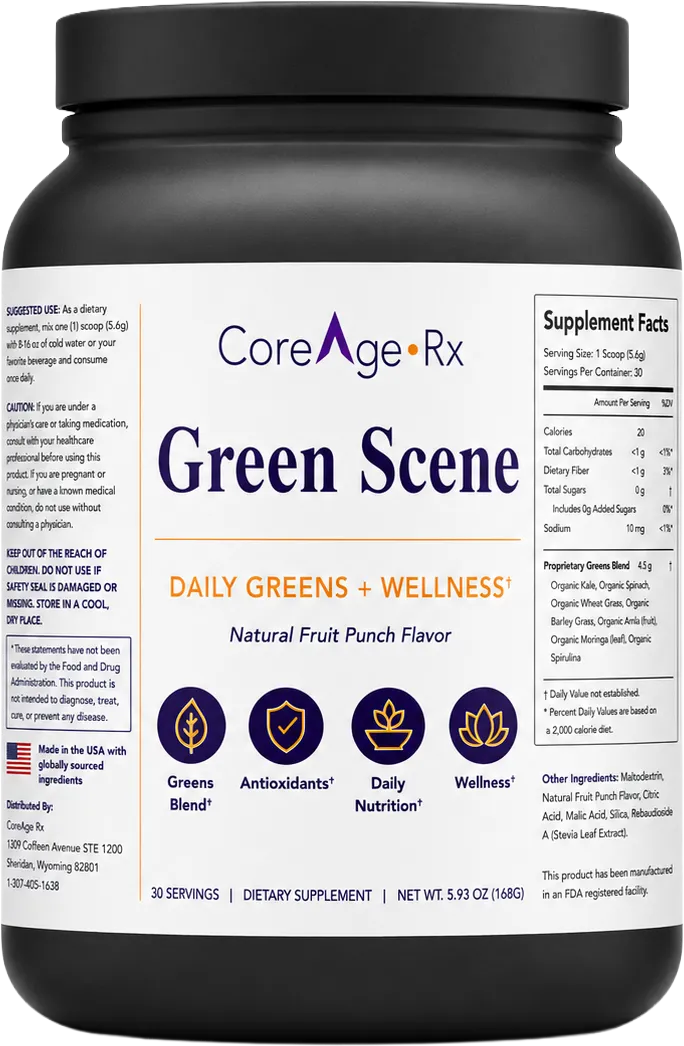
Green Scene is CoreAge Rx’s fruit punch greens powder. The pictured label lists a 4.5 g proprietary greens blend and less than 1 g of dietary fiber per scoop. See the current Green Scene™ page and check the bottle you receive before use.
Related reading
- Greens Powder: What It Can Add and What It Cannot Replace
- Greens Powder vs. Vegetables: Can a Scoop Replace a Serving?
- How to Read a Greens Powder Label
- Fruit choices in a balanced weight-management plan
Educational information, not individualized medical advice. Product information and linked research checked September 15, 2026. Ingredient research does not establish identical effects for a finished supplement.