“Organic” and “quality tested” answer different questions about a greens powder. Organic labeling concerns how agricultural ingredients are produced and handled. It does not, by itself, establish a clinical benefit, a contaminant-free product, or an independent sports certification.
What organic labeling means
USDA distinguishes products labeled “100 percent organic,” “organic,” and “made with organic” ingredients. The categories have different composition requirements and rules for use of the USDA seal. The USDA labeling guide explains those distinctions.
Do not treat an organic ingredient in a blend as proof that every part of the finished formula carries the same certification. Check the exact wording and any certifying organization on the current package.
What Green Scene shows
The pictured Supplement Facts panel identifies the seven plants in its proprietary blend as organic. The other-ingredients section also lists flavoring, maltodextrin, acids, silica, and rebaudioside A. A fair product description should preserve that distinction instead of shortening the entire formula to “only organic vegetables.”
The public materials reviewed here do not establish a named independent certification for every possible quality claim. If a particular certification matters to you, ask for current documentation covering the finished product.
Separate the testing questions
| Question | Evidence to look for |
|---|---|
| Does the product contain the stated ingredients? | Identity and content testing information |
| Was it checked for relevant contaminants? | Clear testing scope and applicable results |
| Is a sports certification claimed? | The certifier’s listing for that exact product |
| Is it organic? | The applicable organic statement and certification |
| Does it produce a health result? | Suitable human evidence for the formula and outcome |
One answer does not settle the other questions. A contaminant test is not a clinical trial, and a clinical trial of one ingredient is not a certification of a different finished blend.
FDA registration is not product approval
Green Scene’s pictured label mentions manufacture in an FDA-registered facility. The FDA’s supplement guidance explains that dietary supplements are not approved for safety and effectiveness before marketing in the way drugs are. Do not turn a facility statement into “FDA-approved greens.”
Make a practical purchase checklist
Read the complete label, serving size, current directions, and ingredient amounts. Decide which documentation is relevant to your needs, such as strict allergen avoidance or competitive-sport requirements. Keep unanswered questions visible rather than filling them in with assumptions.
Our label-reading article and Green Scene product guide can help organize that comparison. Quality language is useful when it is specific enough to verify.
Treat organic status as one question among several
Organic labeling concerns applicable production, handling, and labeling requirements. It is meaningful information when properly supported, but it does not answer every question about a supplement. Ingredient identity, contaminant testing, nutrient amounts, and clinical effectiveness remain separate topics.
This distinction helps avoid two oversimplifications: assuming organic means a product has demonstrated every desired health benefit, or assuming the term has no meaning at all. The useful approach is to verify the actual claim and then ask the other questions independently.
The USDA organic-labeling guidance explains the relevant framework. Read the wording carefully, because a statement about certain organic ingredients is not automatically the same as every possible whole-product claim.

Examine the wording on the current product
Green Scene’s reviewed ingredient panel lists organic versions of seven plant ingredients. That identifies the wording shown for those ingredients. When evaluating a broader certification claim, look for the applicable certification information and verify what it covers.
Do not extend a claim from one product to an entire brand or from one ingredient to every ingredient in the formula. The other-ingredients list is a separate part of the label and should remain visible in the comparison.
If the website, container, or a retailer uses different wording, ask the manufacturer to clarify. Retain a photograph of the current product and lot information. A clear answer about the exact item is more useful than a general statement that the company values quality.
Ask what testing actually examined
Testing can address different questions: whether the ingredients are correctly identified, whether stated amounts are present, or whether particular contaminants were assessed. A document that answers one question should not be treated as a universal certificate for all possible questions.
Look for the product identity, the scope of testing, the date or lot connection when relevant, and the organization responsible. If a claim is described as independent testing, ask what “independent” means in that context and what information is available to support it.
An absence of publicly posted documents does not prove a particular test was never performed. It does mean a consumer cannot verify the claim from those materials alone. Keep that distinction honest: request the information rather than either endorsing or condemning a claim without evidence.
Separate product quality from clinical effectiveness
A product can be manufactured consistently and still lack evidence for a particular advertised outcome. Conversely, an ingredient can have research behind it while the exact amount or preparation in a finished product remains unclear. These are different layers of evaluation.
For Green Scene, the reviewed panel provides a 4.5 g proprietary blend but does not disclose each plant’s amount. That limits comparisons with studies using a known amount of one ingredient. Organic wording does not fill the dosing gap or establish that the finished blend has demonstrated the same result.
If a seller cites research, ask whether it studied the exact formula, a single ingredient, or a different preparation. Then check whether the measured outcome matches the claim. A general discussion of antioxidant compounds does not by itself establish a detoxification or weight-loss benefit.
Use a document request that is specific enough to answer
| Question | A focused request |
|---|---|
| Is this exact product certified organic? | The applicable certifier and product information |
| Which ingredients are covered by the wording? | Clarification of the current label claim |
| Has the product been tested for a particular concern? | The relevant testing scope and available results |
| Is an independent certification claimed? | A listing or verification for the exact product |
| Does it match a cited study? | Ingredient preparation, amount, and study reference |
Specific requests are easier for a manufacturer to answer than “Is this high quality?” They also make it easier to see which parts of the decision remain unresolved.
Understand facility and FDA language
The FDA’s supplement guidance explains that dietary supplements are not approved for effectiveness in the same way as drugs before they are marketed. A statement about facility registration should not be interpreted as FDA approval of a supplement’s claimed benefits.
Read manufacturing language literally. Which facility or standard is referenced? Does the statement concern production practices, registration, or a specific inspection? Does it actually say anything about the exact product’s effect in humans? Avoid letting several official-sounding phrases merge into a conclusion they do not support.
This is not a reason to ignore manufacturing information. It is a reason to assign it the right role. Production practices and health-outcome evidence both matter, but they answer different questions.
Build a practical purchase decision
Once the claims are separated, consider the ordinary features: the disclosed serving, flavor, storage needs, current price, and whether the product has a clear purpose in your routine. A more expensive or more heavily marketed product is not automatically a better fit.
If a particular quality question is essential because of an allergy, medical restriction, or sport requirement, resolve it before relying on the product. If the reason for purchase is simply a convenient drink, assess that honestly without adding unsupported clinical expectations.
Keep the current label and any relevant manufacturer response. Formulations and claims can change, so an old review should not override new information on the product you actually receive.
Frequently asked questions
Does organic mean contaminant-free?
Do not interpret organic wording as a guarantee that every possible contaminant is absent. Ask separately about relevant testing and what the available documentation covers. Certification and testing questions should remain distinct.
Does third-party testing prove the product works?
Testing for identity, amounts, or contaminants is different from clinical research on a health outcome. Read the scope. A product can have testing documentation without having demonstrated every benefit described in marketing.
Is a logo enough to verify certification?
A logo is a starting point. When a certification matters to your decision, verify the exact product through the certifying organization’s information and check the scope. Do not assume a brand-level statement applies automatically to every item.
What if the manufacturer gives only a general quality statement?
Ask the specific question again in terms of the product and information you need. If the answer remains general, keep the limitation visible in your decision. A confident statement does not replace the particular documentation you were seeking.
Explore Green Scene™
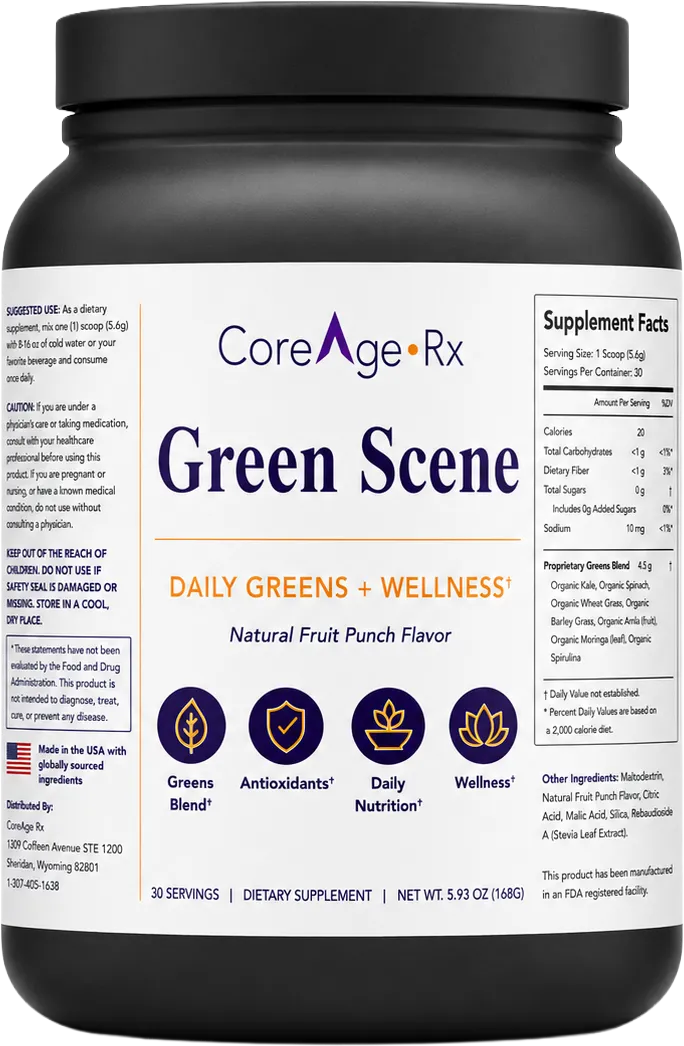
Green Scene is CoreAge Rx’s fruit punch greens powder. The pictured label lists a 4.5 g proprietary greens blend and less than 1 g of dietary fiber per scoop. See the current Green Scene™ page and check the bottle you receive before use.
Related reading
- Greens Powder: What It Can Add and What It Cannot Replace
- How to Read a Greens Powder Label
- Greens Powder Ingredients: What Those Plant Names Tell You
- Fruit choices in a balanced weight-management plan
Educational information, not individualized medical advice. Product information and linked research checked September 15, 2026. Ingredient research does not establish identical effects for a finished supplement.