Plant names on a greens label tell you what ingredients are included. They do not, by themselves, tell you the amount of each plant, the nutrient content of the finished serving, or the clinical effect of taking it. Those are separate questions.
The seven plants in Green Scene
| Ingredient on the pictured label | What the name identifies |
|---|---|
| Organic kale | A leafy vegetable ingredient |
| Organic spinach | A leafy vegetable ingredient |
| Organic wheat grass | A grass ingredient |
| Organic barley grass | A grass ingredient |
| Organic amla fruit | A fruit ingredient |
| Organic moringa leaf | A leaf ingredient |
| Organic spirulina | An algae-derived ingredient |
Together, these make up a 4.5 g proprietary blend per scoop. The pictured label does not give a separate quantity for each. It is therefore not possible to tell from that panel whether any ingredient matches an amount used in a particular study.
Why a familiar food name is not a nutrient measurement
Seeing spinach does not establish the exact iron content. Seeing a fruit ingredient does not establish a specified vitamin C amount. Processing, the amount used, and the finished formulation all matter. FDA labeling guidance helps explain the information available for a proprietary blend.
This is not an argument that plants lack value. It is a reason to separate a food’s general nutritional reputation from a quantified claim about a small supplement serving. The USDA vegetable guide describes whole-food choices that can remain part of your meals.

Check the ingredients outside the blend
Green Scene’s pictured other-ingredients list includes maltodextrin, fruit punch flavor, citric acid, malic acid, silica, and rebaudioside A. Those ingredients help explain the flavor and powder format. A product can have 0 g added sugars while still tasting sweet.
If you react to a new drink, share the complete list with your clinician rather than focusing only on the most prominent plant on the front. A bloating review should consider the entire routine, including what you mix into the drink.
Allergens and individual restrictions
Do not infer that a blend is safe for every allergy or dietary restriction from the words “plant-based” or “organic.” If you need strict gluten avoidance or have an ingredient allergy, obtain the current finished-product information and appropriate professional advice. Ingredient names alone do not verify contamination controls or a certification.
Use the list to ask better questions
Ask about individual amounts, the nutrients actually quantified, and the tests relevant to your needs. Then decide whether the product adds something practical to your routine. The label-reading guide and Green Scene overview put those details together without assigning unsupported benefits to each plant.
A plant name is a starting point for identification
An ingredient list tells you which materials the formula includes. It does not necessarily tell you the amount of each plant, its complete nutrient contribution, or whether the preparation matches a research intervention. Those are additional questions that require additional information.
This is especially relevant when familiar foods appear in a concentrated or powdered product. Seeing kale or spinach may bring a full serving of the food to mind, but the product’s actual serving is much smaller and the individual amounts may be undisclosed. Keep the food association separate from the measurable contents of the scoop.
For Green Scene, the seven plants sit within a 4.5 g proprietary blend. That gives a combined weight, not seven individual doses. The ingredient list can guide questions without supporting a precise nutrient calculation for every plant.
Distinguish different types of ingredient information
There are several levels of detail a label or manufacturer may provide: the common plant name, the plant part, the preparation, the amount, and any specification relevant to testing. Each level can make a research comparison more or less informative.
For example, a leaf powder and a standardized extract should not automatically be treated as the same intervention. Even when they originate from the same plant, preparation and dose can differ. A study of one form cannot be transferred to another solely because the familiar name is shared.
If a specific claimed benefit matters to you, ask which ingredient and preparation supposedly supports it. Then look for evidence that matches the amount and outcome. This is more useful than collecting a separate benefit claim for every word in the ingredient list and adding them together as if the finished formula had demonstrated all of them.
Read the seven-plant blend as a blend
Green Scene lists organic kale, spinach, wheat grass, barley grass, amla fruit, moringa leaf, and spirulina. These names identify a mixture of leafy vegetables, grasses, a fruit ingredient, a leaf ingredient, and an algae-derived ingredient. They do not establish the proportion of each component.
The combination may be appealing to someone who wants a convenient plant-based drink. That preference can be assessed on its own. It does not require claiming that the blend duplicates a vegetable serving, supplies a complete multivitamin, or provides clinically tested doses of all seven components.
Avoid equal-division calculations. A 4.5 g total divided by seven names is not a recipe. The actual proportions could differ, and the reviewed materials do not resolve them. If an individual ingredient is central to your decision, that missing amount is a meaningful question for the manufacturer.
Do not overlook the formulation outside the blend
Flavor, sweetness, acidity, and powder handling are influenced by ingredients outside the botanical blend. Green Scene lists natural fruit punch flavor, citric acid, malic acid, maltodextrin, silica, and rebaudioside A among its other ingredients.
This is useful information for someone comparing taste preferences or reviewing a previous reaction. It also shows why “greens powder” is not a complete description of everything in the serving. Two products with some of the same plants can still have different other-ingredients lists and different preparation experiences.
If you have a known allergy, medically required restriction, or a history of reactions, review the exact current label and contact the manufacturer when needed. Do not infer allergen suitability solely from a botanical name or from the word organic. A general ingredient discussion cannot establish the manufacturing details relevant to every restriction.
Ask for evidence in a form that answers your question
| Your question | Information that would help |
|---|---|
| How much of one plant is present? | An individual ingredient amount |
| Does it match a study? | Preparation, amount, and study details |
| Does it provide a particular nutrient? | A disclosed nutrient amount or suitable testing information |
| Is it appropriate for an allergy or restriction? | Current label and relevant manufacturer confirmation |
| Was the finished blend studied? | Research on the actual formula and outcome |
The absence of an answer does not prove the product is ineffective or unsafe. It means that a particular claim cannot be evaluated confidently from the reviewed information. Keeping uncertainty explicit is more accurate than filling it with either a favorable or unfavorable guess.
Keep food variety in the larger plan
Eating a range of foods remains a separate goal from taking a botanical blend. The USDA vegetable guidance describes vegetables within a food pattern, and the NIH multivitamin guidance explains why supplements do not replace varied foods.
If the practical issue is limited meal variety, identify a few foods you enjoy and can prepare reliably. A frozen vegetable added to a familiar meal, a fruit you will actually eat, or a convenient protein-containing food may address a concrete gap more directly than focusing on the number of plants in a powder.
The supplement can be evaluated as an optional addition while those food choices remain visible. Its value does not depend on claiming that one scoop completes every nutritional task for the day.
Frequently asked questions
Does seven ingredients mean seven full servings?
No. Ingredient count and food-serving count are different measures. The reviewed blend lists seven plants within a combined 4.5 g amount and does not establish a serving-equivalence calculation.
Can I assume spinach supplies a particular iron amount?
Not from the ingredient name alone. The amount and preparation matter, and the reviewed information does not provide a complete nutrient profile for each plant. Use disclosed nutrient amounts when making a nutrient comparison.
Are the other ingredients automatically a reason to avoid it?
No universal conclusion follows from that list alone. Review ingredients in relation to your tolerances, restrictions, preferences, and health circumstances. Specific questions deserve specific information rather than a blanket judgment about unfamiliar names.
Does organic mean the plant amount is higher?
No. Organic wording concerns applicable production and labeling standards, not the grams of each ingredient in a serving. The organic-quality guide separates certification questions from nutrient and effectiveness claims.
Explore Green Scene™
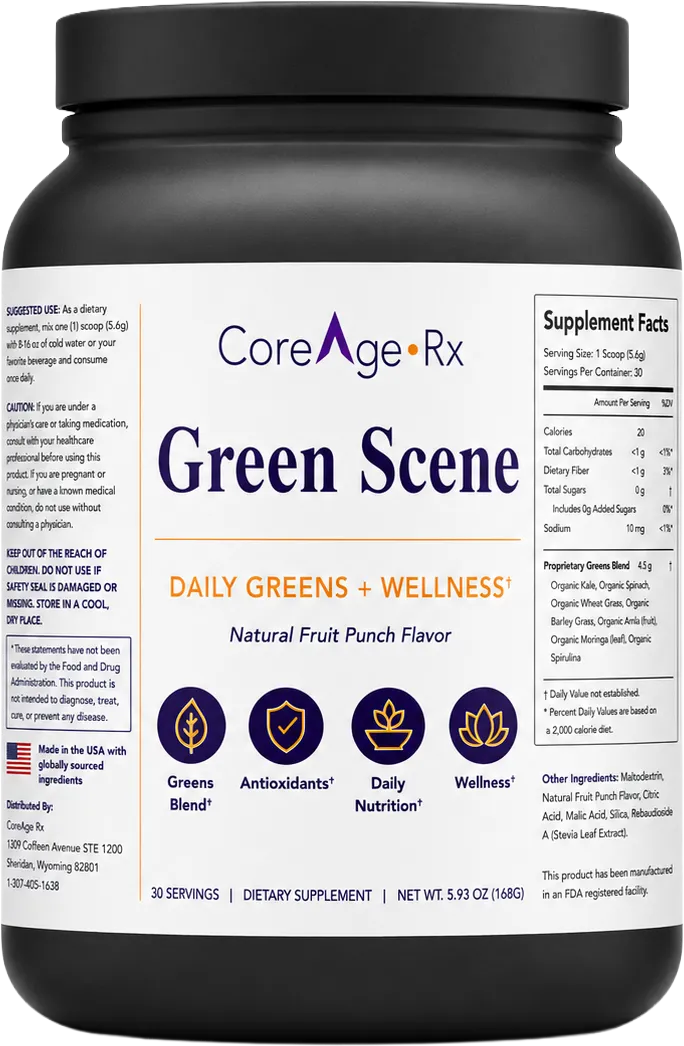
Green Scene is CoreAge Rx’s fruit punch greens powder. The pictured label lists a 4.5 g proprietary greens blend and less than 1 g of dietary fiber per scoop. See the current Green Scene™ page and check the bottle you receive before use.
Related reading
- Greens Powder: What It Can Add and What It Cannot Replace
- How to Read a Greens Powder Label
- Can Greens Powder Cause Bloating?
- Fruit choices in a balanced weight-management plan
Educational information, not individualized medical advice. Product information and linked research checked September 15, 2026. Ingredient research does not establish identical effects for a finished supplement.