Bai can be a low-calorie flavored drink, but “healthy” depends on the bottle you choose, what it replaces, and your own needs. Calories, sweeteners, caffeine, and serving size are more useful decision points than an antioxidant phrase on the front of the package.
The manufacturer pages we reviewed on September 30, 2026 describe different Bai products. They should not be merged into one universal formula. Check your actual bottle first: a public label example does not establish that every current store package has the same ingredients or caffeine amount.
Start with the drink you are replacing
If you want something flavored instead of a sugary drink, a low-calorie option may serve that purpose. If you already enjoy plain water, there is no automatic nutritional reason to replace it with a branded beverage. CDC discusses water and choosing healthier drinks within a broader eating pattern. CDC water and drink guidance.
Ask what you want the drink to do. Taste, convenience, a lower-sugar alternative, and avoiding caffeine are different goals. A bottle can fit one goal while being a poor match for another.
For example, the product may be low in sugar but contain caffeine you would rather avoid. A higher-caffeine version may be convenient in the morning but add to coffee already consumed. Looking at those tradeoffs is more useful than assigning the entire brand a single healthy or unhealthy label.
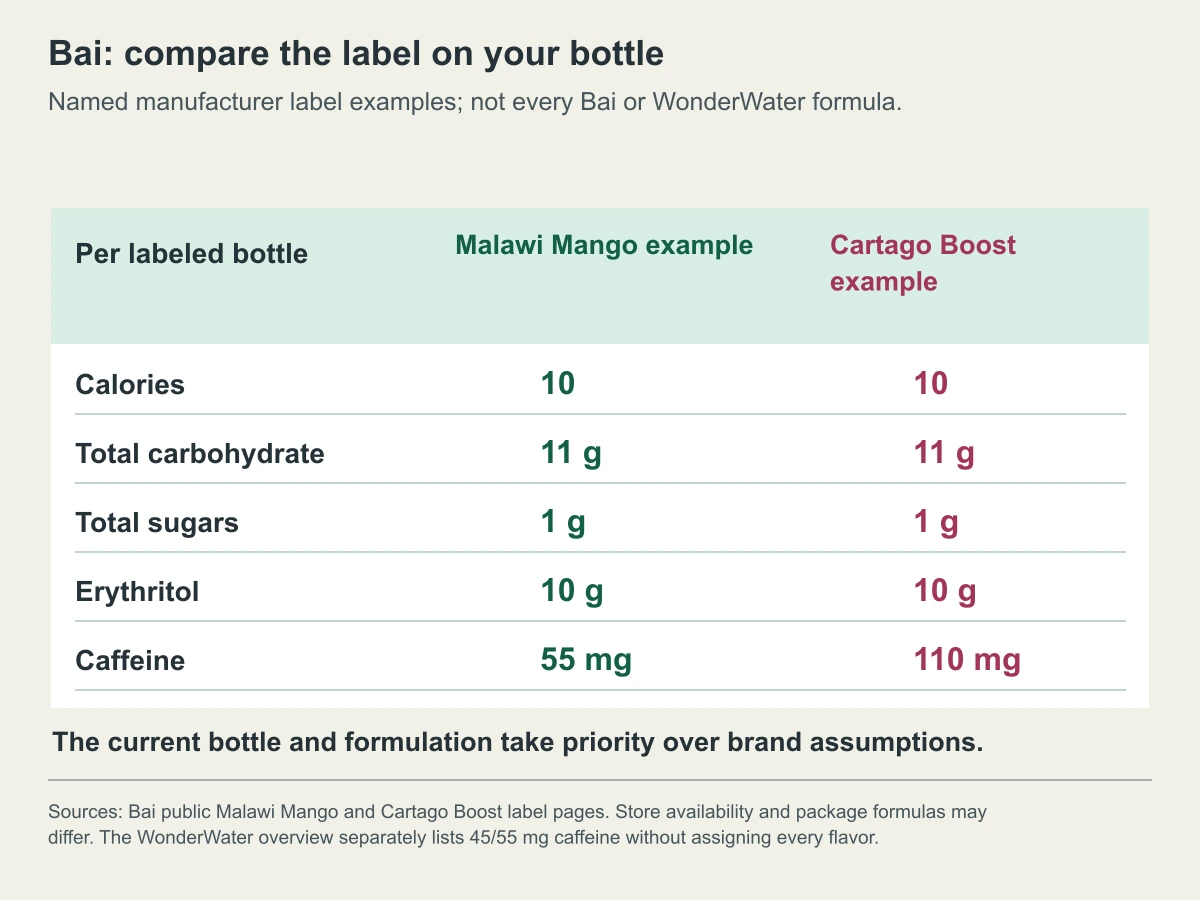
Bai label examples: calories, sugar, and caffeine
These are named public manufacturer label examples, not a guarantee of current retail availability or the contents of every bottle.
| Public label example | Calories per bottle | Total carbohydrate | Sugar | Erythritol | Caffeine |
|---|---|---|---|---|---|
| Malawi Mango | 10 | 11 g | 1 g | 10 g | 55 mg |
| Cartago Pineapple Passion Fruit Boost | 10 | 11 g | 1 g | 10 g | 110 mg |
Sources: Bai Malawi Mango page, Bai Boost Cartago page.
The Boost example has twice the caffeine of the Mango example at the stated bottle serving. That is a comparison of these two labels, not a claim about every Boost or every regular Bai flavor.
If your bottle’s panel differs, use the bottle for your own intake calculation. Package changes, different product lines, and different flavors can matter. Do not use an old online screenshot to override the ingredients and amounts on the product you actually have.
What about Bai WonderWater?
The manufacturer’s WonderWater overview separately describes 10 calories, 1 g of sugar, stevia, and caffeine amounts of 45 or 55 mg. It also discusses zinc in some varieties associated with vitamin C or E. The overview does not assign every caffeine figure to every flavor or supply a complete zinc amount for each product. Bai WonderWater overview.
That information should remain separate from the Mango and Boost label table above. It does not establish that WonderWater has the same erythritol content or ingredient list as those examples.
If the mineral content matters to you, find the actual product label rather than infer it from the general brand page. Our daily zinc guide explains why a nutrient amount, a dietary requirement, and a reason to supplement are different questions.
Why can a low-sugar drink list more total carbohydrate?
The Nutrition Facts panel separates several categories. Total carbohydrate and total sugars are not the same line. In the named Mango and Boost examples, the label also identifies erythritol, so reading only the sugar number leaves out part of the label information.
FDA’s label guide explains how serving size and nutrient amounts are organized. Use the entire panel when comparing products rather than treating “1 gram of sugar” as a description of everything in the bottle. FDA Nutrition Facts guide.
If you have diabetes or follow an individualized carbohydrate plan, ask the care team how that particular product fits. Do not subtract ingredients from a label or predict your glucose response from a marketing claim. NIDDK emphasizes individualized food and activity planning in diabetes care. NIDDK healthy living with diabetes.
How much caffeine are you getting over the whole day?
Count the other sources you use, including coffee, tea, energy drinks, and any caffeine-containing products. A flavored drink can be easy to overlook when you think of it as water.
As an arithmetic example, two bottles of the public Boost example would supply 220 mg of caffeine; two of the Mango example would supply 110 mg. Those calculations do not recommend two bottles or establish a safe personal amount.
FDA says 400 mg daily is an amount not generally associated with negative effects for most adults. That is not a target, a guarantee for an individual, or a rule for children. Sensitivity, medicines, health conditions, pregnancy, and lactation can change the discussion. FDA caffeine guidance.
If you are trying to reduce caffeine, compare labels before assuming all fruit-flavored waters are caffeine-free. Note when you drink them as well as how much. Discuss unwanted symptoms or a relevant medical restriction with the clinician rather than working up to a reference maximum.

Are sweeteners automatically a problem?
The first step is identifying the actual sweeteners on your bottle. A newer overview and an older flavor label may describe different formulations. Do not assume that every Bai product contains the same combination or amount.
Your own experience also matters. If a particular drink repeatedly seems uncomfortable for you, record the product, amount, timing, and symptoms and discuss persistent problems with the care team. The observation alone does not identify which ingredient caused the problem.
This guide does not assign a universal serving limit to erythritol, predict an individual’s tolerance, or treat a single drink as the cause of every digestive symptom. During GLP-1 treatment, symptoms deserve review in the context of meals, other products, medicines, and the clinical plan.
Does “antioxidant” mean Bai causes weight loss?
No weight-loss outcome is established by the word itself. A manufacturer description of ingredients or nutritional functions is not the same as an independent trial showing that the finished beverage produces fat loss.
A low-calorie drink can fit a person’s intake pattern without acting as a weight-loss treatment. Its practical value may be that they enjoy it and use it instead of something else. That does not support claims that drinking additional bottles burns more fat or offsets food intake.
Our calorie planning guide puts individual food and drink choices into daily context. The fat-loss timeline guide explains why a scale change cannot prove that one beverage produced the result.
Can Bai count toward hydration?
Beverages can contribute fluid, but the amount you need depends on your circumstances and any clinical guidance. A brand name does not determine your personal fluid target. CDC also notes that fluid comes from both drinks and foods. CDC hydration information.
Plain water remains a simple option when you want fluid without additional caffeine or product ingredients. You can choose a flavored drink sometimes without making it your only beverage. The useful plan is one you can follow comfortably and that fits the actual restrictions, if any, supplied by your care team.
If you have kidney disease or a prescribed fluid plan, follow individualized guidance rather than a bottle-count rule from an article. NIDDK kidney nutrition guidance. Our water and drinks guide covers practical hydration questions without promising special fat-loss properties.
Bai during semaglutide or tirzepatide treatment
Choosing a drink does not require purchasing a specialized “GLP-1 beverage.” Review the actual label, your preference, your food intake, and any symptoms. A low-calorie drink should not become a way to replace meals when you are already struggling to eat adequately.
Tell the care team if appetite is very low, vomiting persists, or you cannot maintain fluids. Those concerns need assessment of treatment and intake rather than a switch between flavored-water brands.
Our semaglutide questions guide and tirzepatide questions guide offer a broader starting point for follow-up. If exploring care, CoreAge Rx’s semaglutide and tirzepatide pages describe separate service options; no drink label establishes eligibility or predicts a medication result.
A five-minute comparison at the store
Put the actual bottles side by side and check:
- Product line and flavor. Make sure you are comparing the intended versions.
- Serving size and servings per container. Determine whether the numbers cover the amount you expect to drink.
- Calories and carbohydrate details. Read more than the front-label sugar claim.
- Caffeine. Include the rest of your day’s sources and your individual guidance.
- Ingredients and added nutrients. Check anything relevant to allergies, preferences, or supplements already used.
Then compare the price for the amount you actually use. A package advertised with more features is not automatically a better everyday choice. You may prefer a caffeine-free alternative, plain water, or a smaller amount of a flavored product.
Keep the decision simple enough to repeat. You do not need to rank every drink online to choose an option that fits today’s needs.
Common Bai questions
Is Bai healthier than soda?
Compare the specific products and what matters to you. The named Bai examples are low in calories and sugar, but caffeine, sweeteners, portion size, and the drink being replaced still matter. “Soda” is not one uniform formula either.
Does every Bai bottle have 55 mg of caffeine?
No. The public Boost example lists 110 mg, and the WonderWater overview separately lists 45 or 55 mg without assigning every flavor. Use your bottle’s label.
Is Bai sugar-free?
The named examples list 1 g of sugar per bottle. Do not turn “low sugar” into “zero sugar,” and check other versions individually.
Is Bai the same as plain water?
No. Both can provide fluid, but the flavored product may add caffeine, sweeteners, and other ingredients. Decide whether those features fit your goal.
Will the zinc in WonderWater cover my daily needs?
The overview alone does not provide a complete flavor-specific amount. Read the actual panel and consider food and supplements together rather than infer an intake from a marketing statement.
Can I drink unlimited Bai because it has few calories?
Low calories do not remove caffeine or other intake considerations. There is no unlimited-bottle recommendation here.
What if the online page and my bottle disagree?
Use the actual package to assess the product you have and contact the manufacturer for clarification if needed. Public pages may describe a different formulation or version.
Will Bai make me lose weight?
No specific weight outcome follows from choosing the brand. Consider what it replaces and how it fits the overall food, drink, activity, and care pattern.
Educational information for adults; individual treatment decisions require a qualified clinician. Sources reviewed September 30, 2026. Original AI-generated article images depict fictional people and objects, not patient outcomes. Other editorial images are illustrative. Graphics summarize the cited sources.