
RemedyMeds’ public compounded-medication pages reviewed September 30, 2026 advertised semaglutide at $179 for the first month, then $299 per month, and tirzepatide at $279 for the first month, then $399 per month. Those are dated advertised offers, not guaranteed checkout prices or prices for branded Ozempic, Wegovy, or Zepbound. Semaglutide offer, tirzepatide offer.
The more useful review goes beyond the introductory number. Identify the product, ongoing charge, billing interval, clinical and pharmacy arrangement, cancellation terms, and conditions behind any weight-loss warranty before enrolling.
What this review covers
This is a review of public provider pages, its June 4, 2026 terms, and its refund information. We did not enroll, receive medication, test a shipment, or conduct an independent patient-outcome audit. Public descriptions establish what is advertised; they cannot verify an individual experience.
The service describes online clinical access and prescription medication options. A prescription still depends on an evaluation. For any offer, distinguish the company handling the subscription from the clinician making treatment decisions and the pharmacy dispensing the product. RemedyMeds public site.
Our online prescription guide explains that care access, dispensing, and billing are separate parts of the arrangement. A service can be convenient while still needing careful review of those details.
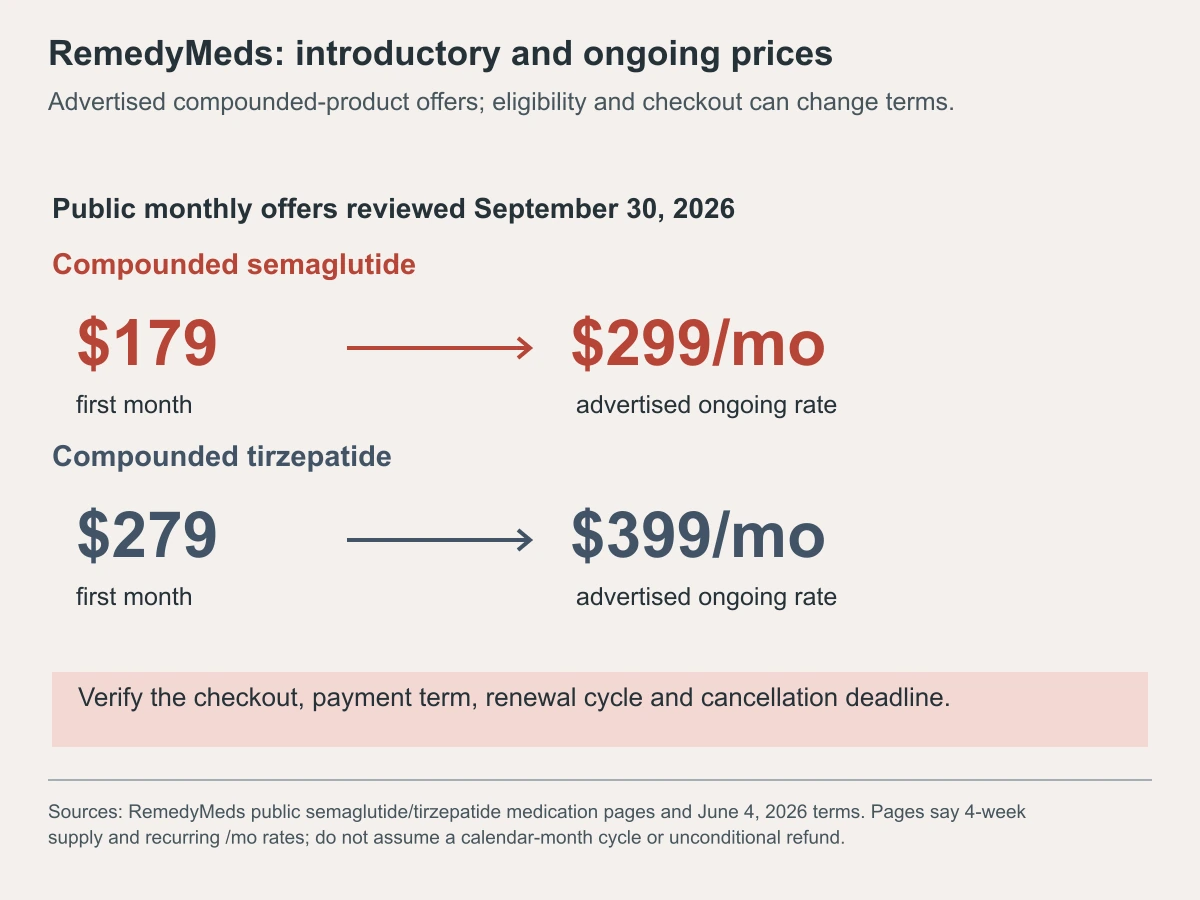
Current advertised compounded-medication prices
| Public medication-page offer | Advertised first month | Advertised ongoing rate | Product identified on the page |
|---|---|---|---|
| Compounded semaglutide injection | $179 | $299/mo | Compounded preparation, not branded Ozempic or Wegovy |
| Compounded tirzepatide injection | $279 | $399/mo | Compounded preparation, not branded Zepbound or Mounjaro |
The pages describe a four-week supply and clinician access, prescription, and shipping as included. Confirm the exact offer at checkout, including eligibility, quantity, formulation, renewal interval, and anything charged separately. Public semaglutide page, public tirzepatide page.
An introductory discount is useful only if you also understand the recurring rate. Do not infer that language about a price lock makes the first-month promotion permanent; ask which rate is locked and under what conditions.
A simple comparison beyond the first charge
Using the advertised figures as arithmetic examples, three charges at the semaglutide offer would total $179 + $299 + $299, or $777. Three at the tirzepatide offer would total $279 + $399 + $399, or $1,077.
These examples are not checkout quotes, recommendations, or guarantees of treatment duration. They also do not convert a four-week billing interval into three calendar months. A different term, promotion, quantity, or fee could change the calculation.
When comparing services, write down what will be charged now, the amount at the next renewal, and the actual renewal date. That three-item list is easier to compare than several pages displaying a monthly equivalent without the full initial payment.
Four weeks, 28 days, and calendar months
The medication pages describe four-week supplies, while the provider’s refund information discusses 28-day cycles. A recurring four-week charge does not always fall on the same date of each calendar month. Official refund information.
Ask for the schedule that applies to your purchase rather than estimate it from the word “monthly.” Include any multi-month term, refill requirements, and dates when the payment method may be charged.
Make a calendar entry for the confirmed renewal and any cancellation deadline. If you travel or know you will need a treatment review, ask how that affects the subscription in advance. Clinical interruption and cancellation are separate requests; make both explicit when both are needed.
What do the subscription terms say?
The June 4, 2026 terms describe upfront payment for the selected term, automatic renewal, and a cancellation notice requirement of at least 48 hours. They also state that charges may continue when refill forms are not completed or medication is not shipped, and describe early renewal or shipping circumstances. RemedyMeds terms.
Those details make the exact checkout offer important. The reviewed medication pages emphasize month-to-month access, while the broader terms address other subscription lengths. Ask which term you are actually buying and save the version presented with the purchase.
Do not assume that failing to submit a refill request cancels billing. If you want to stop a subscription, use the documented cancellation process and keep the confirmation. If a medicine cannot be supplied or is no longer appropriate, separately ask how the account and payment status will be handled.
Refunds and the weight-loss warranty are different questions
The official refund information describes ordinary paid months as nonrefundable, with an initial clinician-ineligibility exception. The separate weight-loss warranty is conditional. Neither should be summarized as an unconditional satisfaction refund. Refund FAQ, terms and warranty section.
The warranty terms specify 12 continuous months and 13 shipments, apply to particular standard-dose compounded plans, and include adherence, verification, exclusion, and claim-deadline conditions. Brand-name or microdose use can affect eligibility. Read the complete current section for the actual offer.
Before relying on a warranty, ask for a written explanation of eligibility and the records needed. Consider whether its conditions fit the treatment a clinician may actually recommend. Medical decisions should remain responsive to benefit and safety rather than be driven by retaining a marketing benefit.

Which medicine are you being offered?
“Semaglutide” identifies an active ingredient, not every detail of a finished product. Ozempic and Wegovy have their own formulations, labels, and indications. A compounded injection has its own pharmacy preparation and instructions. The same distinction applies to compounded tirzepatide and branded products.
FDA states that compounded GLP-1 drugs are not FDA approved. Claims about testing or ingredient identity do not make a preparation equivalent to an approved finished medicine or establish that brand-name trial results apply to it. FDA unapproved GLP-1 information.
Ask for the exact ingredient, pharmacy, concentration, route, supplies, and label instructions. Our compounded GLP-1 guide covers those questions. The semaglutide formulation guide explains why a tablet and an injection cannot be compared by name alone.
How to assess clinical support before subscribing
Ask how the initial evaluation works and how the clinician reviews relevant conditions and medicines. Establish who answers treatment questions after prescribing and how to get urgent guidance when symptoms need prompt attention.
Practical questions include:
- How do I contact the prescribing team between routine visits?
- What happens if I cannot tolerate the medication or maintain food and fluids?
- Who explains the device, label, and any measurement instructions?
- How are medication changes reflected in the next shipment?
- What is the process if a package is delayed, damaged, or exposed to uncertain temperatures?
- How do clinical decisions affect the subscription and billing?
The aim is to identify the actual process, not collect reassuring adjectives. A clear answer should tell you whom to contact, what information to provide, and what happens next.
What do testimonials and average results tell you?
The public site describes member-reported results and testimonials, including compensated testimonials. Those reports are not an independently audited, controlled comparison with another service. They cannot predict your result or isolate the medication’s contribution from other changes. Provider homepage disclosures.
Ask which product, population, duration, and measurement process underlie a result. A brand-name clinical trial is another evidence category; it does not validate every compounded preparation or service experience.
Our medication comparison guide helps distinguish treatment fit from a ranking based on marketing averages. Progress can include tolerance, nutrition, function, and relevant health measures as well as weight.
What about insurance and branded alternatives?
The reviewed provider terms describe cash payment. A cash subscription and an insurance-covered branded prescription should be compared using their actual totals and care arrangements, not assumed to be the same route. Provider terms.
If you want a branded medicine through insurance, check the formulary, eligibility policy, prior authorization, pharmacy network, and out-of-pocket quote. Our GLP-1 insurance guide, Wegovy cost guide, and Zepbound cost guide explain those separate questions.
Availability matters as well. A pharmacy stock problem can change the practical timeline without establishing that another product is appropriate. See our Wegovy supply guide for national-versus-local checks.
Comparing RemedyMeds with CoreAge Rx or another service
Use the same questions for every provider. Compare the exact medicine, upfront payment, recurring interval, clinician access, pharmacy information, instruction process, and stop-treatment process. Avoid a comparison that contrasts one company’s promotional first charge with another company’s ongoing rate.
CoreAge Rx’s semaglutide service and tirzepatide service are separate options to review. Their product information does not establish that you qualify, that one service is cheaper for your situation, or that a compound is equivalent to a branded medicine.
If you already have a prescription, give the evaluating clinician the current product and last administration date. Moving between services can involve both a clinical transition and a billing cancellation; one does not automatically complete the other.

A checklist to save before enrollment
Keep the dated product page or offer, full checkout total, term length, next renewal date, cancellation instructions, and any warranty details. Also record the care and pharmacy contacts once they are provided.
For the medicine, retain the actual prescription and instructions. Recheck the label when a refill arrives, especially if the concentration or device changes. An older screenshot of a dose instruction is not a substitute for the current pharmacy explanation.
You can evaluate the service without completing a health questionnaire simply to see marketing claims. When you do decide to seek care, provide accurate medical information and ask for clarification before paying for an arrangement you do not understand.
Common RemedyMeds review questions
What is the current advertised starting price?
On the reviewed pages, compounded semaglutide was $179 for the first month then $299/mo; compounded tirzepatide was $279 then $399/mo. Confirm the current checkout offer and term.
Are these branded Ozempic or Zepbound prices?
No. The two offers reviewed here identify compounded injections. Review branded-product offers separately if that is what you want.
Does a first-month discount apply forever?
Do not assume so. Ask which ongoing rate applies and what any price-lock statement covers.
Can I stop submitting refill forms to cancel?
Use the documented cancellation process. The terms address continued charges despite incomplete refill steps, so inactivity should not be treated as cancellation.
Is the warranty an ordinary refund policy?
No. It has separate eligibility and claim conditions. Read the actual section for your offer rather than rely on a short promotional phrase.
Did this review test the medication or service?
No. It reviews dated public information. It does not claim a firsthand treatment experience, laboratory testing, or an independently measured patient result.
What should determine the final decision?
Clinical suitability, a clear medicine and pharmacy plan, accessible follow-up, and understood costs and terms. The introductory price is only one part of that decision.
Educational information for adults; individual treatment decisions require a qualified clinician. Sources reviewed September 30, 2026. Original AI-generated article images depict fictional people and objects, not patient outcomes. Other editorial images are illustrative. Graphics summarize the cited sources.