
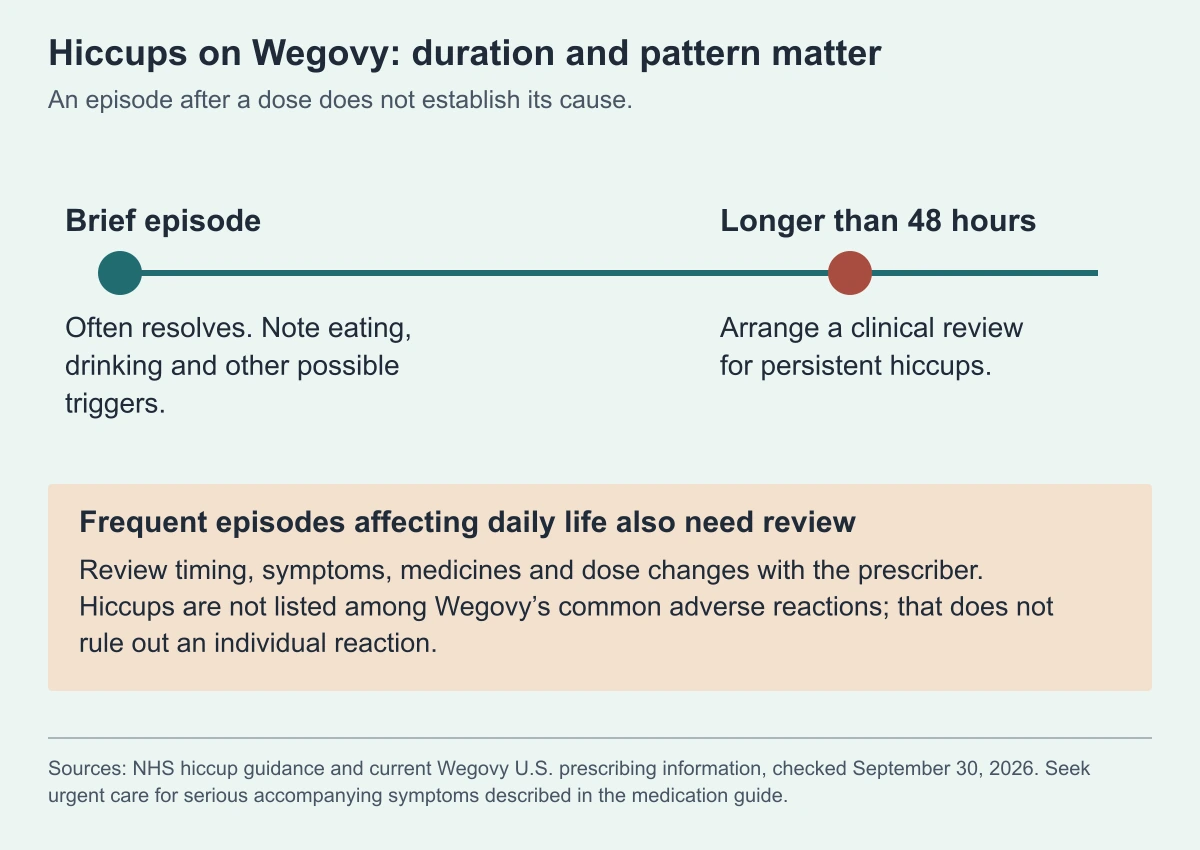
Hiccups are not listed among the common adverse reactions in the current Wegovy prescribing information. That does not prove that an individual episode is unrelated to treatment, and an episode after a dose does not establish that Wegovy caused it. The duration, recurrence, other symptoms and exact medication history are more useful than timing alone. Wegovy prescribing information.
Most hiccup episodes are brief. NHS guidance recommends a clinical review if hiccups last longer than 48 hours or return frequently enough to affect daily life. Serious accompanying symptoms need attention on their own merits; do not label every stomach or breathing problem “just hiccups.” NHS hiccup guidance.
What does the Wegovy label say?
Wegovy contains semaglutide, a GLP-1 receptor agonist. Its current labeling includes injection and tablet presentations, with product-specific instructions. Identify what you actually take rather than assuming that every prescription called “sema” is branded Wegovy.
The label describes common gastrointestinal reactions, including nausea, vomiting, diarrhea, constipation and abdominal pain. Other listed reactions in the adult weekly 2.4 mg injection trial table include dyspepsia, belching and gastroesophageal reflux disease. Hiccups are not included in that common-reaction table. Wegovy label.
That distinction has two practical limits. First, a common-reaction table is not a complete inventory of every experience any patient could have. Second, the presence of reflux or belching in the label does not establish that either caused your hiccups. A clinician needs the symptom pattern and context to evaluate that possibility.
Avoid using percentages from a particular trial as the risk for a different dose, formulation or compounded product. The 2.4 mg injection table, for example, describes a defined adult trial population. It is not a universal side-effect rate for every semaglutide preparation.
Could eating or drinking be a trigger?
NHS guidance identifies eating, drinking, stress and strong emotions as possible triggers for some people. Often there is no obvious reason for a brief episode. It also suggests avoiding habits such as eating very quickly and drinks or foods that a person notices trigger symptoms. NHS guidance.
Wegovy can change appetite and has gastrointestinal effects. Those facts may make a review of meals, drinks and symptoms useful, but they are not proof of a specific hiccup mechanism. Describe the pattern rather than concluding that delayed gastric emptying necessarily caused the episode.
Useful details include whether hiccups start during a meal, after a particular drink, alongside belching or nausea, or without an apparent food connection. An occasional episode and persistent hiccups affecting eating or sleep deserve different levels of attention.
The balanced-meal guide can help with general food questions. If nausea is the main problem, the semaglutide nausea and vomiting guide addresses that separate symptom. Do not assume that a remedy for nausea will also treat hiccups.
When should you contact a clinician?
Arrange a review if the hiccups continue beyond 48 hours or recur frequently and affect ordinary life. NHS notes that persistent episodes can sometimes be related to a health condition or a medicine, which is why a clinician may review both. You do not need to prove that Wegovy is responsible before asking for help. NHS guidance.
Contact the prescribing team earlier if episodes are interfering with meals, drinking, sleep or your ability to follow the treatment plan. Explain the interference rather than only reporting the word “hiccups.” If you are unable to keep fluids down or have significant ongoing gastrointestinal symptoms, obtain medical advice rather than waiting for a duration threshold.
| Pattern | A useful next step |
|---|---|
| Brief, occasional episode without concerning accompanying symptoms | Notice the context and whether a repeatable trigger is present. |
| Hiccups lasting more than 48 hours | Arrange clinical review. |
| Frequent episodes affecting sleep, eating or daily activities | Discuss the pattern with a healthcare professional. |
| Severe or persistent abdominal pain, significant vomiting, or serious allergy symptoms | Follow the medication guide’s urgent instructions; do not attribute these symptoms to ordinary hiccups. |
The table organizes questions; it cannot assess a particular person’s symptoms remotely.
Which accompanying symptoms should not wait?
Wegovy’s medication guide instructs patients to stop using it and call their healthcare provider promptly for severe abdominal pain that does not go away, with or without nausea or vomiting, because pancreatitis is a concern. It also directs patients to stop using it and get immediate medical help for serious allergic-reaction symptoms, including swelling of the face, lips, tongue or throat or problems breathing or swallowing. Wegovy medication guide.
These are instructions for serious symptom patterns, not a claim that a brief hiccup episode is pancreatitis or an allergy. Follow the actual medication guide and obtain urgent help when the accompanying symptoms warrant it.
The label also discusses kidney problems associated with fluid loss from gastrointestinal reactions. Repeated vomiting or difficulty maintaining fluids deserves clinical attention. The guide to how long GLP-1 nausea can last provides context, but duration alone should not delay assessment of severe symptoms.

What should you record before calling?
Keep a concise record that helps the prescriber distinguish the symptom and its pattern:
- The exact medicine, formulation and prescribed dose.
- When the last dose was taken and whether the prescription recently changed.
- When the hiccups began, how long episodes last and how often they recur.
- Whether eating, drinking or another circumstance appears related.
- Other symptoms, including nausea, reflux-like discomfort, pain or vomiting.
- Whether the episodes affect sleep, meals, fluids or ordinary tasks.
- Other prescriptions, nonprescription medicines and supplements you use.
A record is useful even when there is no clear trigger. It should not become an experiment in repeatedly provoking symptoms or altering doses to test a theory. Let the prescribing team decide whether a medicine review, examination or another evaluation is appropriate.
If you take compounded semaglutide, bring the pharmacy label rather than reporting only a number of syringe “units.” Concentration and administration instructions can differ. The compounded GLP-1 guide explains why the formulation and dispensing source matter.
Are home hiccup remedies reliable?
There is no remedy that works for everyone. NHS explicitly notes the limited certainty behind commonly suggested self-help approaches. For a brief episode, avoiding a trigger you have actually noticed—such as eating very quickly—may be a reasonable practical step. NHS advice.
Do not let a search for a quick cure postpone review of persistent or disruptive symptoms. Be cautious about advice that involves adding a prescription drug, changing your Wegovy dose or using an elaborate breathing maneuver without understanding your health circumstances.
If you can drink normally, a few comfortable sips of water are different from forcing a large amount. People with fluid restrictions or swallowing problems need their own guidance. There is no special universal water quantity that treats Wegovy-associated hiccups.
Should you skip, reduce or delay the next dose?
A brief episode does not provide enough information to choose a dose change. Contact the prescriber about persistent or significant symptoms, particularly if the next dose is approaching. Explain what is happening and ask for instructions for the exact product.
Do not create a personal dose-escalation, restart or split-dose schedule from an online discussion. Follow the medication guide’s urgent instructions when serious symptoms occur; routine treatment changes require the prescribing team’s advice. The semaglutide missed-dose and restart guide addresses a related question, but it does not decide whether a particular symptom calls for a dose to be withheld.
People often describe gastrointestinal symptoms near a treatment change. That timing is worth reporting, but it does not make every new symptom an expected adjustment that should simply be endured. The first-month semaglutide guide can help organize starting-treatment questions.
Can an anti-nausea medicine treat hiccups?
Treatments for different symptoms are not interchangeable. A prescription used for nausea does not automatically have evidence or an appropriate role for hiccups. NHS describes clinician evaluation of the underlying condition or medication history before considering treatment for persistent hiccups. NHS clinical advice.
Do not take another person’s prescription or request a medicine solely because a forum describes it as a hiccup cure. The clinician can consider the symptom, likely contributors, other medicines and potential risks.
If you already have an anti-nausea prescription, tell the prescriber what you have taken and whether it helped the symptom it was intended to treat. The ondansetron and semaglutide article explains nausea-related questions; it should not be read as a recommendation to use ondansetron for hiccups.

Is the same answer true for Ozempic or compounded semaglutide?
Does Ozempic cause hiccups?
Hiccups are not listed in the reviewed Ozempic common adult adverse-reaction table. That limited observation does not prove that every episode is unrelated to treatment or establish a cause. Record onset, duration, meals and drinks, reflux or other symptoms, and prescription changes. Persistent, disruptive, or concerning episodes deserve clinical review. Use the exact Ozempic label and your own prescription rather than assuming that every Wegovy or compounded-product statement applies identically. Ozempic U.S. prescribing information.
These products may share semaglutide as an ingredient, but the brand, indication, dose, formulation and instructions can differ. A Wegovy trial table is not a side-effect rate for every semaglutide prescription. Do not change a product name in an article and assume that all the directions remain valid.
The semaglutide questions guide and oral semaglutide versus injections guide explain those distinctions. For a compounded product, FDA emphasizes that it does not receive the same premarket review as an approved medicine and highlights concerns about quality, handling and dosing errors. FDA guidance.
CoreAge Rx’s semaglutide service page describes offered compounded care. An individual assessment is needed, and branded Wegovy’s approval or trial results should not be assumed to apply to that preparation. Ask which product is being considered and how symptoms and follow-up would be handled.
What matters most about the hiccup question?
Identify the medicine, describe the symptom and notice its duration and impact. A label that does not list hiccups among common reactions cannot settle an individual episode, and timing after a dose cannot prove the cause. Persistent, recurrent or disruptive symptoms deserve a clinical discussion; serious accompanying symptoms deserve the urgent care described in the medication guide.
Educational information for adults; individual treatment decisions require a qualified clinician. Sources reviewed September 30, 2026. Original AI-generated article images depict fictional people and objects, not patient outcomes. Other editorial images are illustrative. Graphics summarize the cited sources.