Noom is a weight-management platform with several different programs. Noom Weight centers on behavior change, lessons, tracking, and support. Noom Med adds access to medical evaluation and, when appropriate, prescription treatment. What you receive and what you pay depend on the exact program and offer.
This review examines public program information, pricing, terms, and research checked September 30, 2026. CoreAge Rx publishes this article and offers competing treatment services. We have not purchased or personally tested Noom, and this is not a ranking based on customer experience.
How does Noom Weight work?
Noom describes a program built around understanding eating habits, completing lessons, logging food and weight, and receiving support. Its public explanation emphasizes behavior change and a color-coded food system rather than a single prescribed menu. Noom program overview
The practical question is whether that routine fits how you learn and what support you need. An app can provide structure, reminders, and a place to record patterns. It does not automatically resolve medical reasons for weight change or replace an individualized nutrition assessment.
Before enrolling, ask what coaching or group support the specific plan includes and how it is delivered. Marketing descriptions across programs should not be assumed to describe every subscription identically.
What is different about Noom Med?
Noom Med provides access to clinicians who can evaluate whether prescription treatment is appropriate. The public medication page lists several options, including branded medicines and programs involving compounded preparations. Not everyone who completes an intake will qualify for a prescription. Noom Med overview
| Program category | Main distinction to confirm |
|---|---|
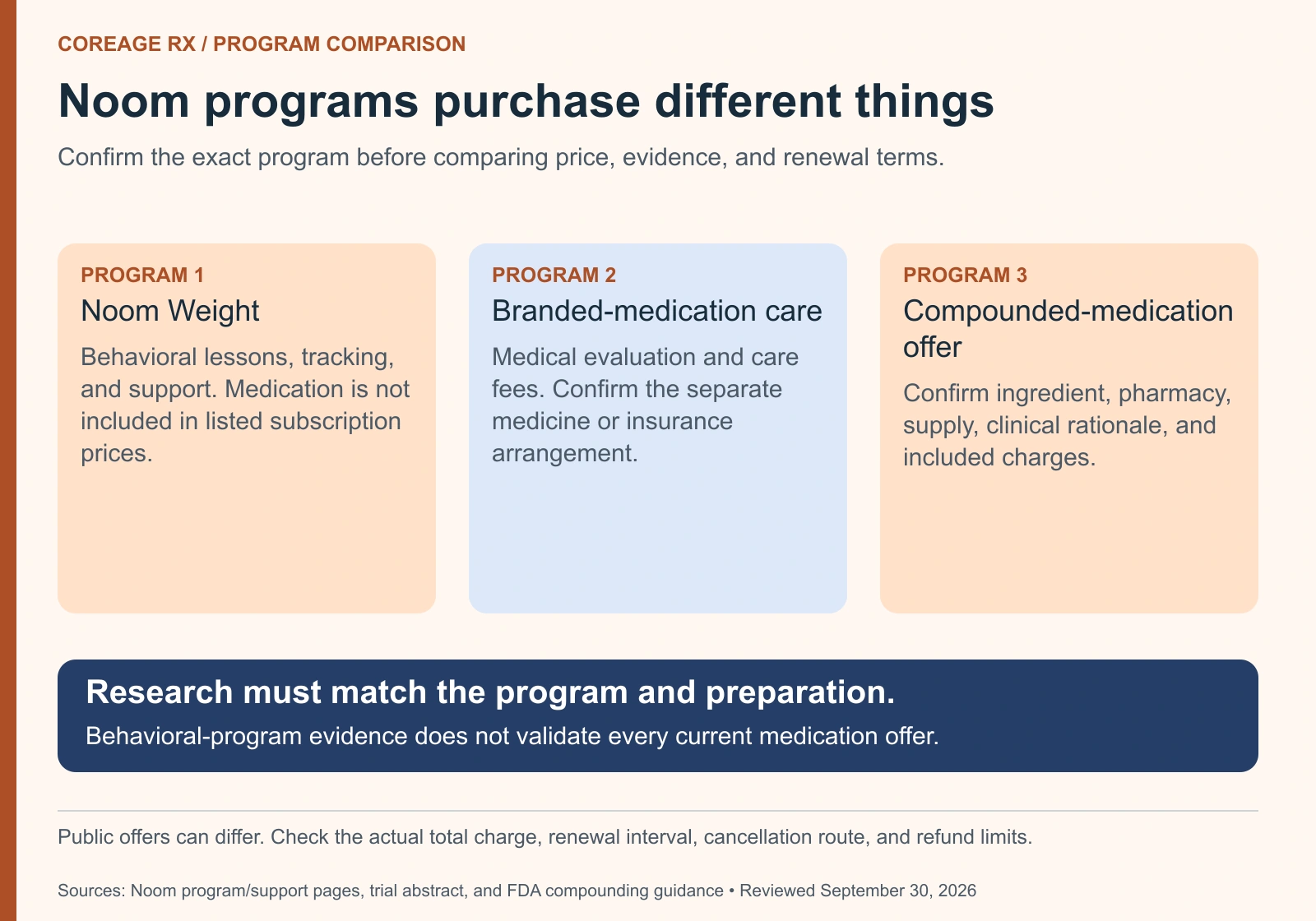
| Noom Weight | Behavioral program; medication is not included in its listed subscription prices |
| Medical care for branded medicines | Confirm the clinical-service fee and separate medication cost or insurance arrangement |
| A program including a compounded preparation | Confirm the exact medicine, pharmacy, included supply, clinical reason, and renewal terms |
Those categories should not be treated as one interchangeable product. An app subscription, a prescribing service, and a medication-inclusive offer purchase different things.
The GLP-1 insurance guide explains why a prescription evaluation does not guarantee that a plan will pay for the resulting medicine.
How much does Noom Weight cost?
Noom’s published support page lists several plan lengths. Selected examples below are before any applicable tax or discount, and the page notes that offers and signup routes may affect pricing. Medication is not included. Noom Weight pricing
| Listed plan length | Published total price |
|---|---|
| One month | $70 |
| Three months | $159 |
| Six months | $179 |
| Twelve months | $209 |
The annual price works out to approximately $17.42 per month, but that equivalent should not be mistaken for a monthly payment plan. Compare the amount charged upfront, the renewal interval, and the cancellation terms.
The support page states that subscriptions renew automatically unless canceled. Confirm the price and next billing date in the actual order summary rather than assuming the general table is your final quote.
What should you know about Noom Med pricing?
The current Noom Med landing page advertises a microdose GLP-1 program starting at $79 and access to branded medication care starting at $39 plus the medicine’s out-of-pocket cost. These are starting figures for different offers, not one all-inclusive monthly price. Noom Med pricing statements
A separate Noom explanatory article describes other introductory and renewal arrangements, including a $69 initial branded-care amount and a $297 three-month renewal with medication excluded. As of September 30, that article also presents a different medication-inclusive offer starting at $149 plus tax, with a $299-per-month plus tax renewal for a twelve-week subscription. Its initial subscription and medication-supply periods differ. Noom’s program-cost article
Because the public pages present different offers, obtain the exact current checkout terms. Do not assume that the lowest introductory amount applies to every program or continues indefinitely. Ask what is included, how long each supply lasts, what renews, and what happens if the prescription changes.
Our Ro pricing guide and TrimRx alternatives comparison use the same separation between care fees, medicine, prepayment, and renewal.

Does a compounded program mean the medicine is FDA approved?
No. Noom’s medication page discloses that compounded preparations are not FDA approved or reviewed for safety, effectiveness, and quality. FDA likewise explains that compounding is different from approval of a finished drug. Noom medication disclosure, FDA compounding overview
Do not transfer the clinical-trial results of an approved brand to every compounded preparation solely because the ingredient name is similar. The formulation, route, concentration, pharmacy, and patient-specific reason for compounding matter.
A program name such as “microdose” also does not establish a standardized FDA-approved regimen. Ask the clinician what is being prescribed and what evidence supports the proposed use. Our compounded GLP-1 guide and oral tirzepatide review explain related evidence distinctions.
Is there research showing Noom can help with weight loss?
There is research, but it needs to be matched to the program studied. A 2026 randomized trial compared a 16-week digital weight-management program with educational materials in 427 adults with overweight or obesity. The published abstract reports average weight changes of about −1.2% versus +0.6% at 16 weeks, and −4.1% versus +1.5% at 68 weeks. Original study abstract
These are average group changes; negative values indicate weight loss and positive values weight gain. They are not a guarantee that a subscriber will lose a specific amount. Noom’s accompanying report identifies company funding and notes that weight was self-reported in the remote study. Noom’s trial report
The study provides evidence about a particular behavioral program and comparison. It does not prove the effectiveness of every current Noom Med prescription, compounded formulation, or medication-discontinuation plan. A shared brand name does not make all programs the same intervention.
What about claims that greater app engagement improves results?
Noom’s current medical page also describes an analysis of members who logged weight and compares groups with different app engagement. Its disclosure explicitly says that the association does not establish causation. Noom analysis disclosure
That distinction matters. People who use an app more may differ in motivation, adherence, support, health, or other factors. An association between more engagement and greater weight change does not show that opening the app a particular number of times will produce the same result for everyone.
When evaluating a claim, ask whether the evidence comes from a randomized comparison, an observational analysis, or a testimonial. Each can provide information, but they answer different questions and support different levels of certainty.
Is Noom a good fit if you already use a GLP-1 medicine?
It may offer structure that some people find useful, but compare the support with what your existing clinical team already provides. Ask how nutrition, activity, adverse effects, and medication questions will be coordinated rather than assuming two services automatically work together.
An app goal should not encourage continued restriction when appetite is already very low or nausea is interfering with meals. Our semaglutide protein guide and tirzepatide protein guide discuss keeping adequate nourishment and function in the plan.
Do not interpret a behavior-change program as proof that you should stop a medicine once a target weight is reached. Treatment continuation and discontinuation require a clinical discussion. The stopping tirzepatide guide explains why weight maintenance needs its own plan.

How do you cancel, and are refunds available?
Noom’s support instructions describe managing a subscription through the account portal or the app’s subscription settings. The correct route can depend on how the subscription was purchased. Deleting the app should not be treated as confirmation that billing has stopped. Noom cancellation instructions
The published refund policy distinguishes programs:
- Noom Weight: A refund may be available when requested within 14 days of the first charge; renewals are not refundable under the stated policy.
- Medication-inclusive Noom Med programs: The policy says refunds are not available after a prescription has been written.
- Telehealth for branded medicines: The stated initial refund window is seven days, unless a clinical visit has already occurred.
These are policy summaries, not a promise that a particular request will qualify. Review the current terms, purchase channel, and order details. Cancel before renewal if you do not want another billing period, and keep the confirmation. Noom refund policy
Questions worth asking before you join
Make the decision concrete:
- Which exact program and subscription length am I buying?
- What is charged now, and what will renew later?
- Is medication included, separately billed, or dependent on insurance?
- Which clinician and pharmacy would handle a prescription?
- What coaching or support is included, and how do I contact it?
- Which evidence applies to this program and medicine?
- What event ends refund eligibility, and how do I cancel?
If you are also evaluating CoreAge Rx semaglutide care or tirzepatide care, ask the same questions. Compare the actual treatment and support rather than the provider name or the smallest advertised price.
Noom may suit someone who wants a structured digital routine, medical evaluation, or both. The useful decision is whether the specific program matches your health needs, preferred support, and sustainable total cost.
Educational information for adults; individual treatment decisions require a qualified clinician. Sources reviewed September 30, 2026. Original AI-generated article images depict fictional people and objects, not patient outcomes. Other editorial images are illustrative. Graphics summarize the cited sources.