
Not having diabetes does not remove the risks of tirzepatide. If Mounjaro is being considered for someone without type 2 diabetes, first clarify the intended use, whether it is off-label, and why that exact product is proposed. Zepbound contains the same active ingredient but has different approved indications and its own evidence and instructions.
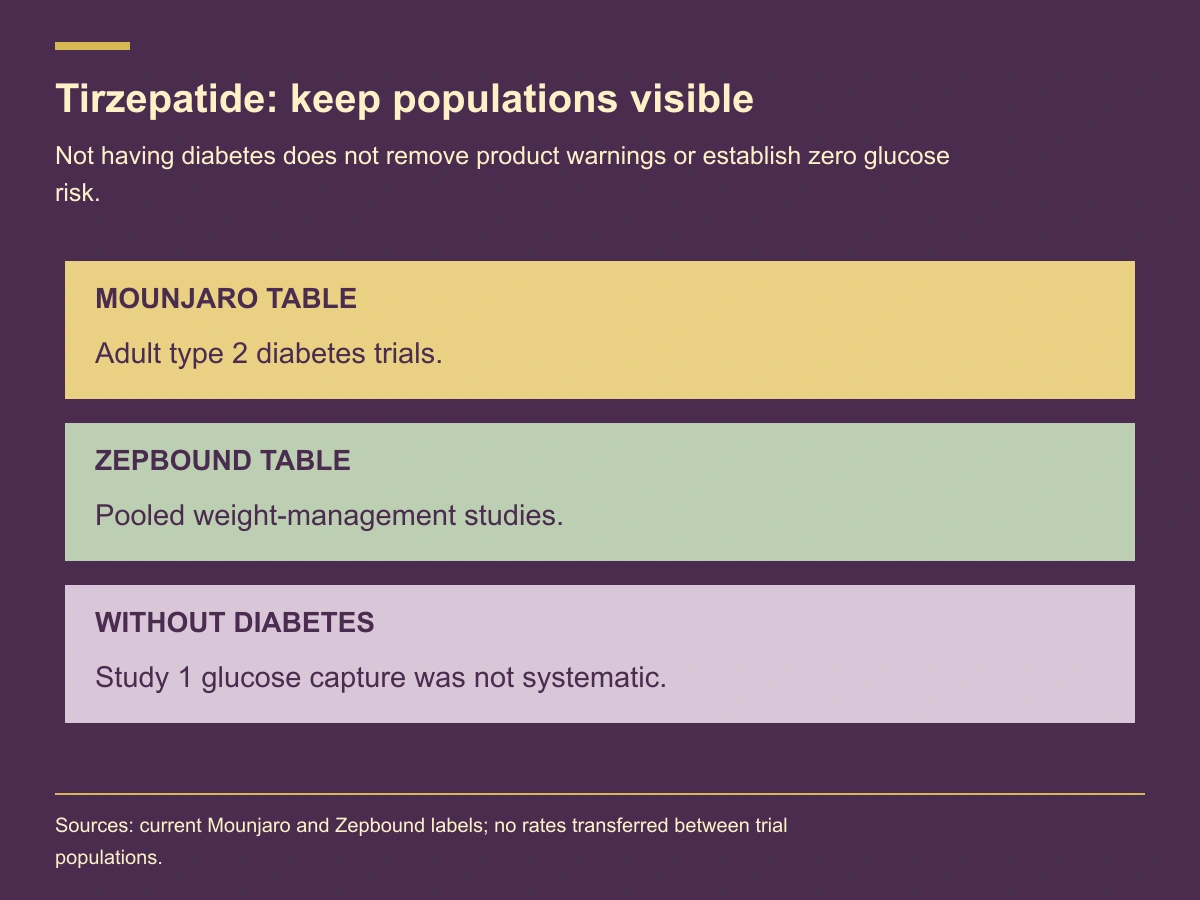
Side-effect percentages must stay attached to the product and study population that generated them. Mounjaro’s diabetes-trial table is not a universal prediction for every person without diabetes, and Zepbound results should not be relabeled as Mounjaro-specific non-diabetic rates.
Mounjaro and Zepbound: the indication matters
The current Mounjaro U.S. prescribing information includes improving glucose control with diet and exercise in people with type 2 diabetes, with age-specific requirements, and reducing major cardiovascular events in certain adults with type 2 diabetes. This guide focuses on adult questions.
The current Zepbound label includes reducing excess body weight and maintaining reduction in adults with obesity or adults with overweight and a weight-related condition, alongside diet and activity. It also includes moderate to severe obstructive sleep apnea in adults with obesity.
If someone without type 2 diabetes is offered Mounjaro for a weight goal, ask the clinician to explain that use and the product choice. NIDDK’s medication guidance describes off-label use as using a medicine differently from FDA approval. The term does not establish that a particular prescription is appropriate or inappropriate by itself.
Our Mounjaro ingredients guide explains active ingredient and formulation. Shared tirzepatide does not mean you can substitute presentations, overlap prescriptions, or assume insurance covers them for the same purpose. Ask about the exact prescribed brand, device, indication, and monitoring plan.
Common digestive reactions still matter
Mounjaro’s reviewed placebo-controlled adult type 2 diabetes trial table lists nausea, diarrhea, decreased appetite, vomiting, constipation, dyspepsia, and abdominal pain among common reactions. The label describes many nausea, vomiting, and diarrhea reports occurring during escalation and decreasing over time. That group pattern does not predict an individual symptom’s duration.
For example, nausea was reported in 12%, 15%, and 18% of participants in the 5 mg, 10 mg, and 15 mg Mounjaro groups, compared with 4% in the placebo group. These are adult diabetes-trial figures. They should not be presented as the measured rates for all Mounjaro users without diabetes. Mounjaro label.
The Zepbound label provides additional evidence in weight-management populations, including studies with and without type 2 diabetes. Its common-reaction table pools Study 1 and Study 2. A pooled figure from those studies is not a separately measured rate for every non-diabetic patient.
Our Mounjaro side-effect guide provides broader symptom questions. When reporting symptoms, identify the exact preparation and note any recent increase, treatment interruption, other medicine change, or possible measurement error.
Keep the trial populations visible
| Evidence source | Relevant population or design | What to avoid assuming |
|---|---|---|
| Mounjaro adult common-reaction table | Placebo-controlled trials in adults with type 2 diabetes | That the same percentages were directly measured in everyone without diabetes |
| Zepbound common-reaction table | Pooled weight-management Studies 1 and 2 | That every pooled figure describes only participants without diabetes |
| Zepbound Study 1 glucose finding | Adults with obesity or overweight without type 2 diabetes | That limited capture proves zero risk or a precise universal rate |
| Individual symptom after treatment | A personal temporal association | That timing alone establishes cause or predicts another person’s experience |
This distinction does not make the evidence useless. It helps a clinician explain which findings fit your situation, which are indirect, and where uncertainty remains. A shared active ingredient supports relevant discussion while leaving product and population boundaries important.
The tirzepatide versus semaglutide evidence guide applies the same approach when comparing different medicines. A larger percentage in one unrelated table is not automatically a head-to-head comparison or a reason to choose a particular dose.
Can low blood sugar happen without diabetes?
Low-glucose risk is particularly important when tirzepatide is used with insulin or an insulin secretagogue, such as a sulfonylurea. Tell the clinician about every prescription and any unusual use of another person’s diabetes medicine. Do not change a diabetes medicine yourself to manage a guessed risk.
For people without type 2 diabetes, the Zepbound label provides a useful but limited finding. In Study 1, hypoglycemia was not systematically captured; plasma glucose below 54 mg/dL was reported in 0.3% of Zepbound-treated participants and no placebo participants. This is not proof that the risk is zero, a complete estimate of every low-glucose episode, or a Mounjaro-specific non-diabetic trial rate. Zepbound label.
Ask the team how to respond to symptoms such as sweating, shaking, dizziness, weakness, or confusion and whether glucose monitoring is appropriate for your circumstances. Symptoms alone do not confirm low glucose or identify its cause. A clinician can consider readings, intake, other medicines, illness, and history.
If confusion, fainting, inability to swallow safely, or another severe symptom occurs, obtain emergency help. Do not give oral food or drink to someone who cannot swallow safely. The care plan should explain the appropriate response before an event occurs.

Reduced appetite should not become inadequate intake
Being less hungry does not remove the need for adequate meals and fluids. If intake becomes too low, a person may have trouble with energy, nutrient variety, and everyday function. A lower scale number alone cannot establish that treatment is going well.
Discuss your current eating pattern, foods you tolerate, work schedule, and any dietary restrictions. Ask whether a registered dietitian would help and what symptoms should lead to reassessment. Persistent vomiting, severe fullness, or inability to eat adequately should not be treated as a desirable weight-loss effect.
Our tirzepatide protein and muscle guide keeps strength and function in the conversation. The calorie-intake guide explains why a fixed low target is not suitable for everyone. Do not combine appetite suppression with severe restriction simply to accelerate a result.
NIDDK’s healthy-living guidance emphasizes individualized meal planning and the relationship between food, activity, and medicines. Although that resource addresses diabetes, its medication-specific meal questions should not be copied indiscriminately onto someone without diabetes; your team should explain which apply.
Serious warnings do not disappear without diabetes
Mounjaro carries a boxed warning based on thyroid C-cell tumors in rats; whether it causes these tumors in humans is unknown. It is contraindicated with a personal or family history of medullary thyroid carcinoma or MEN 2 and with a prior serious hypersensitivity reaction to tirzepatide or relevant excipients. Current Mounjaro label.
Its warnings also include pancreatitis, severe gastrointestinal reactions, and dehydration-related kidney injury. It is not recommended in severe gastroparesis. Tell the clinician about relevant symptoms and history before treatment, and report a meaningful change rather than assuming it is an expected inconvenience.
Persistent or severe abdominal pain, sometimes extending to the back, with or without nausea or vomiting, needs prompt assessment for pancreatitis. Repeated vomiting or inability to keep fluids down can lead to dehydration and deserves urgent attention. Severe allergic symptoms, including trouble breathing or facial or throat swelling, require emergency help.
Our Zepbound back-pain guide explains why severe abdominal-to-back pain differs from ordinary localized soreness. It is a symptom framework for discussion, not a diagnosis or a reason to use another product’s instructions in place of your clinician’s advice.
Contraception, pregnancy, and other oral medicines
Mounjaro delays gastric emptying and may affect absorption of oral medicines. Its label advises people using oral hormonal contraceptives to switch to a non-oral method or add a barrier method for four weeks after initiation and four weeks after each dose escalation. This applies to the drug’s effect, not simply to whether a person has diabetes. Mounjaro label.
Discuss contraception and pregnancy plans before treatment. Pregnancy wording differs between products, and diabetes treatment during pregnancy has additional considerations. Ask the team to explain the instructions for your exact prescription rather than inventing a universal washout or applying a social-media rule.
The tirzepatide pregnancy and breastfeeding guide reviews those separate questions. Also provide the complete oral medication and supplement list. A general instruction to space tablets by an arbitrary number of hours does not necessarily solve an absorption concern.
Compounded tirzepatide adds product-specific questions
A preparation advertised as compounded tirzepatide is not FDA-approved Mounjaro or Zepbound. FDA says compounded drugs do not receive its premarket safety, effectiveness, and quality review and should meet an appropriate individual medical need. FDA compounding guidance.
If a vial is proposed, confirm the actual pharmacy, concentration, written directions, measuring device, storage, and contact pathway. Do not transfer a brand’s trial percentages into a claim that an unverified compounded preparation has identical safety. The compounded tirzepatide side-effect guide explains those additional concerns.
FDA’s current guidance also addresses dose errors, false pharmacy labels, warm shipments, and the 28-day discard recommendation for multidose compounded GLP-1 vials. Current FDA concerns. Ask the pharmacist to reconcile directions before use when information conflicts.

Questions before starting or continuing care
- What condition are we treating, and why this exact product?
- Is the proposed use off-label, and what evidence fits my circumstances?
- Which risks are relevant to my history and other medicines?
- How will we assess meals, fluids, symptoms, and daily function?
- What is the plan for low-glucose symptoms or severe digestive problems?
- What do I need to know about contraception and pregnancy?
- Who responds between visits, and what are the continuing costs?
The CoreAge Rx tirzepatide page provides service information to discuss with the team. Confirm the preparation, personal suitability, pharmacy, availability, and follow-up. A product description does not establish a prescription or guarantee that a branded medicine will be supplied.
Frequently asked questions
Is Mounjaro approved for weight loss in people without diabetes?
Its reviewed indications are type 2 diabetes-related. Zepbound has weight-management indications. Ask the clinician to explain an off-label Mounjaro proposal and why that product is considered appropriate.
Are side effects milder if I do not have diabetes?
Do not assume so. Product warnings remain relevant, and trial percentages need the correct population and context. There is no universal non-diabetic Mounjaro side-effect rate established by its diabetes-trial table.
Can low blood sugar occur without diabetes?
The Zepbound label reports a limited Study 1 finding in participants without type 2 diabetes and notes that hypoglycemia was not systematically captured. That supports discussing the risk; it does not establish zero risk or a precise universal probability.
Does nausea prove the treatment is working?
No. Assess the intended health benefit and tolerability separately. Poor intake, repeated vomiting, dehydration, or difficulty functioning requires review rather than treating discomfort as proof of success.
Can I switch myself between Mounjaro and Zepbound?
No personal switching plan is provided here. Product, indication, device, dose, supply, and history matter. Coordinate any change with the prescribing team; the shared ingredient does not authorize overlapping treatment or improvising a schedule.
Educational information for adults; individual treatment decisions require a qualified clinician. Sources reviewed October 2, 2026. Original AI-generated article images depict fictional people and objects, not patient outcomes. Other editorial images are illustrative. Graphics summarize the cited sources.