
Wegovy contains semaglutide, which has an elimination half-life of approximately one week. That does not mean it is completely gone a week after the last dose. The current label says semaglutide can remain in circulation for about five to seven weeks after the last 2.4 mg or 7.2 mg injection, or the last 25 mg oral dose.
Those are pharmacokinetic statements for the specified products and doses. They are not a promise about when appetite, side effects, or every clinical effect will end. Stopping, restarting, pregnancy planning, procedures, and an uncertain dose each need their own product-specific advice.
What does Wegovy’s half-life mean?
An elimination half-life describes the period associated with a reduction to half of an amount or concentration during elimination. It is a way of describing persistence, rather than an exact date at which the medicine becomes zero.
The current Wegovy prescribing information, revised June 2026, reports an approximately one-week elimination half-life. It also describes metabolism and excretion of semaglutide-related material. Drinking more water, exercising intensely, or using a cleanse does not create a validated personal clearance shortcut.
The semaglutide overview explains how the medicine’s effects and treatment purposes fit into the broader clinical discussion. The timing figure is only one part of that picture.
Which doses does the five-to-seven-week statement concern?
The current label explicitly names the last injectable dose of 2.4 mg or 7.2 mg and the last oral dose of 25 mg. The same label includes several presentations and separate administration schedules.
Do not turn that sentence into a precise personal clearance deadline after a starter dose, an uncertain injection, another semaglutide brand, or a compounded preparation. Exposure depends on the actual treatment course and formulation.
The Wegovy dosage guide separates initiation, maintenance, indications, and route. The injection guide explains why different devices need their own instructions. A tablet amount is not an injection-conversion formula.
Why one week does not mean “all gone”
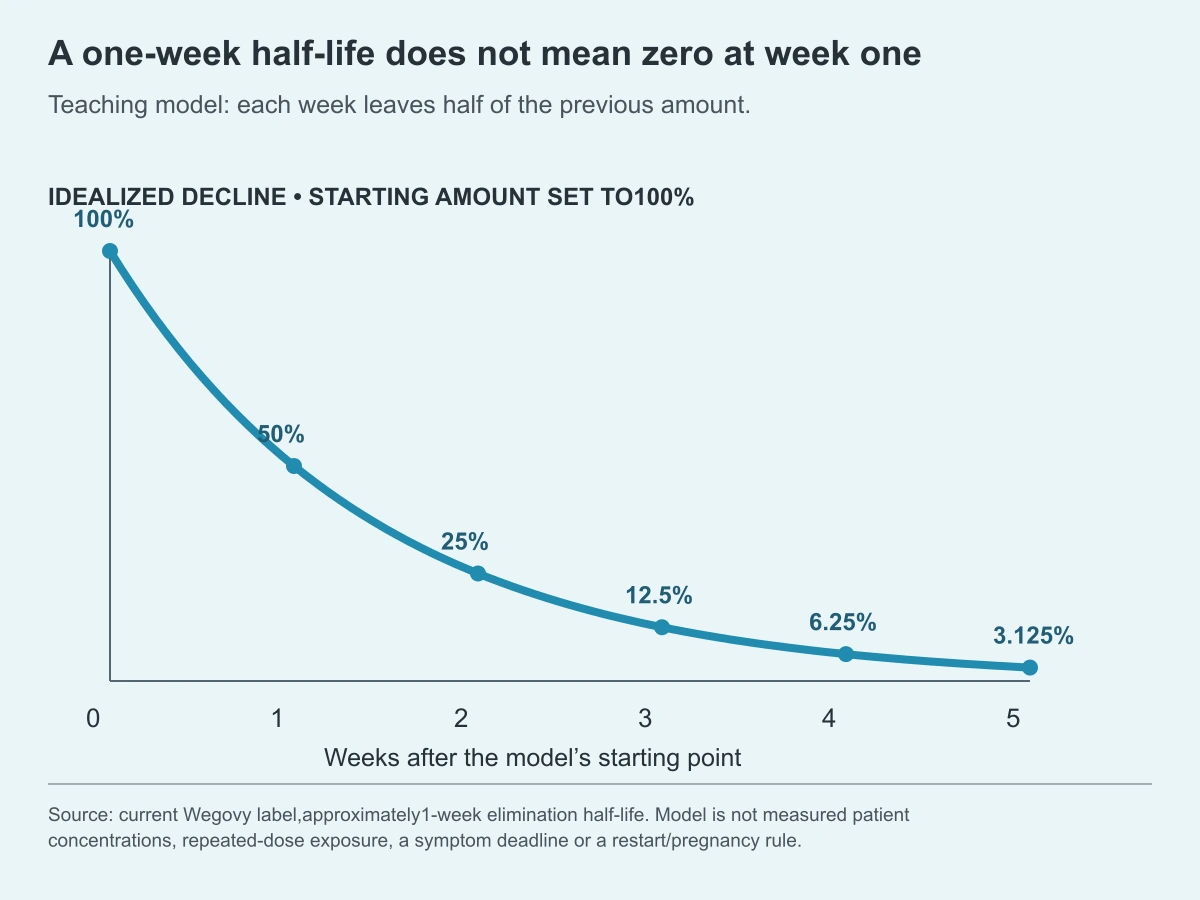
A simple teaching model can show the difference. If an amount falls by half each week, it leaves half of the previous week’s amount, rather than subtracting the same quantity until it reaches zero.
| Time in the simplified model | Percentage of the starting amount remaining |
|---|---|
| Starting point | 100% |
| One week later | 50% |
| Two weeks later | 25% |
| Three weeks later | 12.5% |
| Four weeks later | 6.25% |
| Five weeks later | 3.125% |
This is arithmetic normalized to a starting amount, not measured patient blood concentrations. It does not reproduce absorption, repeated dosing, individual exposure, or a clinically meaningful threshold. It therefore cannot select a dose, determine pregnancy safety, or predict when a symptom will disappear.
The model’s purpose is simply to explain why a half-life and complete clearance are different ideas.
Does the last dose date tell you when appetite returns?
Not precisely. Appetite is a subjective and clinical experience, influenced by food intake, routine, illness, other medicines, and the treatment course. The presence of semaglutide in circulation is not a day-by-day appetite meter.
Some people notice a change before a theoretical clearance period ends, while a symptom or eating pattern may persist for other reasons. Report the actual pattern rather than assuming that every change must match a pharmacokinetic calculation.
If treatment is stopping, ask how to support adequate meals and review the original goals. The protein shake meal guide and macros guide offer practical food-planning context without a compulsory intake number.
Will side effects end when semaglutide clears?
There is no universal symptom deadline. A continuing symptom may involve the medicine, a complication, another condition, or something else in the treatment history. Clearance does not make severe or worsening symptoms safe to wait on.
Persistent vomiting, inability to maintain fluids, severe abdominal pain, serious allergic symptoms, or a substantial change in function needs appropriate clinical attention. The Wegovy side-effect guide and diarrhea guide explain the symptom and safety questions in more detail.
Tell the clinician when the last dose occurred, what symptoms began or changed, and whether there was a recent increase, interruption, or additional medicine. That record is more useful than saying that the drug “should already be gone.”
Why pregnancy planning has its own interval
The Wegovy label includes a precaution to discontinue at least two months before a planned pregnancy because of semaglutide’s long half-life. For weight-management use, pregnancy planning should therefore be discussed with the prescribing team before trying to conceive.
The label also has indication-specific pregnancy context, including the benefit-risk assessment for MASH. If you are using Wegovy for another condition, review that exact clinical situation with the treating team rather than applying a weight-loss discussion on your own.
The five-to-seven-week circulation statement should not replace the labeled pregnancy precaution. A simplified curve or a perceived return of appetite does not establish that pregnancy exposure is no longer a concern. If pregnancy occurs or is suspected, contact the treating team promptly.

What if you miss a weekly injection?
A missed-dose decision is not made by waiting for the medicine to leave your body. The injection label has specific instructions based on the time until the next scheduled dose, and longer interruptions raise a separate question about restarting.
The semaglutide missed-dose and restart guide explains the product distinctions. Keep the actual last-dose and next-dose dates available when you ask for advice. Do not double up because the drug is gradually declining.
For Wegovy tablets, the missed-dose instructions differ: the label says to skip a missed tablet and return to the regular schedule. That is another reason the broad phrase “semaglutide timing” cannot replace the actual product’s directions.
Can you restart the old dose after several weeks?
Do not assume so. The June 2026 Wegovy label directs reinitiating dosage escalation at a lower dosage after two or more consecutive missed injections to reduce gastrointestinal adverse reactions. Confirm the specific restart plan with the prescriber.
Tell the prescriber why treatment stopped, whether symptoms remain, the previous dose, and how long the gap lasted. A calculation saying that little medicine remains is not permission to resume the former maintenance dose independently.
Restarting after a reaction, a supply interruption, or planned pregnancy involves different questions. Ask for a written plan and confirm the exact device or formulation you will receive.
What about surgery or anesthesia?
Tell the procedural team that you use Wegovy and provide the exact formulation and last administration date. The label describes pulmonary aspiration reports during general anesthesia or deep sedation in people receiving GLP-1 medicines.
The same label notes insufficient data to determine which changes to fasting or temporary discontinuation would mitigate that risk. An elimination half-life therefore does not establish a universal pre-procedure hold interval.
Follow the plan coordinated by the procedural and prescribing teams. Do not change fasting instructions, postpone necessary care, or stop a treatment regimen based on a general clearance chart. The procedure, symptoms, and other clinical factors need their own assessment.
What happens to weight after stopping?
Clearance and long-term weight maintenance are different questions. In the original STEP 1 extension, a selected group of participants was followed after sixty-eight weeks of treatment. Both semaglutide and the active lifestyle intervention were discontinued.
The extension included 327 participants and followed them for another year. The semaglutide group regained, on average, about two-thirds of its previous weight reduction during that off-treatment period. The analyses were exploratory, and the result is not a forecast for every person or a day-by-day timeline.
The study supports planning for ongoing weight-management needs when treatment changes. It does not prove that a particular taper prevents regain, or that every person needs the same replacement strategy.
Planning a treatment change
Discuss why treatment is changing: symptoms, pregnancy plans, cost, access, a different clinical goal, or a lack of useful benefit. Each reason can lead to a different follow-up plan.
Ask which health measures should be followed, how eating and activity support will continue, and when the next review will occur. If another medicine is being considered, the transition should identify the exact product and directions. Do not overlap semaglutide products or add another GLP-1 medicine based on a remaining-percentage calculation.
For service details, see CoreAge Rx’s semaglutide information. CoreAge Rx describes a compounded offering. Compounded medicines are not FDA-approved, and branded Wegovy evidence does not establish the same safety, effectiveness, or instructions for a compounded preparation.

What if an extra or uncertain dose was taken?
Contact the prescriber, pharmacist, or poison-control service for prompt product-specific advice. Explain the exact product, amount if known, timing, symptoms, and any other glucose-lowering medicines. Seek urgent care for serious symptoms.
The Wegovy label notes that prolonged observation and treatment may be needed after overdose because of the long half-life. Waiting until a calculated clearance date is not an appropriate response to a suspected extra dose.
If delivery was uncertain, keep the device and packaging available. The injection guide explains why repeating an injection automatically can lead to too much medicine.
Frequently asked questions
Is Wegovy gone after seven days?
No. Approximately one week is its elimination half-life, not a complete-clearance date. The label describes persistence over several weeks for the specified maintenance doses.
Does five to seven weeks mean symptoms will last that long?
No. Drug persistence and symptom duration are different measurements. Severe or continuing symptoms need assessment rather than a promised waiting period.
Does drinking more water make it clear faster?
No validated clearance shortcut is established here. Maintain the intake appropriate for your health and symptoms, and do not use a detox or forced-fluid plan.
Can I use the five-week model for a new prescription?
No. It is an arithmetic illustration, not a conversion, switching interval, or personal blood-concentration measurement.
Can I use the circulation estimate instead of the pregnancy instruction?
No. Follow the labeled precaution and the treating team’s indication-specific plan. A curve or appetite change does not establish pregnancy safety.
What is most useful to tell the care team?
The exact formulation, prescribed dose, last-dose date, reason for stopping or missing treatment, current symptoms, and the decision you need help making.
Educational information for adults; individual treatment decisions require a qualified clinician. Sources reviewed October 1, 2026. Original AI-generated article images depict fictional people and objects, not patient outcomes. Other editorial images are illustrative. Graphics summarize the cited sources.