Trulicity and Ozempic are once-weekly injectable medicines used for type 2 diabetes. Trulicity contains dulaglutide; Ozempic contains semaglutide. Both act at the GLP-1 receptor, but their approved uses, devices, dosing instructions, and clinical evidence are not identical.
If you are comparing them, start with the purpose of treatment: blood sugar, cardiovascular risk, kidney disease, weight change, tolerability, or a combination of concerns. A medication can perform better on one trial outcome without being the best fit for every person. This guide compares the current U.S. injection labeling and explains the main head-to-head trial without treating its averages as personal predictions.
The main differences at a glance
| Feature | Trulicity | Ozempic injection |
|---|---|---|
| Active ingredient | Dulaglutide | Semaglutide |
| Drug class | GLP-1 receptor agonist | GLP-1 receptor agonist |
| Schedule | Once weekly | Once weekly |
| Blood-sugar indication | Type 2 diabetes in adults and children age 10 and older | Type 2 diabetes in adults |
| Cardiovascular indication | Adults with type 2 diabetes and established cardiovascular disease or multiple cardiovascular risk factors | Adults with type 2 diabetes and established cardiovascular disease |
| Specific chronic-kidney-disease indication | Not listed as a separate indication in the current U.S. label | Certain kidney and cardiovascular risk reduction in adults with type 2 diabetes and chronic kidney disease |
| Approved specifically for chronic weight management? | No | No |
Sources: Trulicity prescribing information and Ozempic prescribing information. An indication is the use described in the FDA-approved label; it is not a statement that every other clinical question has been settled.
How are they similar?
Both medicines are part of the GLP-1 receptor agonist class. Their actions help regulate blood sugar, and they can also affect appetite and digestion. Neither is insulin. Your clinician still needs to review any insulin or other diabetes medicines you use, because the complete treatment combination matters.
Both injections are given under the skin and can be used with or without a meal according to their instructions. Weekly dosing may make a routine convenient, but it does not make the two products interchangeable. The correct device technique and missed-dose rules remain product-specific. Trulicity label, Ozempic label
If the names are confusing, our guide to semaglutide and Ozempic explains the relationship between an ingredient and a branded product. Knowing that relationship also helps when comparing a pharmacy label with an advertisement.
What did the SUSTAIN 7 trial find?
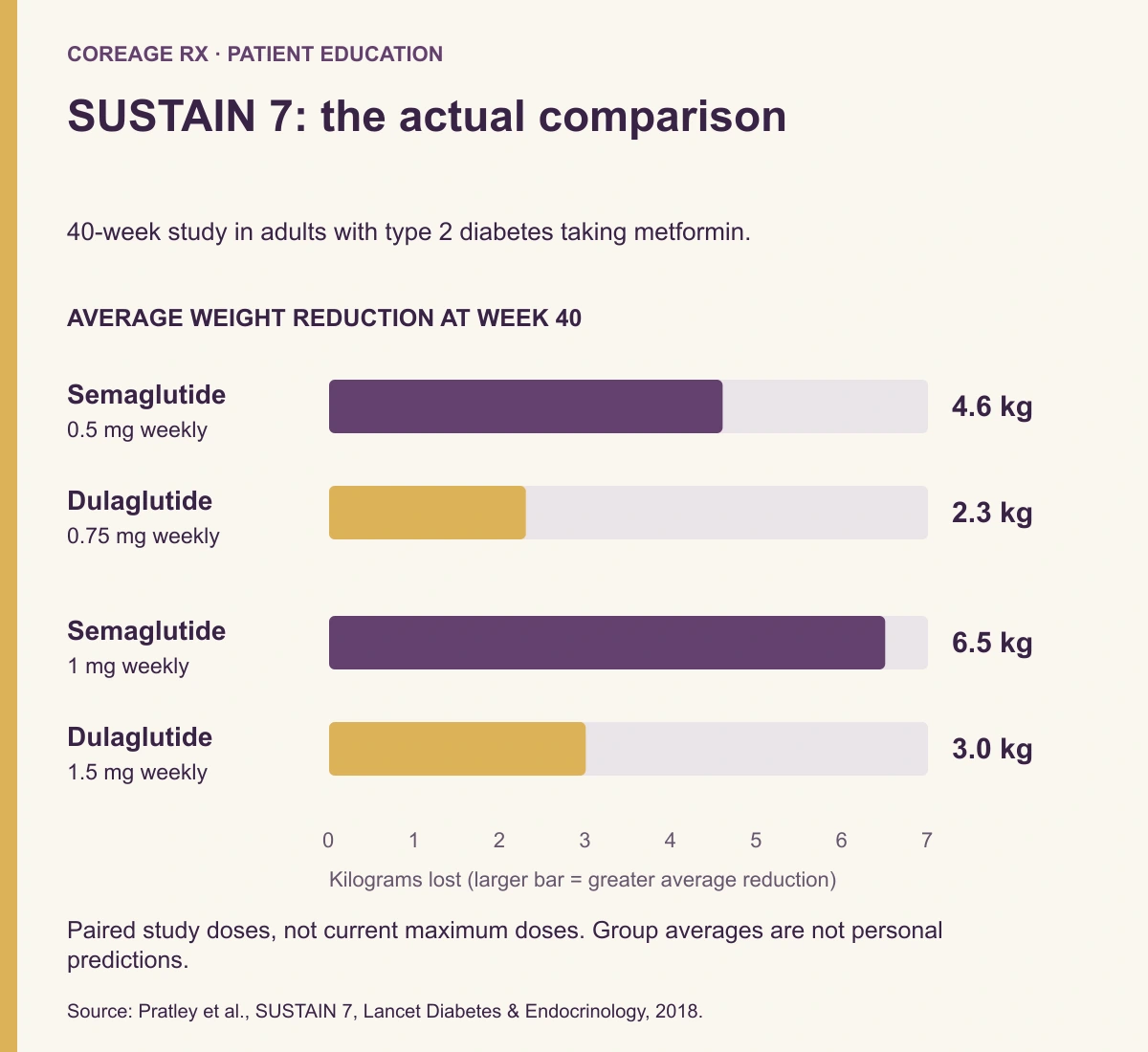
SUSTAIN 7 was a 40-week, randomized, open-label trial in adults with type 2 diabetes inadequately controlled with metformin. It randomized 1,201 participants. The paired comparisons favored semaglutide for average HbA1c and weight reductions at the doses studied. SUSTAIN 7
| Weekly study treatment | Average HbA1c reduction | Average weight reduction |
|---|---|---|
| Semaglutide 0.5 mg | 1.5 percentage points | 4.6 kg |
| Dulaglutide 0.75 mg | 1.1 percentage points | 2.3 kg |
| Semaglutide 1 mg | 1.8 percentage points | 6.5 kg |
| Dulaglutide 1.5 mg | 1.4 percentage points | 3.0 kg |
The study did not compare today’s maximum Ozempic 2 mg and Trulicity 4.5 mg doses, and it was not a trial of weight-management treatment in people without diabetes. These results do not establish equivalent switching doses or guarantee an individual’s response.
HbA1c is a measure used to assess blood sugar over time. A change measured in percentage points is different from a percentage change in body weight. Keeping the outcome and units visible is essential when reading a comparison chart.
Is Ozempic better for weight loss?
The trial above supports a specific conclusion about the paired doses and population studied. It does not justify promising a particular weight loss to someone choosing between current prescriptions.
Your starting health, time on treatment, tolerated dose, food intake, other medicines, and consistency of access can influence the experience. An early appetite change is not the same outcome as a measured long-term weight change. If you already take a medicine, compare your response with the goals you and your clinician set rather than with a stranger’s before-and-after photos.
If weight management is the main treatment purpose and you do not have type 2 diabetes, ask about products approved for that purpose. Wegovy is a semaglutide brand with weight-management indications; it has its own formulations and instructions. Do not substitute Wegovy trial outcomes for Ozempic outcomes simply because both contain semaglutide. Wegovy prescribing information
Our guide to choosing a GLP-1 medication provides a broader starting point, including how diagnosis and goals change the comparison.

How do heart and kidney considerations affect the choice?
The cardiovascular indication wording differs, as shown in the table. That difference can matter when a person has several risk factors but has not been diagnosed with established cardiovascular disease. It should be discussed with the clinician who knows the person’s history.
Ozempic also has a specific labeled indication addressing kidney outcomes and cardiovascular death in adults with type 2 diabetes and chronic kidney disease. That does not mean it is appropriate for everyone with a kidney problem, or that Trulicity has no kidney-related research. It means the current approved-use statements are different. Ozempic label, Trulicity label
Bring recent laboratory results, your medication list, and the diagnoses you have been given to the appointment. Ask which outcome is driving the recommendation and how that outcome will be monitored. A weight-loss ranking alone cannot answer a question about protecting kidney function or reducing cardiovascular events.
What about nausea and other side effects?
Gastrointestinal symptoms are common with this class. Both labels describe risks involving severe gastrointestinal reactions, pancreatitis, gallbladder disease, dehydration-related kidney injury, and diabetic retinopathy complications. Low blood sugar risk can increase with insulin or insulin-releasing medicines. The products also carry boxed thyroid-tumor warnings and are contraindicated with a personal or family history of medullary thyroid carcinoma or MEN2. Trulicity safety information, Ozempic safety information
Those warnings do not mean every person will experience the same symptoms. They do mean a smaller dose or a different brand name is not enough to decide safety on its own.
During a review, describe what is happening rather than reporting only that a drug “does not agree with me.” Useful details include symptom timing, severity, bowel changes, how much you can eat and drink, and whether symptoms followed a dose increase. Our GLP-1 nausea guide can help you organize that information.
Persistent severe abdominal pain, repeated vomiting, inability to keep fluids down, or a serious allergic reaction needs prompt medical attention. Do not manage those problems by alternating products or taking extra medication without advice.
Are the injection devices and doses the same?
No. Trulicity uses a single-dose pen. The current Ozempic injection label includes multidose pens and certain single-dose prefilled syringes. Learn the instructions for the presentation actually dispensed to you; older online demonstrations may show another device. Current Trulicity instructions, Current Ozempic instructions
A higher milligram number across two different drugs does not mean a stronger or equivalent treatment. Dose selection also differs for children and adults where pediatric use is approved. This adult comparison should not be used to construct a child’s prescription.
Before the first injection or a device change, ask the pharmacist to demonstrate preparation, administration, and disposal. Check that the packaging, prescription, and written directions agree. Our Ozempic dosage guide explains the labeled schedule, but your own prescription and device training govern administration.
Can you switch from Trulicity to Ozempic?
A clinician may consider a switch for reasons such as blood-sugar response, side effects, coverage, or a change in health goals. The transition needs a plan; it is not a milligram-for-milligram substitution.
Provide the current dose, date of the last injection, recent symptoms, glucose readings if relevant, and the other medicines you take. Ask for written instructions covering the first dose of the replacement, follow-up, and what to do if there is a delay in obtaining it. Do not overlap the two on your own.
If the reason is that weight change has slowed, first consider whether the treatment is meeting other goals. A plateau in weight is not automatically treatment failure for a medicine prescribed for diabetes or cardiovascular risk. Our semaglutide plateau guide explains questions that are more useful than immediately increasing a dose.

Cost and access questions to ask
Your pharmacy cost depends on the exact product, insurance rules, deductible, eligibility for assistance, and dispensing circumstances. An advertised price may not describe your ongoing total cost.
Ask the insurer which product is covered for your diagnosis, whether prior authorization is required, and what documentation is needed. Ask the clinic whether visits, laboratory work, and follow-up are included in any quoted program price. Our GLP-1 insurance guide and Ozempic cost guide provide a checklist for those conversations.
CoreAge Rx’s semaglutide service page describes its program. Confirm the exact formulation and pharmacy product before comparing it with branded Ozempic; a service using the same ingredient is not necessarily dispensing that brand.
Questions to bring to your next appointment
The most productive comparison usually ends with a few clear decisions:
- What outcome are we treating, and how will we measure it?
- Does my cardiovascular or kidney history change the recommendation?
- How do my current symptoms and other medicines affect the choice?
- What device will I receive, and who will teach me to use it?
- What is the follow-up and access plan if we change treatment?
Trulicity and Ozempic both have established roles in diabetes care. The decision should connect the evidence to your diagnosis, tolerability, and ability to continue treatment, rather than rely on one headline about weight loss.
Check a Trulicity price against its supply and eligibility
- Trulicity GoodRx prices and savings terms — Compare a dated local coupon example with insurance claims, current manufacturer eligibility, supply periods, and savings caps.
Educational information for adults; individual treatment decisions require a qualified clinician. Sources checked September 27, 2026. Original AI-generated article illustrations depict fictional people and objects, not patient outcomes. Other editorial images are illustrative. Graphics summarize the cited sources.