
Sourdough bread can fit into a weight-management eating pattern. The word sourdough, however, does not tell you the calorie amount, fiber content, whole-grain proportion, or portion you will eat. Fermentation and nutrition are related questions, but they are not interchangeable label claims.
The most useful comparison starts with the actual bread and slice. Then consider the rest of the meal, your preferences, and any medical requirements. You do not need to find one universally “best” bread to make a workable plan.
Here is how to compare sourdough with other breads, interpret the human research, and answer common questions about blood sugar, gluten, and weight loss.
What does sourdough mean on a bread label?
Sourdough describes a fermentation approach. It does not automatically mean that the bread is made entirely from whole-grain flour, has little carbohydrate, or contains fewer calories than another loaf.
Read the ingredient list and Nutrition Facts separately. The ingredients tell you about the formula; the panel tells you amounts for a defined serving. A tangy taste, rustic crust, or artisan appearance cannot replace either check.
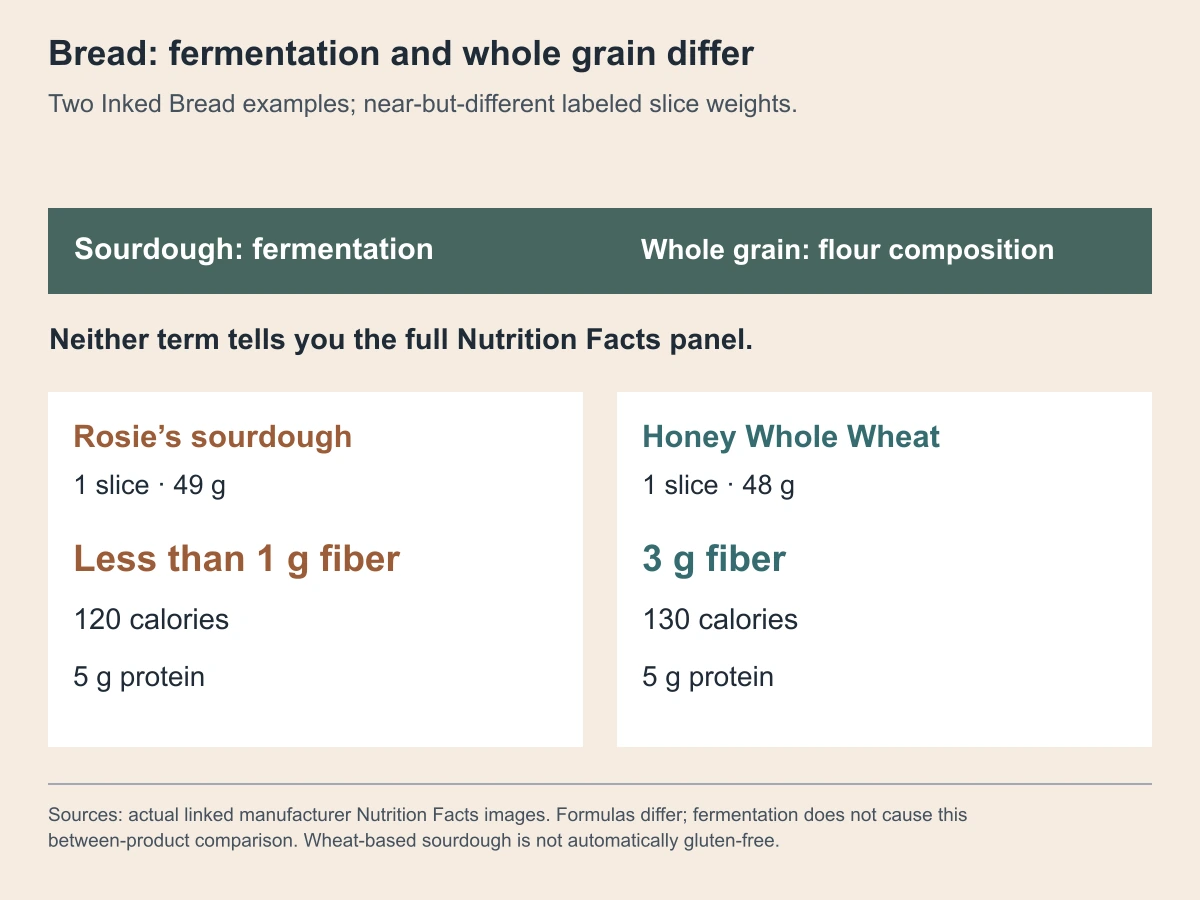
For example, the manufacturer ingredient list for Inked Bread Rosie’s San Francisco Bay Sourdough begins with unbleached wheat flour and lists whole-wheat flour later. Its Honey Whole Wheat bread begins with whole-wheat flour. These are different formulas from the same manufacturer; their names alone do not provide the full comparison.
Sources: Rosie’s sourdough product and label and Honey Whole Wheat product and label. These examples help illustrate label reading rather than recommend a particular brand.
Compare actual slices, not bread categories
The manufacturer’s linked Nutrition Facts images give these values:
| Named bread example | Serving | Calories | Carbohydrate | Fiber | Protein |
|---|---|---|---|---|---|
| Rosie’s San Francisco Bay Sourdough | 1 slice, 49 g | 120 | 24 g | Less than 1 g | 5 g |
| Honey Whole Wheat | 1 slice, 48 g | 130 | 25 g | 3 g | 5 g |
The portions are close in weight, but they are not identical. The fiber difference is more useful than assuming the sourdough name guarantees a higher-fiber product. It also does not follow that fermentation caused the difference; the formulas differ in other ways.
Neither row describes every sourdough or whole-wheat bread. A dense bakery slice may weigh much more than a packaged slice. A homemade recipe may have a different flour mix. Check the loaf you eat rather than borrowing a value because its name sounds similar.
The FDA explains that label serving sizes are reference amounts for the panel, not prescribed personal portions. If you eat two slices, include two servings in the comparison; fillings and spreads add their own amounts. FDA Nutrition Facts guidance
Is sourdough lower in calories?
Sometimes a particular portion has fewer calories than another, but the category does not guarantee it. In the examples above, one sourdough slice is listed at 120 calories and one whole-wheat slice at 130. That small difference between named products cannot predict a weight-loss result.
Portion and meal context often explain more than the category name. Two large slices with toppings are different from one smaller slice in a mixed meal. Counting only the bread while ignoring a substantial spread gives an incomplete picture.
It can be useful to ask, “What portion makes this a meal I enjoy?” rather than always seeking the lowest number. A food that fits your routine and leaves room for variety may be easier to use consistently than a bread chosen only for a marginal label difference.
Our balanced-meal guide focuses on the meal as a whole. Our breakfast planning article gives examples that include carbohydrate foods rather than requiring their removal.
Does sourdough cause weight loss?
The primary research reviewed here does not establish that choosing sourdough causes long-term weight loss. A short study of glucose responses is not the same as a trial showing sustained fat loss.
Bread can fit an eating pattern that supports your goals. The effect of a choice depends on what else you eat, the amount, and whether the routine remains workable. Calling one loaf a weight-loss food skips those questions.
If a familiar bread helps you build a satisfying meal, that is a practical reason to use it. If you find another bread more enjoyable, affordable, or useful for your fiber intake, that may be a better fit. The decision does not need a promise that fermentation burns fat.
Similarly, bread is not the automatic explanation for a plateau. Our weight-loss plateau article provides a broader set of questions for people using semaglutide, including treatment response and tolerability.
What does human research say about blood sugar?
A 2017 randomized crossover study compared traditionally made whole-grain sourdough with industrial white bread during two one-week interventions. The original abstract reported no significant difference across multiple clinical measures and substantial person-to-person variation in glucose responses. Original 2017 study record
That result does not mean bread types never matter. It means the study did not support a simple universal ranking for the participants and comparisons it measured. Its short duration also cannot establish long-term weight loss, and the reviewed abstract does not provide every method or participant detail.
If you have diabetes, use your care plan rather than assuming that sourdough cannot raise glucose. Portion, carbohydrate content, the rest of the meal, and individual responses matter. NIDDK diabetes eating guidance
Do not start extensive glucose tracking because one food article suggests a universal “spike” problem. If monitoring is already part of care, discuss the pattern with the team that knows your situation.
Is whole-grain sourdough different from white sourdough?
Yes, the flour composition can differ. A bread can be both sourdough and whole grain, or sourdough with a substantial refined-flour component. Fermentation does not replace the need to read the ingredient list.
Look for the actual grain ingredients, then check the fiber amount per serving. A product name that contains “wheat” does not by itself establish an entirely whole-grain formula. A darker color or seeds on the crust cannot establish it either.
The comparison above shows why both checks help. Rosie’s sourdough lists less than 1 g of fiber per slice, while the named whole-wheat example lists 3 g. Another sourdough could have a different value; use its actual panel.
If you want more fiber across the day, bread is one possible contributor. Beans, fruit, vegetables, and other foods can also be part of the discussion. Our pinto-bean article and grapes-at-night article offer other defined food comparisons.
If you are also reviewing CoreAge Rx Full House, identify it as a fiber-focused supplement. A supplement has its own ingredients and suitability questions; it does not make bread labels irrelevant or replace the variety supplied by meals.
Is sourdough gluten-free or safe for celiac disease?
Ordinary wheat-based sourdough should not be treated as gluten-free because it is fermented. The two breads in this article contain wheat. An easier-to-digest claim does not establish celiac safety.
NIDDK explains that celiac disease requires a gluten-free eating pattern. Use appropriately identified products and guidance from your care team, rather than testing wheat sourdough based on a general wellness claim. NIDDK celiac nutrition guidance
Wheat allergy is another distinct issue. Check the allergen statement on the actual bread and follow your allergy plan. Fermentation is not proof that wheat proteins have become safe for someone with an allergy. FDA allergen information
If avoiding gluten has made meals difficult, a dietitian can help you find suitable options. The goal is adequate, practical eating within the necessary restriction, not finding a way around a diagnosis.
Does sourdough contain live probiotics?
The presence of fermentation in production is not enough to claim that the finished baked bread delivers a clinically effective live probiotic. That claim would need evidence about the organisms in the finished product, the amount, and the outcome.
“Fermented,” “probiotic,” and “good for digestion” are different claims. A product should not inherit the benefits of a different fermented food or supplement simply because both involve microbes at some point.
You can enjoy bread without attaching a gut-health treatment claim to it. If digestive symptoms are persistent, describe them to a clinician rather than relying on a loaf to solve the problem.
Our probiotic bloating article discusses another product category. It is not evidence that sourdough acts as a probiotic or that a probiotic is needed alongside bread.
Ways to include bread in a more complete meal
Think about what the bread is carrying or accompanying. A sandwich with a protein food and vegetables is different from eating toast alone and then remaining hungry. A soup-and-bread meal can also vary greatly depending on the soup.
Examples to adapt include toast with eggs and a vegetable side, a sandwich with a protein food you enjoy, or a smaller slice alongside beans and vegetables. These are meal ideas, not prescribed servings or promises of a specific calorie deficit.
If reflux or nausea makes a large meal uncomfortable, discuss smaller practical combinations with your care team. Do not assume that sourdough solves a medication-associated symptom because it has a reputation for digestion.
Our tirzepatide nausea and reflux guide and semaglutide protein article explain why tolerability and adequate intake need attention together.

For another bread format, our guide to bagel nutrition and weight-management questions compares a named label, portion size, toppings and the complete breakfast rather than declaring every bagel unhealthy.
Common questions about sourdough and weight management
Is sourdough keto?
The named sourdough example has 24 g of carbohydrate per slice. A product’s fermentation category is not a low-carbohydrate guarantee. Read the actual label if carbohydrate intake is part of your plan.
Is homemade sourdough healthier than packaged bread?
Homemade describes where it was made, not a fixed formula or nutrient profile. Flour, recipe, slice size, and the meal still matter. Convenience and enjoyment are also reasonable considerations.
Can I eat sourdough every day?
That depends on the role it plays in your eating pattern, portion, preferences, and any medical restrictions. Frequency alone cannot tell you whether a food is suitable.
Can I eat it while taking semaglutide or tirzepatide?
Discuss your nutrition needs and symptoms with the prescribing team. A bread category is not a universal GLP-1 rule. The semaglutide questions guide and tirzepatide questions guide provide more treatment context.
Where do medication options fit?
CoreAge Rx semaglutide care and tirzepatide care involve separate eligibility and risk discussions. Choosing a bread or finding meal planning difficult does not establish that medication is indicated.
A useful bread decision
Identify the bread, read the ingredients and serving, compare fiber and other relevant nutrients, and consider the complete meal. Follow gluten, allergy, diabetes, or other medical instructions when they apply.
Sourdough can be part of a good meal. Its value should come from how the actual loaf fits your needs, not from treating fermentation as a guarantee of weight loss, gluten safety, or superior glucose responses for everyone.
Educational information for adults; individual treatment decisions require a qualified clinician. Sources reviewed October 1, 2026. Original AI-generated article images depict fictional people and objects, not patient outcomes. Other editorial images are illustrative. Graphics summarize the cited sources.