
Pinto beans can be a useful part of a varied eating pattern: they provide carbohydrate, fiber, and protein, and they work in many inexpensive meals. They do not cause weight loss by themselves. The portion, product, recipe, and rest of the meal matter.
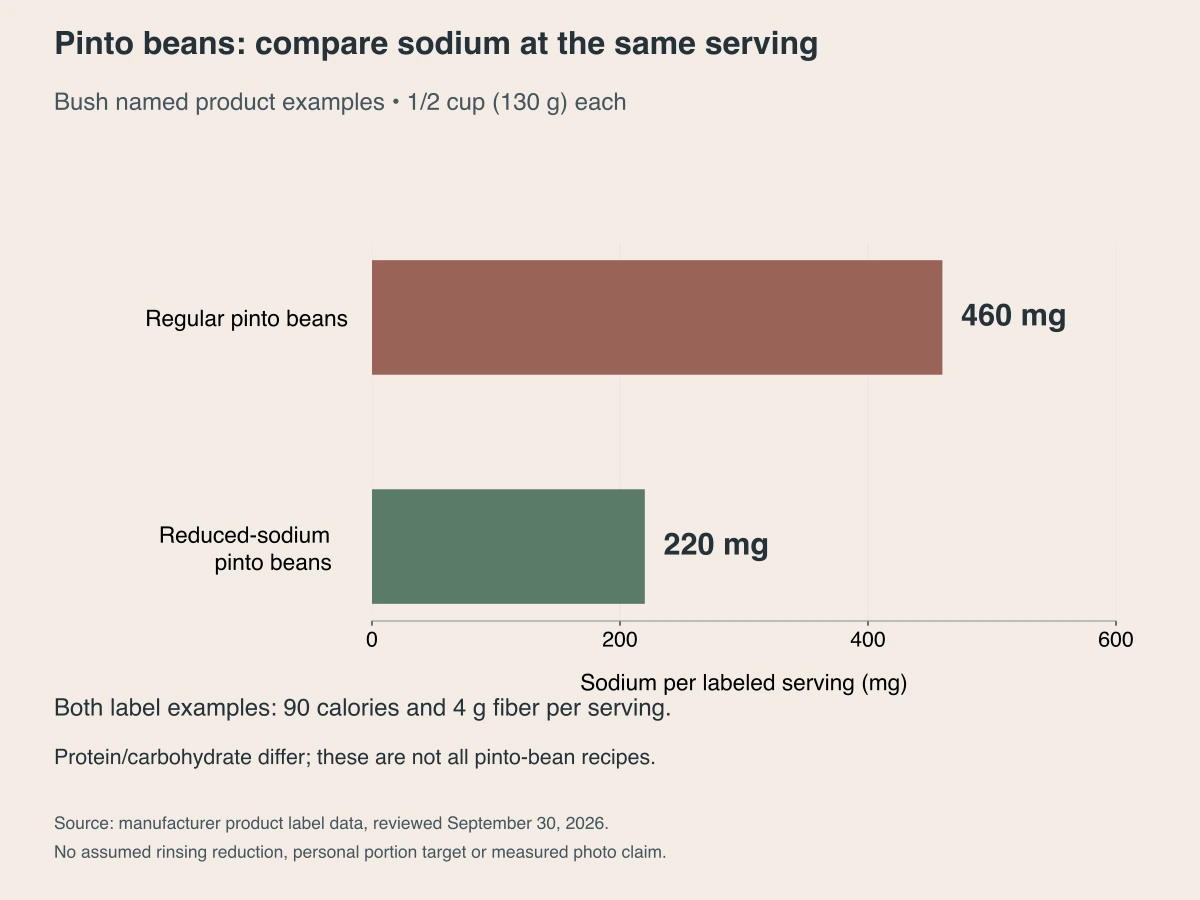
A label can also challenge assumptions about “all beans” having one nutrition profile. Two Bush canned pinto products reviewed September 30, 2026 have the same labeled serving size but different sodium and some other nutrient amounts. Use your actual package when planning your own meal.
Pinto-bean nutrition: two named product examples
Both examples below use 1/2 cup, or 130 g, as the labeled serving. These values describe those canned products, not every home-cooked pot of beans.
| Nutrient per labeled serving | Bush Pinto Beans | Bush Reduced Sodium Pinto Beans |
|---|---|---|
| Calories | 90 | 90 |
| Total carbohydrate | 15 g | 16 g |
| Fiber | 4 g | 4 g |
| Protein | 5 g | 6 g |
| Sodium | 460 mg | 220 mg |
Sources: Bush regular pinto-bean product data, Bush reduced-sodium product data.
The differences are not a reason to assume one product produces a different weight-loss outcome. They show why a comparison should retain the brand, product, and serving amount. Rounded labels and formulations can differ; a generic database entry may not match your can.
Are pinto beans carbohydrates or protein?
They provide both. The table also shows fiber, which is included within total carbohydrate rather than added on top as a separate carbohydrate total. Looking for a single food-category label can hide that combination.
For meal planning, a bean portion can contribute to several parts of the meal. The protein amount still depends on the portion and product, and it should not be assumed to meet an individual’s entire meal requirement.
NIDDK includes beans within diabetes food planning and explains that carbohydrate amounts and portions matter. Having carbohydrate does not automatically exclude a food from a balanced plan. NIDDK nutrition guidance.
Our balanced-meal guide offers ways to combine foods without requiring every ingredient to have only one nutritional job.
Are pinto beans good for weight loss?
They can fit an eating pattern used for weight management, but the useful question is how the meal fits your needs and routine. Beans are not a shortcut that overrides the amount or composition of everything else eaten.
Consider what you are replacing or building. Adding a modest bean portion to vegetables and another suitable food is a different meal from a large restaurant dish with several calorie-containing toppings. Both may use pinto beans; the full dishes are not nutritionally identical.
Our calorie-intake guide explains why estimates and individual needs matter. The fat-loss timeline guide can help interpret progress without attributing a scale change to one food.
You do not need to label beans as either a mandatory diet food or a forbidden carbohydrate. Choose an amount and preparation that fit the overall plan and are practical enough to eat consistently.
How much is one serving?
A labeled serving is the amount used to display nutrient information. FDA explains that serving size is not a personal recommendation for how much to eat. FDA Nutrition Facts guidance.
If you eat twice the stated amount of the regular example, the label arithmetic doubles: approximately 180 calories, 30 g carbohydrate, 8 g fiber, 10 g protein, and 920 mg sodium. This is a calculation, not a recommended portion.
If you use less or more, calculate from that amount rather than call every bowl “one serving.” Measuring once can help you see what the labeled portion looks like in your usual dish. You do not need to weigh every meal indefinitely to learn the distinction.
Dry beans, cooked beans, and canned beans also use different measurement contexts. Do not carry a dry-food cup measure directly into a cooked-serving calculation. Use information appropriate to the product and preparation you are actually eating.
Why sodium can change the comparison
At the same stated serving, the two manufacturer examples list 460 and 220 mg sodium. The lower-sodium choice may be relevant if your personal plan includes a sodium limit. It does not remove the need to count other ingredients in the dish.
Seasoning packets, sauces, cheese, broth, and other foods can add sodium. A lower-sodium can plus a salty sauce may produce a different total than you expected. Compare the complete recipe when the amount matters medically.
If you drain or rinse beans, do not assume a particular reduction percentage from these labels. The numbers above describe the manufacturer reference products; this review does not measure the nutrition of your drained or rinsed portion.
For kidney disease or another condition requiring a specific plan, use the clinician or dietitian’s guidance. NIDDK kidney-disease nutrition explains why sodium and other nutrition questions can be individualized.
Are canned or dried pinto beans better?
The practical choice depends on time, equipment, storage, cost, and the product. Canned beans may make a quick meal easier; dried beans require planning and preparation. Neither format supplies one universal nutrient amount for every recipe.
For canned products, compare serving size, ingredients, and sodium, and follow the package instructions. For dried beans, use reliable product-specific preparation guidance and account for the ingredients added during cooking.
Compare cost at an equivalent prepared amount when possible. A low bag price is less useful if preparation does not fit your schedule. A convenient can may be worthwhile if it helps you make a meal you otherwise would skip.
Choose an option you will use, then keep the comparison grounded in its actual label or recipe. The goal is a dependable food routine, not winning an argument about one format.
A simple bean meal formula
Start with beans, then add foods that suit your appetite and nutrition plan. Examples include:
- Bean bowl: pinto beans, vegetables, a suitable grain, and a preferred sauce.
- Bean wrap: beans, vegetables, a tortilla, and another protein food if wanted.
- Bean soup: beans with vegetables and broth, with bread or another side as needed.
- Breakfast beans: beans on toast, or beans alongside eggs or tofu and produce.
These are assembly ideas, not quantified recipes. Oil, toppings, grain portions, sauces, and any additional protein change the final nutrition. If a number matters to your plan, calculate from the ingredients and amounts used.
Our breakfast guide includes savory and leftover options. Breakfast does not need to come from a separate category of specialty products.
Are refried beans the same as plain pinto beans?
Not necessarily. A prepared dish may contain other ingredients and use a different serving size. Check its label or recipe rather than substitute the table for every dish made from pinto beans.
At home, record what you add if you are calculating the meal. At a restaurant, use available menu information and recognize that an unmeasured portion is still an estimate. You cannot determine the full nutrition from the word “pinto” or a photograph.
The same applies to chili, bean dips, burritos, and bean salads. Each can be a useful food, but each needs its own context. A familiar base ingredient does not make every finished dish the same.
Beans during semaglutide or tirzepatide treatment
Appetite and meal size may change during treatment. Choose a portion that fits the individual eating plan and describe any persistent difficulty eating to the care team. A bean dish can be an option; it is not a required GLP-1 food or a way to manage medication intolerance by itself.
If discomfort repeatedly follows a meal, note the portion and all ingredients, not just the beans. That gives the clinician or dietitian more useful information than a general statement that “fiber bothers me.” Seek assessment for persistent or concerning symptoms.
The semaglutide nutrition guide and tirzepatide nutrition guide discuss adequate intake and function. When reviewing CoreAge Rx’s semaglutide or tirzepatide services, include eating difficulties in the clinical conversation rather than focus only on the scale.
Do beans replace a fiber supplement?
A food and a supplement are different products. Beans contribute several nutrients and become part of a meal; a capsule’s ingredients and serving are assessed on its own label. There is no one-for-one substitution established by the table above.
If you are considering CoreAge Rx’s Full House fiber supplement, review the actual ingredients and reason for using it with your clinician or pharmacist. Do not assume that adding it to a bean meal is necessary or that a supplement can resolve persistent digestive symptoms without assessment.
You can improve a food routine without buying an additional product. The useful question is what the overall plan is missing and which option addresses that need appropriately.

Storing and reheating bean meals
Perishable leftovers should be refrigerated promptly. USDA advises refrigeration within two hours, or one hour when temperatures are above 90°F, refrigerated storage for three to four days, and reheating leftovers to 165°F. USDA leftovers guidance.
Use suitable containers and plan cooling and transport when preparing several meals. A bean wrap or bowl should not sit unrefrigerated in a bag all morning simply because its main ingredient came from a shelf-stable can.
Follow the package’s instructions before opening and safe handling after opening or cooking. Food-storage guidance is different from medicine-storage guidance; do not transfer these rules to an injectable product.
Common pinto-bean questions
Are pinto beans low-carb?
The two named examples contain 15 or 16 g total carbohydrate per 130 g serving. Whether that fits a particular carbohydrate plan depends on the portion and individual guidance.
Do they contain protein?
Yes. The examples list 5 or 6 g at that serving. The amount in your meal depends on the product, portion, and other foods.
Does reduced sodium mean fewer calories?
Not in these examples: both list 90 calories at the same serving. Compare the specific nutrients you care about rather than assume one change affects everything.
Can I eat beans every day?
They can be one option in a varied pattern, but an appropriate routine depends on preference, tolerance, medical guidance, and the rest of the diet. There is no daily-bean requirement here.
Will beans make me lose belly fat?
No specific body-area result follows from eating them. Assess the overall eating pattern and health plan rather than expect one food to select where fat changes.
Can I use the canned label for homemade beans?
Not as an exact nutrition calculation. Ingredients, preparation, and the measured portion differ. Use information that matches the actual recipe.
What is the easiest first change?
Try one simple meal using a product you can regularly obtain. Check its portion and label, add suitable foods, and notice whether the meal fits your schedule and needs. That is more useful than treating beans as a diet rule.
Educational information for adults; individual treatment decisions require a qualified clinician. Sources reviewed September 30, 2026. Original AI-generated article images depict fictional people and objects, not patient outcomes. Other editorial images are illustrative. Graphics summarize the cited sources.