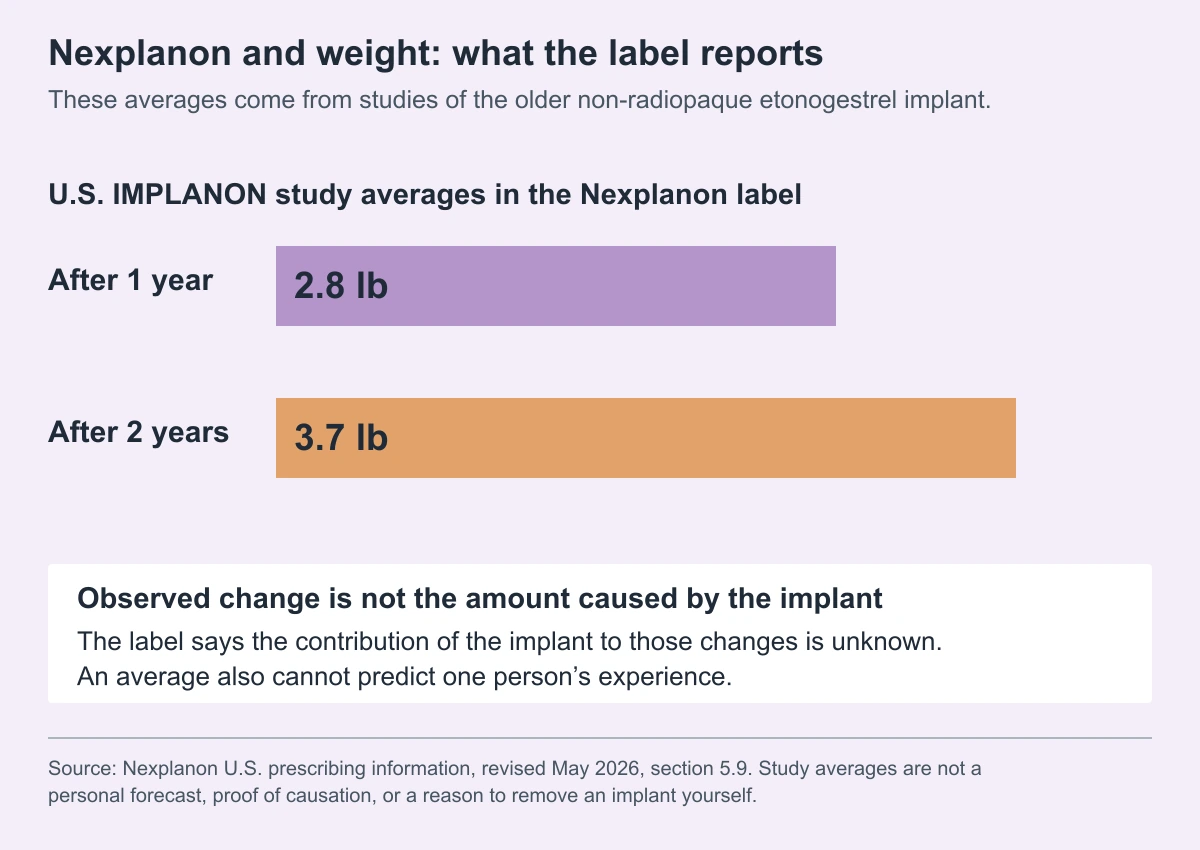
Weight increase has been reported by people using an etonogestrel contraceptive implant, but a reported change does not establish how much the implant caused. The current Nexplanon label cites older U.S. IMPLANON studies with average gains of 2.8 pounds after one year and 3.7 pounds after two years. It explicitly says that the implant’s contribution to those changes is unknown. Nexplanon prescribing information.
Nexplanon is a contraceptive, not a weight-loss treatment. Weight decrease also appears in the label’s postmarketing reports, where reliable frequency and causation cannot be established. If your weight or appetite changes after insertion, the useful next step is a review of your experience, medical history and contraceptive priorities—not a promised outcome from keeping or removing the implant.
What is Nexplanon used for?
Nexplanon contains etonogestrel, a progestin used to prevent pregnancy. It is placed under the skin of the arm by an appropriately trained healthcare professional. The U.S. label revised in May 2026 states use for up to five years. Older online descriptions of a three-year limit may not reflect this current labeling. Confirm the insertion date and removal or replacement plan with your contraceptive clinician. Current manufacturer label.
An implant’s purpose, duration and suitability are separate from its possible side effects. A weight change does not tell you whether the implant is properly placed, whether a new medicine interacts with it, or whether a different method would better fit your needs.
If you want to change methods, ask about alternatives and how contraceptive protection will be maintained during the transition. Do not attempt to remove an implant yourself. Insertion and removal require trained care, and a difficult-to-locate implant can need additional assessment. The decision should consider pregnancy prevention as well as the symptom that prompted the appointment.
What do the weight-gain numbers actually describe?
The label contains several different kinds of information that should not be blended into one statistic. The study averages in section 5.9 describe observed weight changes in U.S. users of the older non-radiopaque etonogestrel implant, IMPLANON. They are not an estimate of the weight caused by Nexplanon in a particular person.
Separately, a three-year clinical-trial adverse-reaction table covering 942 women lists weight increase in 13.7% of participants. A discontinuation table for those trials lists weight increase as a reason for stopping in 2.3%. Those figures describe different outcomes: reporting a reaction and discontinuing because of it. Nexplanon clinical-trial information.
| Label finding | What it describes | What it does not establish |
|---|---|---|
| Mean 2.8-pound increase at one year | An average observed in the cited U.S. IMPLANON studies. | That everyone gains this amount or that the implant caused the whole change. |
| Mean 3.7-pound increase at two years | An average at a different observation point. | A fixed annual rate or a personal weight forecast. |
| Weight increase reported by 13.7% | A reaction reported in the three-year trials involving 942 women. | A causal probability for every current Nexplanon user. |
| Weight increase associated with discontinuation in 2.3% | A reason participants stopped that study treatment. | That removal predictably reverses weight gain. |
The current label also describes a separate study extending Nexplanon use beyond three years, with 498 women evaluated for safety. Do not apply the older trial percentages to that different population or describe them as five-year results. Study duration, formulation and the event being counted matter when interpreting a number.
Does Nexplanon cause weight loss?
It should not be selected as a treatment to lose weight. Weight decrease is included among additional postmarketing reports for IMPLANON and Nexplanon. The label explains that voluntary reports from a population of uncertain size cannot establish reliable frequency or a causal relationship. Postmarketing information.
A person may lose weight while using an implant, but that observation does not demonstrate a weight-loss effect of the implant. Other changes may occur during the same period, including eating patterns, activity, health conditions or other treatments. The timing is worth discussing; it is not a complete explanation.
Unplanned loss should not be dismissed as a welcome side effect simply because weight loss was a previous goal. Tell your clinician whether the change was intentional, how quickly it developed and whether it came with appetite changes or other symptoms. A weight concern can need its own evaluation while contraceptive care continues.
Can Nexplanon change appetite?
Increased appetite is another postmarketing report in the label. As with reported weight decrease, this information does not provide a dependable frequency or establish causation for an individual. It also does not show that everyone experiences an appetite change. Nexplanon label.
If eating feels different after insertion, describe the change in ordinary terms. Are you hungry more often, eating larger portions, skipping meals and then feeling very hungry, or noticing a change alongside another medicine? That history is more useful than assuming that any appetite change proves a hormonal mechanism.
Keep the discussion practical. A clinician or dietitian can help review whether meals are meeting your needs and whether other symptoms require assessment. The balanced-meal guide provides a framework for food questions. It does not replace a review of a new or persistent symptom, and an implant does not require a special universal “Nexplanon diet.”

How can you investigate a weight change without guessing?
Build a short timeline that includes the insertion date, when the change became noticeable and other events around that time. Include medication changes, changes in appetite, activity and sleep, and any pregnancy-related or postpartum context that is relevant to your care.
Use comparable observations rather than isolated scale readings. Note the measurement conditions and distinguish a short fluctuation from a continuing trend. The water-weight versus fat-loss guide explains why body weight does not isolate fat. That distinction can help describe the concern clearly, but it cannot identify the cause by itself.
Bring the record to an appointment without treating it as proof for or against the implant. Ask what else should be considered and what information would change the care plan. If checking weight frequently causes distress or leads to restrictive eating, discuss a different monitoring approach with your clinician.
A review may end with continued use and follow-up, a change in contraception, or assessment of another contributor. The goal is to understand the concern and choose care that fits your priorities. You do not need to demonstrate a particular study average before asking for help.
Will removal make the weight go away?
The label’s reports of weight-related discontinuation do not establish a predictable amount or timetable of weight loss after removal. The study averages cannot be reversed into a promise that removing the implant will remove the same number of pounds. Other contributors to a weight trend may continue.
Discuss your reasons for considering removal, what you hope will improve and how the response would be assessed. If pregnancy prevention remains important, make a contraceptive transition plan with the clinician. In older IMPLANON trials cited by the label, pregnancies occurred as early as 7 to 14 days after removal. That is a reason to plan replacement protection, not a reason to avoid discussing removal. Return-to-ovulation information.
The implant should be removed by a trained professional. Do not cut, manipulate or attempt to retrieve it yourself, even if it feels easy to locate. Weight concerns are appropriate to raise at a routine care visit; they do not justify attempting a procedure at home.
What about Nexplanon and tirzepatide?
People considering a weight-management medicine may reasonably ask about contraception. The Mounjaro and Zepbound labels include a warning about oral hormonal contraceptives because tirzepatide delays gastric emptying. They advise switching to a non-oral method or adding a barrier method for four weeks after starting and for four weeks after each dose escalation. Mounjaro labeling, Zepbound labeling.
Nexplanon is an arm implant, not an oral contraceptive. That oral-absorption warning should not be rewritten as evidence that an arm implant automatically needs removal or is ineffective. Still, tell both prescribing teams which contraceptive method and medicines you use. They can review the entire plan, pregnancy intentions and any relevant interactions.
Nexplanon has its own interaction concerns. The label identifies certain enzyme-inducing medicines and herbal products that may reduce hormonal contraceptive effectiveness, including some antiseizure drugs, rifampicin and St. John’s wort. Do not assume that every supplement or new prescription is irrelevant because the implant is not taken by mouth. Ask the pharmacist or contraceptive clinician about the actual medication list. Nexplanon interaction information.
The tirzepatide and birth-control guide explores that oral-contraception question in more detail. A contraception discussion and a decision about weight-treatment eligibility are related parts of care, but neither should be reduced to a blanket online combination recommendation.
When should you seek prompt medical advice?
Contact your healthcare professional about a rapid or unexplained weight change, persistent appetite problems, new swelling, significant mood changes or other symptoms that concern you. Do not assume that a symptom is harmless because it began after an implant was inserted.
The label also addresses concerns beyond weight, including abnormal bleeding, depressed mood and possible pregnancy. If you suspect pregnancy or have lower abdominal pain, obtain prompt clinical advice; the label specifically warns clinicians to consider ectopic pregnancy in those circumstances. Serious symptoms should receive urgent assessment rather than waiting for a routine weight discussion. Nexplanon warnings.
These cautions do not mean that ordinary weight fluctuation identifies a dangerous problem. They mean that the symptom pattern matters. Describe what changed and let a qualified clinician decide which evaluation is appropriate.

Questions to bring to your appointment
- What do the study averages tell us about my concern, and what can they not establish?
- Should we evaluate another contributor to the weight or appetite change?
- Do any of my prescriptions or supplements affect contraceptive effectiveness?
- What are the benefits and drawbacks of continuing, removing or replacing the implant?
- If I change methods, how will pregnancy prevention be maintained?
- How should we assess symptoms and progress without making a promised weight-loss timetable?
If weight management is a separate priority, the calorie-intake guide and GLP-1 medication-selection guide can help organize questions. CoreAge Rx’s semaglutide and tirzepatide pages describe offered compounded care. Their products require individual evaluation and should not be assumed to share the FDA approval or product-specific evidence of branded medicines.
The decision is broader than one number
Your experience matters, even when a study cannot assign a precise cause. Nexplanon’s purpose is pregnancy prevention, and the right contraceptive choice depends on your health, preferences and response. Use the label’s weight findings as context for a conversation—not as a promise that you will gain, lose or reverse a fixed amount of weight.
Educational information for adults; individual treatment decisions require a qualified clinician. Sources reviewed September 30, 2026. Original AI-generated article images depict fictional people and objects, not patient outcomes. Other editorial images are illustrative. Graphics summarize the cited sources.