
Grapefruit can be part of an eating pattern, but it is not a dependable weight-loss treatment or a proven way to burn belly fat. Small human studies have produced different findings, and a grapefruit diet is not the same as a balanced plan you can sustain. Medication interactions are also an important part of deciding whether grapefruit is suitable for you.
If you take prescription or nonprescription medicines, check the exact products with a pharmacist before adding grapefruit regularly. The interaction is medicine-specific: grapefruit can increase exposure to some drugs and reduce absorption of others. A universal instruction to eat it a few hours away from tablets does not resolve every interaction.
What nutrients does grapefruit provide?
The USDA FoodData Central entry for raw pink and red grapefruit, FDC 174673, provides this composition per 100 grams. The entry is a USDA SR Legacy food record, published in 2019 and reviewed here on October 2, 2026.
| Nutrient | Per 100 grams of the identified raw fruit |
|---|---|
| Energy | 42 calories |
| Carbohydrate | 10.66 grams |
| Dietary fiber | 1.6 grams |
| Vitamin C | 31.2 milligrams |
These values describe a reference amount of whole raw fruit. They do not describe every half grapefruit, a sweetened juice, a supplement or a prepared “detox” drink. The size of the fruit and the amount consumed matter.
You can use the entry to understand a food’s nutritional contribution without treating 100 grams as a prescribed portion. If you add sugar, honey or other ingredients, consider the finished dish rather than the raw fruit alone.
Does research show grapefruit causes weight loss?
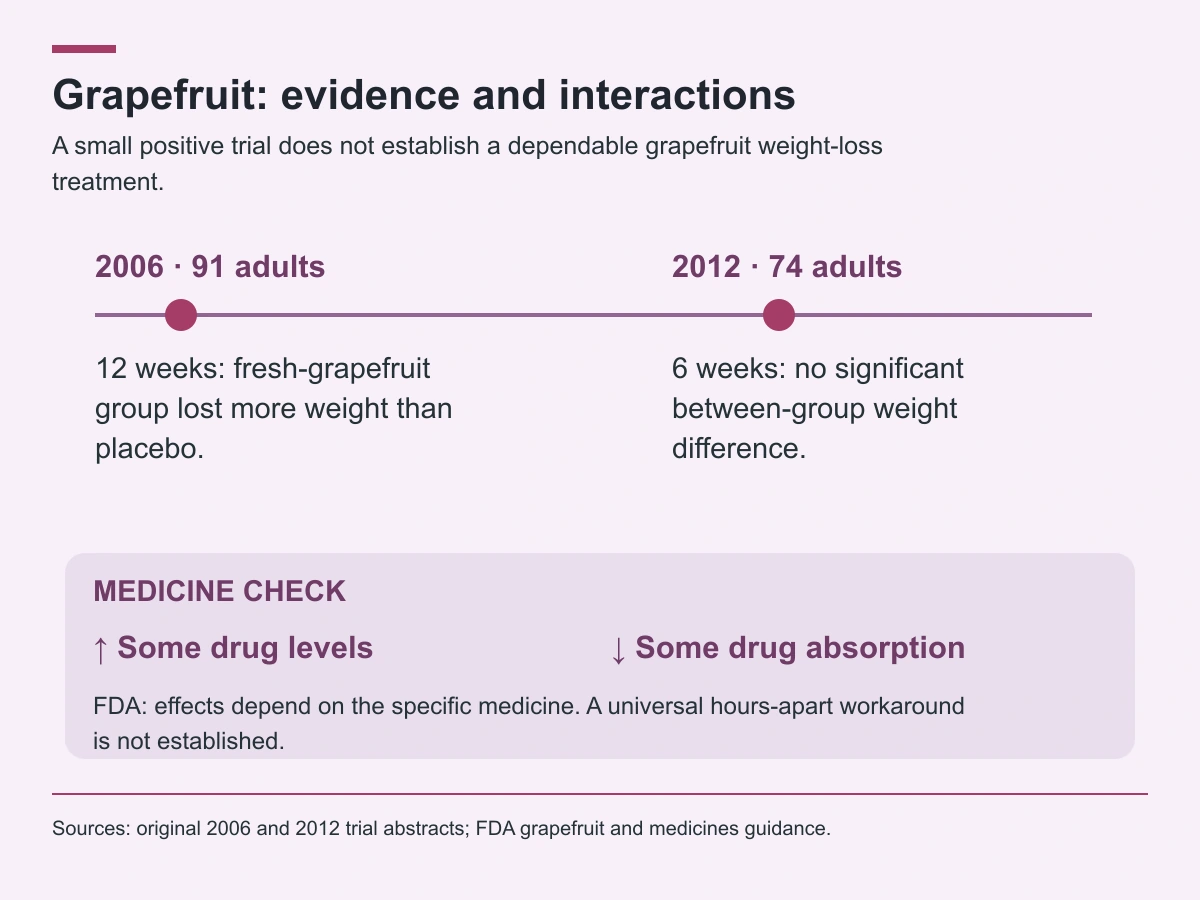
The evidence reviewed here includes two small original human studies with different findings. Their results do not establish a reliable grapefruit treatment or a prediction of your personal result.
A 2006 trial abstract describes 91 adults assigned to four groups for 12 weeks. The fresh-grapefruit group lost an average of 1.6 kilograms, compared with 0.3 kilograms in the placebo group; that fresh-fruit comparison was statistically significant. The experimental fruit schedule is a study detail, not a recommendation to copy it.
A 2012 trial abstract describes 74 overweight adults studied after a three-week washout, followed by a six-week intervention. It did not find significant between-group differences in weight, blood pressure or lipids. Some within-group changes were reported, but those do not establish a treatment benefit over the comparison group.
| Study | Participants and duration | Relevant weight finding | Interpretation limit |
|---|---|---|---|
| 2006 randomized trial | 91 adults, four groups, 12 weeks | Fresh-fruit group lost more weight than placebo | A small trial does not establish dependable benefit or a personal forecast |
| 2012 randomized trial | 74 adults, six-week intervention after washout | No significant between-group weight difference | Within-group change is not proof of benefit versus control |
The original abstracts were reviewed; the full original papers were not read for this article. These studies should not be expanded into claims about selective abdominal-fat loss, all grapefruit formulations or a guaranteed number of pounds per week.
Why “fat-burning fruit” is a misleading shortcut
A food can contribute nutrients and still have no established special effect on stored body fat. Nutrient content, appetite, actual food intake and long-term weight change are separate questions.
If you replace a usual food with grapefruit, the result depends on what you replaced, the amount and the rest of your eating pattern. If you add grapefruit to the same routine, that is a different change. Neither arrangement guarantees weight loss.
A lower scale reading after a highly restrictive diet can also reflect fluid changes or inadequate intake. It does not demonstrate that the fruit selectively burned fat. Our water weight versus fat loss guide explains why short-term numbers need context.
The calorie-intake guide offers a more useful framework for understanding the broader pattern. It does not make one fruit a required daily treatment.
Whole grapefruit, juice and supplements are different
Whole fruit and a glass of juice are not identical products. The reference fiber and calorie values above cannot be transferred to a bottle with different ingredients or an unspecified serving.
Check juice labels for the actual quantity, added ingredients and whether the product is a blend. A drink described as natural, cleansing or low in sugar still needs an ingredient and serving review.
Grapefruit extracts and supplements are another category. The small studies of fresh fruit do not validate every capsule, powder or concentrated mixture. A product’s citrus source does not establish equivalent benefits, interaction risks or a personal dose.
For beverage comparisons, see lime versus lemon water and weight management and our water and drinks guide. Distinguishing the actual drink from the whole food is more informative than grouping everything under citrus.

Grapefruit and medicines: check the specific product
The FDA’s grapefruit and drug guidance explains that grapefruit can interfere with how some medicines are handled. For certain drugs, exposure can increase; for others, transport-related effects can reduce absorption and potentially reduce the intended benefit.
That means the question is not simply whether a medicine is “a statin” or “a blood-pressure drug.” Products within a broad category can differ. The dose, your health and your other medicines can also matter.
Fexofenadine is one example in the FDA guidance where fruit juice can reduce absorption. The page also discusses selected medicines in other categories that can interact. Do not assume that grapefruit always increases drug levels or that every drug in a named class has the same issue.
Bring the complete medicine list to a pharmacist, including nonprescription products and supplements. Ask about the exact product rather than relying on a list copied from a general diet article.
Why separating grapefruit and tablets may not be enough
An interaction can involve how the body processes a medicine, rather than the two items merely being present in the stomach at the same moment. Therefore, a generic two-hour or four-hour separation rule is not a reliable solution for every grapefruit interaction.
Follow the specific product warning and pharmacist’s advice. If the label says to avoid grapefruit, do not replace that direction with an online timing workaround.
Do not stop an important medicine so that you can keep eating grapefruit. Ask about an appropriate food alternative or, when clinically justified, a treatment option the prescriber can evaluate.
The FDA also notes that related fruits such as pomelos, Seville oranges and tangelos may cause similar effects. Substituting another citrus fruit should not be assumed to resolve a known warning without checking.
What if you take semaglutide or tirzepatide?
The main question is the complete treatment plan, including other oral medicines. Being prescribed a weekly injection does not mean grapefruit is automatically suitable with everything else you take.
If you experience nausea or reflux, the fruit’s acidity and your individual tolerance also matter. The NIDDK’s reflux eating guidance discusses individualized food triggers, including citrus for some people. A possible trigger is not a universal prohibition, but recurrent symptoms are a reason to review your experience.
Our tirzepatide nausea and reflux guide and semaglutide nausea and vomiting guide explain questions to bring to the prescribing team. Persistent vomiting or severe abdominal pain should not be managed by switching among fruit-based remedies.
If you are exploring treatment, semaglutide product information can help you ask about the exact formulation, eligibility and follow-up. It does not establish that grapefruit enhances a medicine’s weight effect or that adding it will overcome a plateau.
Diabetes and carbohydrate counting
A grapefruit portion still contributes carbohydrate. Use the actual amount and your individual meal and glucose-management plan rather than treating a “weight-loss fruit” description as a reason not to count it.
Juice can be particularly easy to misdescribe when you do not know the serving or whether it is sweetened. Check the package and discuss repeated glucose concerns with your care team.
Do not change diabetes medicines based on one grapefruit meal, a trial average or a generic internet diet. The nutrition entry helps describe the food; it does not prescribe an insulin adjustment or establish your glucose response.

A practical decision before adding grapefruit
Start with the medicine check. If the exact products are compatible with grapefruit, consider whether you enjoy it and tolerate it. Then decide how it fits the meal, rather than treating it as a treatment to take before every meal.
For example, it might be one fruit option alongside a breakfast that also supplies protein and other nutrients. It should not become the sole food in a restrictive day merely because it is associated with a diet trend.
If grapefruit is unsuitable with your medicine or symptoms, another food can meet your preferences and nutritional goals. You do not lose access to a proven weight-loss treatment by choosing a different fruit.
Our balanced meals guide helps put individual foods in context. The NIDDK’s guide to successful weight-loss programs also emphasizes sustainable plans and support, rather than dependence on one food or a rapid-loss promise.
Frequently asked questions
How much grapefruit should I eat to lose weight?
The reviewed evidence does not establish a universal therapeutic amount. The fruit schedule in a small study is not a prescription for you. First check medicines, then consider portion, tolerance and the rest of your eating pattern.
Does grapefruit burn belly fat?
The reviewed studies do not establish selective abdominal-fat loss. A change in overall weight or intake does not prove that a food targets one body area.
Is grapefruit juice as good as whole grapefruit?
It is a different product with its own serving and ingredients. Do not transfer whole-fruit nutrient values or study findings automatically to juice, and remember that medication interactions can still matter.
Can I eat grapefruit several hours after my medicine?
Ask about the exact medicine. A universal spacing rule does not resolve every interaction, and a specific avoid-grapefruit warning should not be replaced with a timing guess.
Does every cholesterol medicine interact with grapefruit?
No blanket conclusion applies to every product in a class. The FDA advises checking the specific medicine and label. A pharmacist can review your complete list and identify the relevant warning.
Should I stop my medicine if I already ate grapefruit?
Do not independently stop prescribed treatment. Contact a pharmacist or clinician with the product name, dose and amount of grapefruit, and seek urgent help for concerning symptoms. The appropriate response depends on the specific medicine and circumstances.
Educational information for adults; individual treatment decisions require a qualified clinician. Sources reviewed October 2, 2026. Original AI-generated article images depict fictional people and objects, not patient outcomes. Other editorial images are illustrative. Graphics summarize the cited sources.