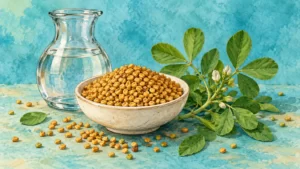
Eggplant water is not an established weight-loss treatment in the sources reviewed here. Whole eggplant can contribute to a varied eating pattern, but its nutrition cannot be assigned to water that has been soaked with slices and strained. A drink’s effect also depends on what it contains, what it replaces, and the rest of your meals.
If you are considering an online eggplant-water recipe, the useful questions are whether it supplies meaningful nutrition, whether it is prepared safely, and whether the claims are supported. This guide explains the difference between the vegetable, an infused beverage, and a weight-management plan.
What is eggplant water supposed to be?
The name usually refers to water prepared with pieces of eggplant, sometimes with lemon or other ingredients, and then consumed as a flavored drink. Online recipes differ in preparation, soaking, additions, and serving suggestions. The name does not identify one standardized product or clinically tested formula.
That variation matters. Water with a few slices, a blended drink containing the vegetable, a sweetened beverage, and a commercial extract can have different compositions. They should not be treated as the same intervention simply because eggplant appears in the name.
The sources reviewed here do not establish a validated eggplant-water recipe, prescribed amount, drinking schedule, or expected fat-loss result. A claim that the drink “works best before breakfast” needs actual evidence for that finished preparation and outcome.
Our water and drinks guide explains why the beverage’s contents and replacement role matter more than a slimming name. Plain water can be a practical drink without being a treatment that burns fat.
What nutrition does whole eggplant contain?
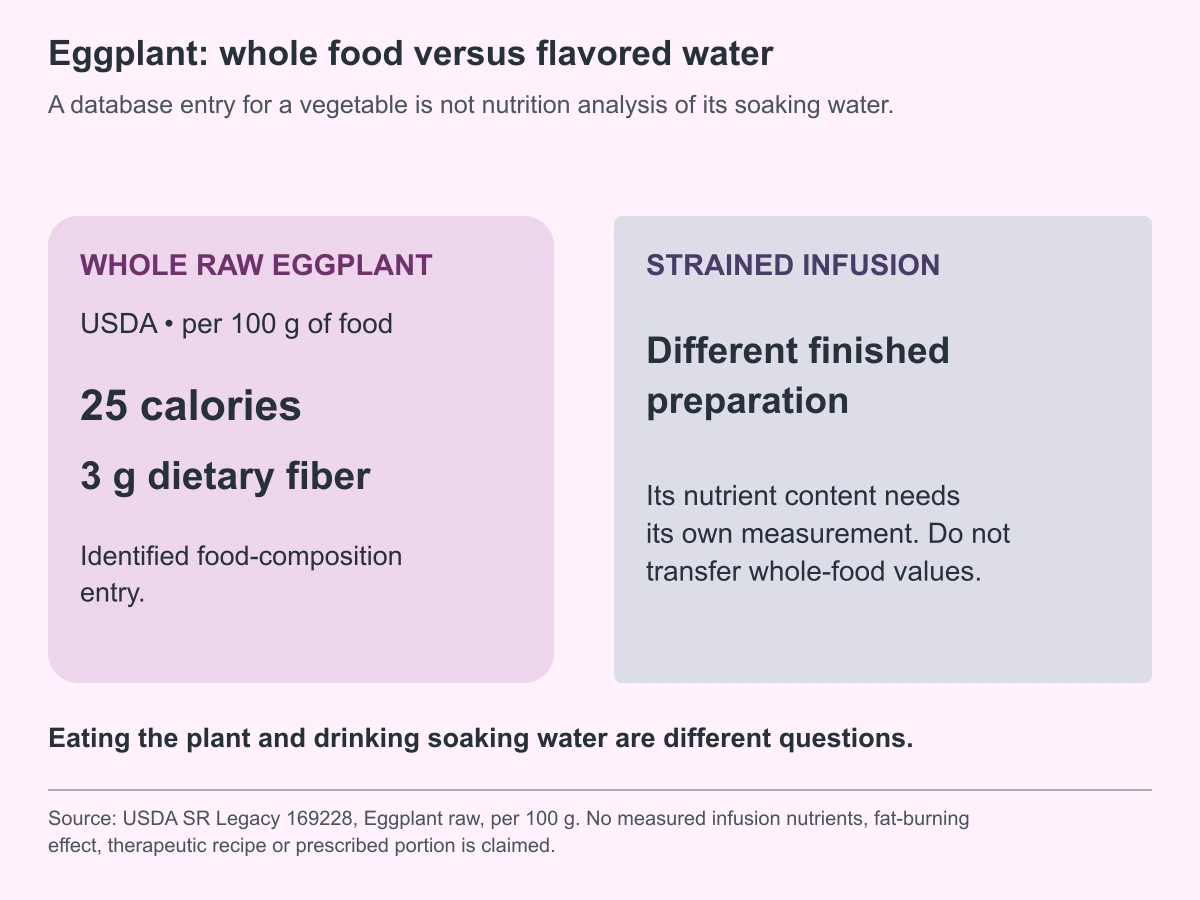
The USDA FoodData Central raw eggplant record provides composition values for the named whole food. Per 100 grams, that entry lists approximately 25 calories, 5.88 grams of total carbohydrate, and 3 grams of dietary fiber.
Those are food-composition values, not a prescribed serving. They concern raw eggplant in the database, rather than a cooked dish with oil, a blended beverage, or strained soaking water. Cooking methods and added ingredients change the finished meal.
| Preparation | What can be said about its nutrition | What needs separate information |
|---|---|---|
| Raw whole eggplant in the USDA entry | The entry provides values per 100 g of that food | Your actual amount and any additions |
| Cooked eggplant in a meal | The vegetable remains one ingredient | Preparation, oil, sauce, and other foods |
| Water infused with slices and strained | It is a different finished beverage | Its measured nutrient composition |
| A blended drink containing the vegetable | More of the plant material is retained | Full recipe, portion, and tolerability |
| A commercial “slimming” blend | The name alone is insufficient | Ingredient list, amounts, warnings, and evidence |
The table explains why a whole-food database entry cannot support an exact nutrient claim for an unmeasured beverage. A product name or appealing photograph is not a laboratory analysis.
Does soaking transfer all the fiber into the water?
No whole-food equivalence should be assumed. Dietary fiber is part of the plant material, and straining out the vegetable changes what is consumed. The USDA’s 3 grams of fiber per 100 grams of raw eggplant does not mean that a glass of strained eggplant water contains 3 grams of fiber.
The precise amount in a particular drink would require information about that finished preparation. It cannot be calculated just by putting the vegetable’s database numbers next to a photograph of a water glass.
This is also why ordinary food fiber and fiber supplements need their own measurements. Our food fiber versus supplements guide explains how to compare actual intake rather than relying on the word “fiber” in a claim.
If fiber is your main goal, discuss food choices and any supplement using the actual label. Drinking an unmeasured infusion can leave the practical nutrition question unanswered even if the drink is pleasant.
Could the drink help by replacing something else?
An unsweetened drink might change overall intake if it replaces a regularly consumed sweetened beverage. That would be a change in the eating and drinking pattern, rather than proof that eggplant releases a fat-burning substance into water.
The effect depends on the comparison. Adding an extra drink without changing anything else differs from replacing a sweetened drink. Adding sugar, honey, syrup, juice, or a commercial mix changes the preparation again.
The FDA’s Nutrition Facts guidance can help you read packaged additions, serving sizes, and added sugars. Use the actual product label rather than assuming that “natural” sweeteners have no nutritional contribution.
Our cucumber and lemon water guide addresses a related beverage claim. Different flavors may make a drink enjoyable, but enjoyment and hydration should not be presented as evidence of a unique slimming effect.
Does eggplant water detox the body?
“Detox” can sound specific without identifying a measurable target. Ask what substance is supposedly being removed, how that was measured, and whether the exact finished beverage has been tested in people.
The National Center for Complementary and Integrative Health’s detox review describes limited, generally poor-quality research on commercial detox approaches. It also discusses risks from restrictive eating, laxatives, and excessive fluid intake. That review does not validate a particular eggplant-water formula.
A short-term scale change is not proof of toxin removal or loss of body fat. Water balance, digestive contents, and changes in food intake can affect the scale. Our water weight versus fat loss guide explains why those outcomes should be distinguished.
Do not use a flavored-water routine to replace adequate meals or a clinical treatment plan. A claim about cleansing should be judged by evidence, rather than by how quickly a person notices a bathroom or scale change.
How can you use eggplant as ordinary food?
If you enjoy eggplant, consider it as an ingredient in a meal you can repeat comfortably. Roasted or otherwise cooked eggplant can be paired with other vegetables, a protein food, and a grain or other carbohydrate source that fits your eating pattern.
The whole dish matters. A preparation with substantial added oil, cheese, or sauce has a different composition from the raw vegetable entry. That does not make it forbidden; it means the meal should be described honestly rather than labeled calorie-free.
A practical comparison looks at the actual recipe, appetite, tolerance, and the role of the meal in your day. It does not require choosing one compulsory portion or removing every enjoyable ingredient.
Our balanced meals guide provides examples of assembling meals. Whole-food variety can address nutrition goals more directly than a strained drink whose fiber and nutrient content have not been measured.
What about preparing an infusion safely?
An internet recipe is not proof that a preparation is safe to leave at room temperature overnight. Use clean utensils and containers, wash produce appropriately, and refrigerate perishable preparations rather than treating soaking as preservation.
The FDA’s food-storage guidance recommends keeping the refrigerator at 40°F or below and observing the two-hour limit for perishable food at room temperature, shortened to one hour when temperatures exceed 90°F. Those general rules do not establish a special shelf life for a homemade eggplant drink.
There is no validated multi-day storage schedule for an unspecified recipe in the sources used here. Smell or appearance alone cannot establish safety. If instructions are unclear, choosing ordinary water and a properly prepared vegetable meal avoids the need to invent a soaking protocol.
People with food allergies or particular digestive, kidney, or fluid restrictions should discuss their own needs. “Vegetable-based” does not mean a finished blend is automatically suitable for every person.
Is eggplant water useful while taking a GLP-1 medicine?
Semaglutide or tirzepatide can change appetite and cause gastrointestinal symptoms. If you are eating less, a flavored drink should not crowd out the food needed to support your nutrition. The GLP-1 nutrition advisory emphasizes nutrition assessment and practical support during treatment.
Describe poor intake, persistent nausea, vomiting, constipation, or difficulty keeping fluids down to the care team. A homemade beverage is not a treatment for an unidentified medication-related symptom. The semaglutide nausea guide provides questions to bring to that review.
If you are exploring CoreAge Rx’s semaglutide or tirzepatide treatment information, ask about the exact preparation and ongoing nutrition support. A beverage claim should not be used to promise the same results as a studied prescription product.
If fiber supplementation is being considered, the fiber supplement guide explains formulation and label questions. CoreAge Rx’s Full House fiber product information is a separate product to evaluate by its actual ingredients and directions, rather than assuming it is equivalent to whole eggplant or any branded psyllium powder.

How should you assess a weight-loss recipe claim?
Look for evidence that answers a defined question about the exact preparation. An ingredient’s nutrient content is useful information, but it is not a trial showing that a drink causes meaningful, sustained weight loss.
The NIDDK’s successful weight-loss program guidance describes eating and drinking changes, physical activity where appropriate, ongoing support, and weight maintenance. Those components provide a more useful framework than a single drink promoted as the missing solution.
Ask whether the recipe is practical, affordable, enjoyable, safe, and compatible with adequate meals. Avoid judging it only by testimonials or a short-term scale photograph. A drink can be an ordinary preference without needing a therapeutic claim.
Frequently asked questions
Is there a proven eggplant-water weight-loss recipe?
The sources reviewed here do not establish one standardized recipe with a validated dose, schedule, or expected fat-loss outcome. Online formulas vary, and ingredient nutrition should not be substituted for a finished-drink trial.
Does it contain the same fiber as eating eggplant?
Do not assume that. Straining out plant material creates a different preparation. Whole raw eggplant’s USDA fiber value cannot be assigned to the water without measuring the finished drink.
Should I drink it instead of breakfast?
A flavored-water drink is not an equivalent replacement for a nutritionally adequate meal. Review your eating pattern and any appetite or digestive problems rather than using a detox rule to skip needed food.
Can lemon make it burn more fat?
Adding lemon changes flavor and composition, but the reviewed sources do not establish that it turns the drink into a fat-burning treatment. Choose ingredients for preference and tolerance while evaluating the full claim accurately.
Educational information for adults; individual treatment decisions require a qualified clinician. Sources reviewed October 1, 2026. Original AI-generated article images depict fictional people and objects, not patient outcomes. Other editorial images are illustrative. Graphics summarize the cited sources.