
Copper-peptide creams are often promoted for firmer-looking skin. The underlying research is interesting, but firmness is a broad claim that can hide several different outcomes. Skin that feels more moisturized, skin that looks smoother in a photograph, and skin with a measured structural change are not the same observation.
If firmness is your main goal, evaluate the evidence at the level of the tested ingredient, formula, and outcome. Then decide how you and your provider will judge whether a particular product is useful. This approach is more informative than treating the largest percentage or the most dramatic before-and-after image as proof.
What does firmness mean in skin care?
In ordinary conversation, firmness may mean less visible sagging, a springier feel, fewer fine lines, or a smoother surface. Research can assess these features differently. Instruments may measure deformation and recovery, investigators may grade photographs, or tissue samples may examine structural markers.
Those measurements are related but not identical. A cream that improves surface hydration can change the way fine lines look without producing a lifting effect. A laboratory change in collagen production does not tell you how much visible improvement a person will notice.
Before choosing a product, name the feature that bothers you. “Fine creases on dry cheeks” is a different goal from “loose skin along the jaw.” That distinction helps the clinician explain what a topical product can reasonably address and where its limits are.
Why copper peptides attracted research interest
GHK-Cu is a copper-binding peptide studied in processes related to tissue remodeling. Laboratory work has examined effects on skin cells and components of the extracellular matrix, the network surrounding cells. These observations provide a biological rationale for further research.
The 2018 GHK-Cu review discusses this work and small cosmetic studies. The topical-delivery review emphasizes limitations in available clinical information and the challenge of skin penetration. The useful conclusion is that the ingredient deserves investigation, while broad certainty about every marketed cream is not justified.
Keep the route of administration in view. Applying a cream to intact facial skin is different from exposing cells directly in a laboratory or delivering a peptide through an experimental method. An impressive result in one setting cannot simply be transferred to another.
Read a firmness claim in five steps
Identify the substance. Was the study about GHK-Cu, another peptide, or a mixture? A general copper-peptide label may not provide enough detail to establish a match.
Identify the finished formula. The vehicle, concentration, and preparation affect exposure. Evidence for one cream does not automatically establish the same benefit for another.
Identify the comparison. A study compared with a matching vehicle can help separate the active’s contribution from moisturizing effects. A photograph taken before and after use without a control leaves more uncertainty.
Identify the outcome. Was firmness measured directly, rated by an investigator, or reported by participants? Was the change large enough to be visible or meaningful?
Identify the follow-up period. Short-term observations do not answer questions about sustained benefit or long-term use. They also may not represent someone with a different age, skin condition, or treatment history.
These questions do not require you to become a researcher. They simply reveal whether a headline answers the question you actually care about.
Why concentration alone cannot settle the question
Bounce Back’s public ingredient summary lists copper peptide 2%. That is product information, not a measured firmness result. It does not disclose every aspect of the formulation or establish that the exact preparation was used in a published trial.
You also cannot compare its percentage numerically with retinol, tretinoin, vitamin C, or a different peptide. Each ingredient has its own chemical properties and formulation requirements. More of an ingredient may change tolerance or stability without producing proportionally greater benefit.
Ask the pharmacy for the exact peptide identity if matching the product to research is important to your decision. If no finished-formula study is available, the provider should explain the rationale and uncertainty clearly rather than imply that ingredient evidence is a direct product guarantee.
Hydration can be valuable without being a lift
Dry skin often has a rougher-looking surface. A suitable moisturizer can improve comfort and make fine dryness lines less prominent. That is a useful cosmetic effect even when it does not alter deeper laxity.
The AAD’s moisturizer guide explains how texture and skin type affect product selection. The cream base deserves attention in any firmness discussion because it may contribute to what you see and feel soon after application.
Separate those early observations from longer-term expectations. If the face looks smoother immediately after cream, record that as a surface effect. Do not convert it into a claim about collagen remodeling or use it to predict what will happen to sagging skin months later.
Compare options by evidence and the actual concern
| Concern | What to discuss | Why the distinction matters |
|---|---|---|
| Dryness lines | Moisturizer and routine tolerance | Surface hydration may be the main issue. |
| Fine photoaging lines | Evidence for topical treatments, including retinoids when appropriate | Some options have more substantial clinical study. |
| Marked laxity | Realistic limits of topical care and other options | Creams should not be presented as equivalent to procedures. |
| New swelling or uneven facial change | Clinical assessment | A new physical change may not be ordinary skin aging. |
The copper-peptide versus retinoid guide explains the evidence comparison. It is not a reason to start a stronger product without review; a treatment still needs to fit your skin, medical history, and tolerance.
How to take useful comparison photographs
Use the same room, light source, distance, and camera settings whenever possible. Keep the facial expression neutral and avoid filters. Compare photographs taken at a similar point in the routine, rather than one before cleansing and another immediately after rich moisturizer.
Include more than a close crop if the concern is facial laxity. A tiny detail may look different because the angle changed. At the same time, do not use photographs to assess a changing lesion or swelling when a medical examination is needed.
Choose a reasonable interval with your provider. Daily comparison encourages overinterpretation of ordinary changes in hydration, sleep, lighting, and expression. A simple record of applications and tolerance helps explain the photographs later.
What would make continuing worthwhile?
Set a goal before the first application. It might be improved comfort, a modest change in texture, or a particular fine-line concern. Also decide how much time, cost, and routine complexity you are willing to accept for that result.
At review, discuss three questions: did the intended feature improve, was the product comfortable enough to use consistently, and is the benefit meaningful to you? A product can be pleasant yet fail to meet the goal that prompted the prescription. That is useful information, not a reason to keep adding layers indefinitely.
If there is no clear improvement, ask whether the initial concern was one a topical could reasonably address. Reconsidering the goal may be more sensible than increasing the amount or combining several firming products without guidance.
Keep safety and sun protection in the plan
Use Bounce Back according to the prescriber’s directions and the pharmacy label. Do not apply a routine cream to broken skin or after a procedure without the treating clinician’s approval. Persistent burning, a rash, or swelling should prompt stopping the new product and seeking advice.
Daily sun protection has a separate role in limiting additional ultraviolet exposure. The AAD recommends broad-spectrum SPF 30 or higher, with appropriate clothing and shade. Copper-peptide laboratory findings do not make the cream a sunscreen.
A useful conclusion from limited evidence
If a clinic offers an instrument-based skin assessment, ask what it measures and how repeat measurements are standardized. A hydration reading, elasticity measurement, and photograph answer different questions. The number is most useful when the conditions and the intended outcome remain comparable.
Limited evidence does not mean a product cannot be helpful. It means the size, consistency, and durability of its benefit are uncertain. That uncertainty should shape the conversation and the claims made about it.
For Bounce Back, review the current product information and ask how the proposed use fits your particular concern. Treat firmness as something to define and assess, not a promise that every peptide cream can deliver in the same way.
Explore Bounce Back™
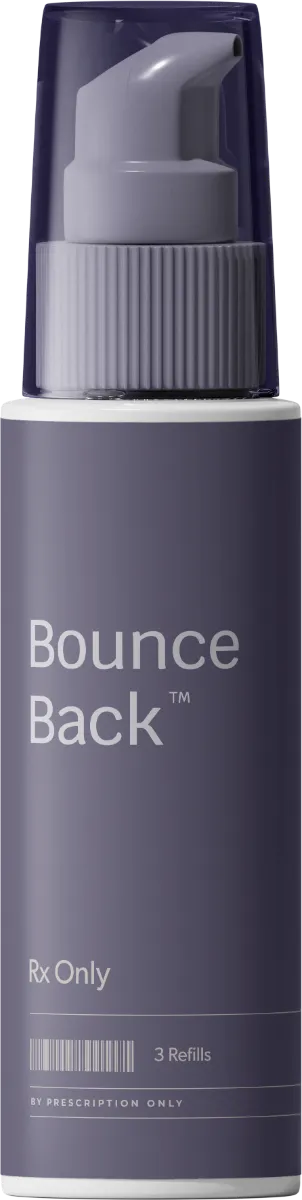
Bounce Back lists copper peptide 2%. Confirm the precise peptide identity, complete formulation, and directions with the dispensing pharmacy and prescribing provider. Review the current Bounce Back™ page and bring your existing skin-care products to the provider discussion.
Related reading
- Copper Peptides for Skin: Evidence, Uses, and Routine Basics
- Copper Peptides vs. Retinoids: Different Roles in Skin Care
- How Long Do Copper Peptide Skin Products Take to Work?
- Bounce Back Copper Peptide Cream: A Product and Evidence Guide
- Tretinoin for fine lines: evidence and daily care
Educational information; your prescription and clinician’s instructions guide individual care. Product details and linked sources checked September 15, 2026. Ingredient research does not establish identical results for a finished compounded formula. Photographs are illustrative and do not show treatment outcomes.