If you are looking for Wegovy in Tulsa, begin by identifying the care and coverage questions separately. A clinician must determine whether treatment fits your health needs. A pharmacy must be able to dispense the actual prescription. Your insurer or public benefit program then applies its own payment requirements.
For Oklahoma residents, official license tools and Oklahoma Health Care Authority pharmacy criteria provide useful starting points. The important detail is that a published Wegovy policy can apply to a specific treatment indication; it should not be read as a promise of coverage for everyone seeking weight loss.
Wegovy, semaglutide, and the reason for treatment
Wegovy contains semaglutide, but a listing for “semaglutide care” does not necessarily mean branded Wegovy. The brand, route, formulation, and indication should be explicit before you compare clinics or prices. Compounded preparations and other semaglutide brands have separate considerations.
The current U.S. Wegovy label includes weight-management and cardiovascular-risk-reduction uses in specified populations. Injection and tablet indications differ in some respects; the injection also has a specified noncirrhotic MASH indication. The correct clinical and coverage discussion therefore starts with what is being treated and which product is proposed. Wegovy prescribing information
Our Wegovy prescription guide explains the assessment questions. The oral semaglutide comparison helps distinguish routes without implying that tablet and injection amounts are interchangeable.
Use Oklahoma’s credential resources before choosing care
Ask for the treating professional’s name and designation. The Oklahoma State Board of Medical Licensure and Supervision search is an official resource for licensees within its scope. Use the appropriate board when the professional is regulated elsewhere.
Match the record to the actual clinician, read the status, and review available relevant information. A search result does not rank clinical quality or guarantee that a service is right for you. The board also notes that some practice information, such as office hours or insurance details, can be incomplete; confirm those directly with the service.
For telehealth, identify who evaluates you, who handles medication questions, and whether the service can care for you in your current location. A website using Tulsa search terms is not evidence of a Tulsa office. Ask for the actual appointment arrangement and contact information.
Check the pharmacy as a separate organization
The Oklahoma State Board of Pharmacy license-lookup page links to pharmacy and pharmacist searches. These are separate credential checks: a professional license and the pharmacy’s authorization describe different entities.
Ask the prescribing service which pharmacy it uses and verify that the package identifies the expected dispenser. If a pharmacy is out of state, ask how its relevant authority can be confirmed. Do not rely only on a platform logo or a reassuring image of a medication box.
Also confirm the pharmacy network, current availability of the prescribed product, delivery or pickup arrangement, and how temperature or device questions are handled. A valid credential does not establish stock or coverage. Our online prescription guide provides a broader checklist for those practical details.
What the published Oklahoma Wegovy criteria do—and do not—say
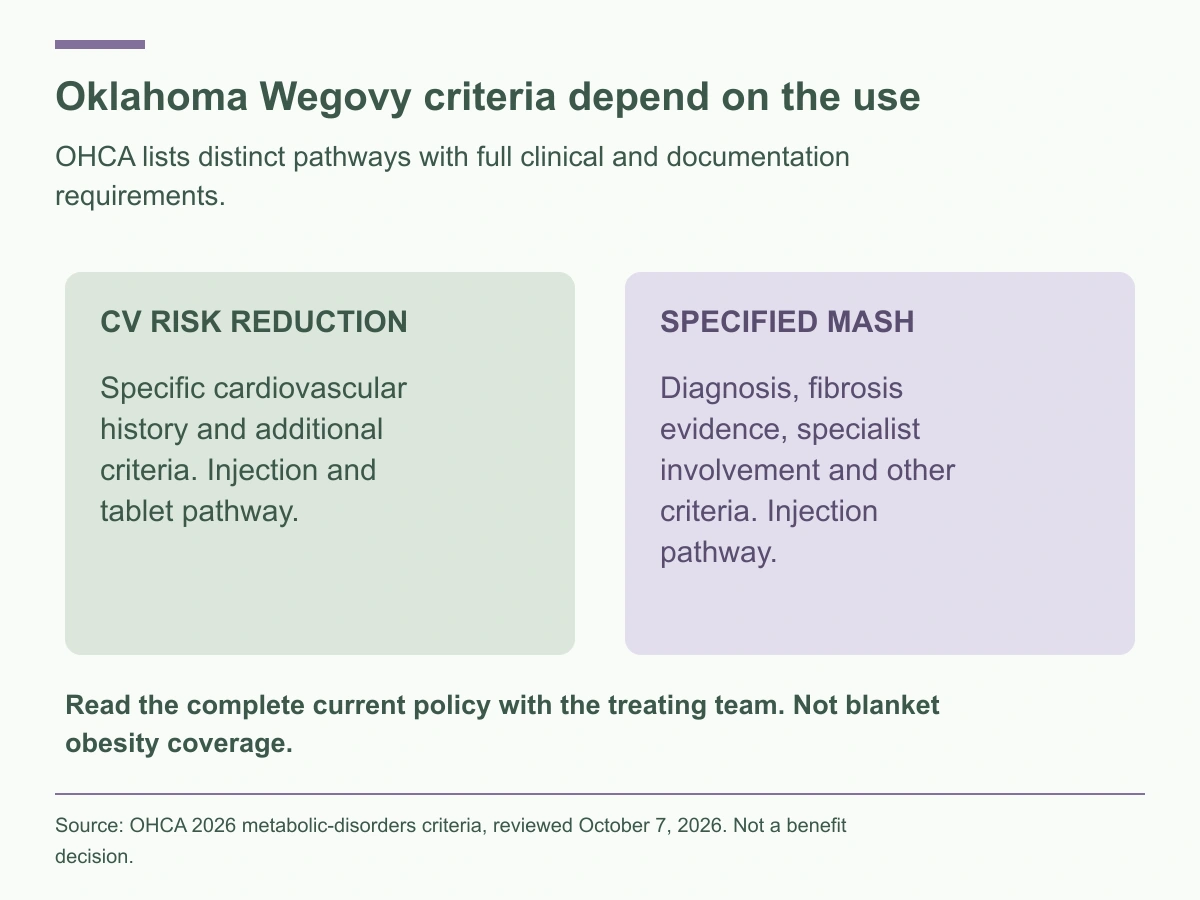
The Oklahoma Health Care Authority’s 2026 metabolic-disorders page contains separate Wegovy criteria for cardiovascular risk reduction and for a specified MASH diagnosis. The page reviewed on October 7, 2026 does not describe blanket Wegovy approval for obesity alone. OHCA Wegovy criteria
For the cardiovascular pathway, the policy specifies established cardiovascular disease with overweight or obesity and additional requirements. The listed criteria include a minimum age, documented qualifying cardiovascular history, BMI, diabetes and A1C restrictions, other treatment conditions, and submission requirements. Reading only the product name would miss much of the actual policy.
For the MASH pathway, the page describes a different diagnosis, fibrosis evidence, specialist involvement, and other requirements. It also distinguishes injection from the broader injection-and-tablet heading used for the cardiovascular pathway. These details should be checked against the current policy and the member’s actual situation.
| Question | Why it matters for the published criteria |
|---|---|
| Which indication is being requested? | Cardiovascular risk reduction and MASH have separate requirements. |
| Which route and product are prescribed? | The policy headings and conditions differ by pathway. |
| Which records are required? | Diagnosis, qualifying history, test results, and other documentation can matter. |
| Who submits each request? | The policy describes separate authorization steps during escalation. |
| What supports continuation? | Tolerability, response, and ongoing criteria must be documented as applicable. |
| Does the current policy apply to this member? | The benefit administrator must confirm the actual enrollment and request. |
This table summarizes questions to ask, not the full eligibility criteria or a determination that you qualify. The treating team should consult the complete current policy and clarify any apparent conflict before submitting a request.
Do not confuse FDA indications with payment criteria
FDA-approved labeling describes the evaluated product’s uses and instructions. A payer can have a more specific approval policy for a particular benefit. The existence of an approved weight-management indication does not establish that every insurer or Medicaid pathway pays for that use.
Conversely, an insurance denial is not a complete clinical assessment. It may reflect an excluded benefit, a missing record, a product mismatch, or a requirement that needs clarification. Ask for the actual reason rather than treating “not covered” as the whole explanation.
The GLP-1 insurance coverage guide separates formulary status, exclusions, authorization, and the final pharmacy charge. Keep the diagnosis accurate. Do not seek a different diagnostic label solely to fit a payment rule.

How to prepare a useful coverage call
Have your member information, the exact medicine and route, treatment indication, pharmacy, and any authorization reference ready. Ask which policy governs the request, when it became effective, and what documents are still needed. Save the answer and the name of the next responsible contact.
If you are enrolled in a commercial plan, use that plan’s documents rather than assuming the OHCA criteria apply. For Marketplace coverage, HealthCare.gov recommends reviewing benefit materials and the drug list, contacting the insurer, and checking the pharmacy network. It also describes exceptions and appeals within that system. Marketplace prescription guidance
A useful call ends with a concrete next step: a document to obtain, a request to submit, a pharmacy claim to review, or a written denial to discuss. Repeatedly asking whether “GLP-1s are covered” can leave the specific issue unresolved.
What should you bring to a Tulsa-area appointment?
Bring a complete medicine and supplement list, prior treatment records, relevant diagnoses, and recent results you already have. Explain what you hope treatment will improve and what has made previous plans difficult to follow. If you have already spoken with a benefit administrator, bring the written policy or response.
Tell the clinician about significant digestive symptoms, pancreatitis or gallbladder history, kidney concerns, diabetes medicines, eye complications, pregnancy plans, and upcoming procedures. Wegovy has contraindications and warnings that require individual assessment, including personal or family medullary thyroid carcinoma, MEN2, and serious hypersensitivity to its ingredients. Wegovy safety information
Ask what happens if the evaluation identifies another cause for symptoms or another treatment is more suitable. A comprehensive assessment should still be useful even if it does not result in a Wegovy prescription.
Compare the full cost of ongoing care
A quote should identify the exact medication and quantity, the interval it covers, and any separate charges for assessment, follow-up, testing, supplies, delivery, or membership. A first-fill promotion may not describe later care. The Wegovy cost guide explains why a starting price and a complete treatment budget can differ.
With insurance, ask about the current patient responsibility for the actual fill. Deductible and coinsurance details may matter alongside authorization. If paying cash, ask what the service includes and how cancellation or changes to the plan affect billing.
Do not make a prescription last longer by inventing a new interval or splitting a device. If affordability threatens continuity, discuss it before supplies run out. The semaglutide missed-dose and restart guide explains why a prolonged interruption is a separate clinical question.
Compounded products are not a guaranteed route around coverage barriers
A compounded preparation is not FDA-approved Wegovy. FDA recommends using compounded drugs only when a patient’s medical needs cannot be met by an approved drug, and warns about dosing problems, fraudulent products, misleading equivalence claims, and inadequate follow-up. FDA GLP-1 guidance
Ask what is being dispensed, why it is proposed, which pharmacy supplies it, and which instructions apply to that preparation. Do not use a branded pen chart to measure a different vial or assume two products with the same ingredient name have identical concentrations or evidence.
CoreAge Rx semaglutide care provides information about the company’s offering. Confirm Oklahoma availability, clinical eligibility, the preparation, and payment terms directly. This article does not establish a Tulsa office, participation in a specific plan, or access to branded Wegovy through that service.
Arrange training, symptom contact, and renewals early
Before the first administration, confirm that you understand the actual presentation and have the appropriate training. The Wegovy label includes multiple injection presentations and a tablet formulation with different instructions. A change in the dispensed product may require new teaching. Wegovy administration instructions
Our Wegovy injection guide explains questions about devices and uncertain delivery. If you are unsure how much medicine was delivered, do not automatically repeat a full dose. Contact the pharmacist or prescribing team with the exact product and what happened.
Ask when follow-up is due, who reviews side effects, and who tracks authorization expiration. For the OHCA pathways described above, the published policy includes escalation and continuation requirements. A reliable handoff between clinic, pharmacy, and benefit administrator can help prevent avoidable gaps, but it does not guarantee renewal.

When a symptom needs care rather than another message
Common digestive effects still deserve review if they persist or interfere with food and fluids. Severe or persistent abdominal pain, repeated vomiting with dehydration, or a suspected serious allergic reaction requires prompt assessment; severe symptoms warrant emergency care. The Wegovy side-effects guide explains these distinctions.
Do not wait for a routine appointment or authorization decision when symptoms are urgent. Also tell a procedural team about semaglutide before anesthesia or deep sedation so the teams can coordinate an appropriate plan. Wegovy warnings
A clear route to the next step
Identify the clinician and pharmacy, collect the clinical and benefit information, and ask for a specific assessment and payment plan. For Oklahoma public coverage, read the indication-specific requirements in full with the treating team.
The most useful service is one whose clinical responsibility, product, follow-up, and costs you can understand. Those details provide a firmer basis for choosing care than a local search ranking or a promise of effortless approval.
Educational information for adults; individual treatment decisions require a qualified clinician. Sources reviewed October 7, 2026. Original AI-generated article images depict fictional people and objects, not patient outcomes. Other editorial images are illustrative. Graphics summarize the cited sources.