
“Wegovy butt” is an informal phrase for changes people notice in buttock size, contour, clothing fit, or skin during weight loss. It is not a medical diagnosis, and it does not tell you which tissue changed. A smaller-looking area might involve fat loss, skin changes, overall body size, or other factors that need assessment.
Semaglutide weight-loss research includes body-composition measurements, but those results do not directly measure a person’s buttock appearance or predict their strength. The useful next step is to separate appearance from function and discuss nutrition, activity, symptoms, and the pace of change with the treating team.
This guide explains what the evidence can show, what it cannot show, and how to ask practical questions without relying on before-and-after photographs or promises about preserving a particular shape.
Why the phrase can be misleading
An informal label can make a broad experience sound like one specific drug effect. In reality, “my jeans fit differently,” “my skin looks looser,” and “I have difficulty standing from a chair” describe different concerns.
Appearance may be the main concern for one person. Another may have pain, fatigue, reduced strength, or difficulty eating. Both deserve to be heard, but they call for different information and potentially different care.
Try describing the actual change before assigning a name: where it is, when it began, whether it is continuing, and whether daily activity changed. That gives the clinician more useful information than the phrase alone.
For a wider discussion, see semaglutide, protein, and muscle. The goal is to understand changes beyond the number on the scale.
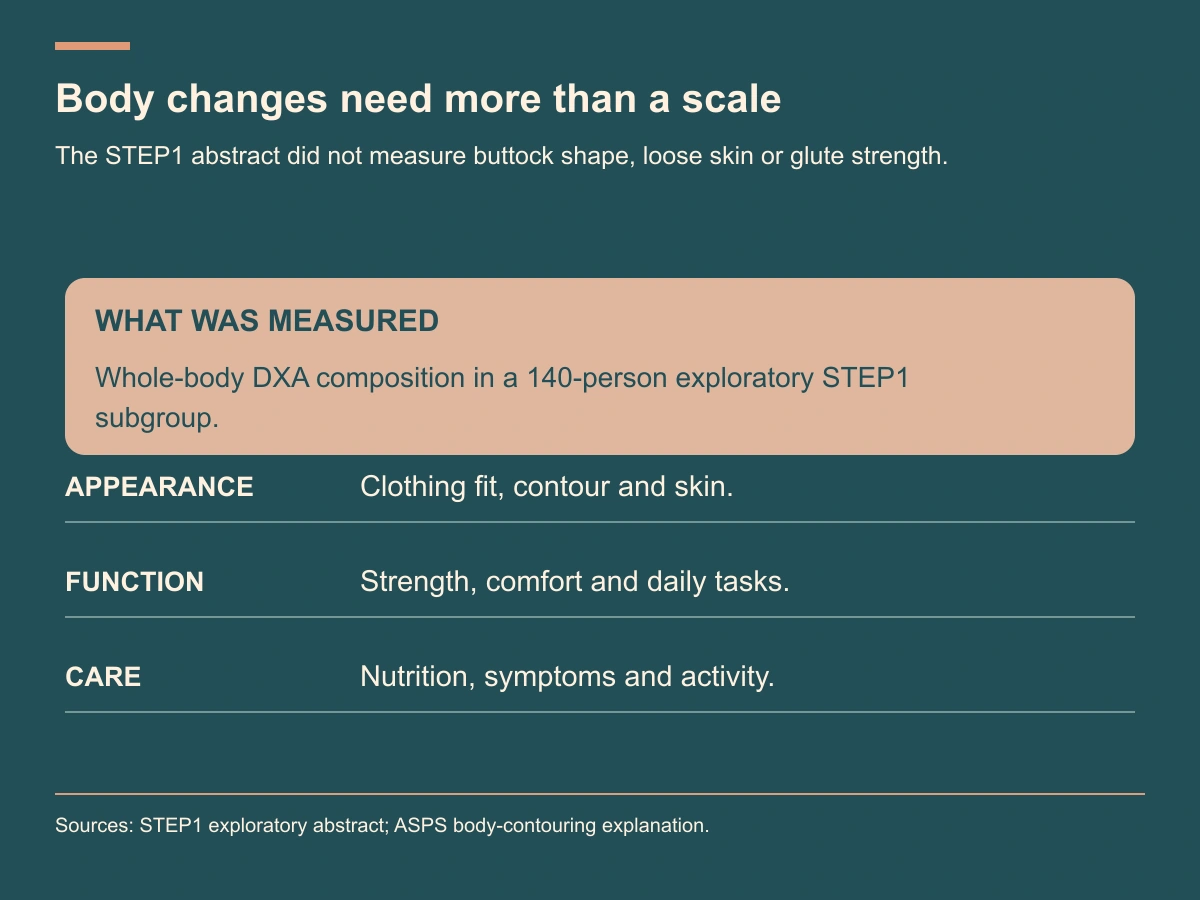
What did the STEP1 body-composition analysis measure?
A 2021 exploratory conference-supplement abstract reported a DXA body-composition subgroup from STEP1. It included 140 participants, with 95 assigned to semaglutide and 45 to placebo, over 68 weeks. The study involved adults without diabetes in a specific weight-management trial setting.
The abstract reported reductions in body weight, total fat mass, and absolute lean body mass with semaglutide. Lean mass made up a larger proportion of body weight after treatment even though the absolute amount fell. STEP1 exploratory body-composition abstract
That combination is important: a percentage can rise while the underlying amount falls. If fat mass decreases more, the lean share can become larger without demonstrating that the person gained lean tissue.
This is an exploratory abstract, not a full review of the trial’s detailed methods and tables. It does not measure buttock volume, loose skin, a person’s gluteal strength, or how an individual body will look.
Lean mass is not the same as glute muscle
Body-composition terms are easy to oversimplify. A whole-body lean-mass measurement does not isolate one muscle group or tell you how strong that group is.
| Question | Relevant observation | Why another question remains |
|---|---|---|
| Did total weight change? | Scale trend | It does not identify the tissue or body region |
| Did whole-body lean mass change? | Body-composition measurement | It does not directly establish glute strength or appearance |
| Do clothes fit differently? | Fit and personal observation | It does not quantify muscle loss |
| Is skin looser? | Examination and skin pattern | It does not establish an individual’s DXA result |
| Is daily function harder? | Actual activity and symptoms | It needs assessment beyond a cosmetic label |
Avoid translating a trial’s average lean-mass change into a statement that every person loses the same amount of skeletal muscle. Also avoid using a single body-composition scan as a diagnosis of why a specific area changed.
Skin can change after substantial weight loss
Skin and supporting tissues do not always conform to a smaller body contour after substantial weight loss. The American Society of Plastic Surgeons describes this as part of the context for body-contouring discussions. ASPS body-contouring overview
That explanation does not mean every person develops excess skin or needs a procedure. The degree and location of change vary, and a photograph cannot determine which care is appropriate.
Tell a clinician if skin changes cause chafing, irritation, discomfort, difficulty with hygiene, or other practical problems. Those concerns are useful to assess separately from dissatisfaction with clothing fit.
Creams, supplements, and exercises should not be presented as guaranteed ways to remove loose skin. A product’s promise to “tighten” an area needs evidence for that actual result.

Function deserves attention alongside appearance
Make a short list of activities that matter in your life: getting out of a chair, carrying groceries, climbing stairs, walking to work, or completing an adapted exercise routine. Notice whether any have become meaningfully harder.
New weakness, pain, dizziness, or fatigue should not be dismissed as the price of a successful scale result. Bring the change to the treating team, especially when it affects safety or everyday activity.
A clinician may consider nutrition, other conditions, medications, activity limitations, and the broader treatment course. The answer is not necessarily more exercise or a larger protein shake.
Our strength training for beginners guide begins with realistic activity and function. Exercise with limited mobility discusses adapting activity when standard routines are not accessible; it concerns a different medication context and is not a substitute for an individualized plan.
Nutrition questions to review during weight loss
If appetite has changed, describe what you can actually eat over a typical day. Include skipped meals, food aversions, nausea, and difficulty tolerating usual foods.
Questions worth discussing include:
- Am I eating regularly enough to meet my needs?
- What protein foods fit my preferences and appetite?
- Have I lost interest in most foods or become limited to a few options?
- Do digestive symptoms prevent eating or drinking comfortably?
- Would a dietitian help me plan around these barriers?
There is no universal protein number in this article. Needs depend on the person and clinical context. A dietitian can translate a target into actual foods and portions when a numerical plan is appropriate.
Balanced meals for weight management and what to eat with a protein shake offer meal-planning ideas. A shake is one possible food tool, not proof that lean tissue or a particular body shape will be preserved.
Strength work should match ability and health
Physical activity can support health and daily function, and a realistic plan can start small. NIDDK encourages choosing activity that fits and finding ways to move throughout the day. NIDDK activity tips
If you want to add resistance exercise, discuss an appropriate starting point when you have pain, balance problems, injuries, or medical limitations. Do not assume that a social-media glute routine is suitable simply because the article mentions buttock changes.
Track activities you can do comfortably and consistently rather than promising a body-shape result from a fixed number of squats. Strength, skill, tolerance, and appearance are related questions, but they are not interchangeable measures.
An adapted plan may involve professional guidance, accessible equipment, or different movements. Progress should make daily life more manageable rather than turn a concern about appearance into an unsustainable workout demand.
Do you need to change Wegovy treatment?
Do not change the dose or stop treatment solely because an informal label sounds alarming. Discuss the actual change and your concerns with the prescribing team. They can review benefits, symptoms, nutrition, function, and the treatment plan together.
If you cannot maintain adequate food or fluid intake or have severe symptoms, obtain medical advice promptly. A cosmetic explanation should not delay an assessment of a treatment problem.
The Wegovy injection guide explains product-use questions, while tirzepatide, protein, and muscle addresses a different medicine’s context. Neither establishes that switching drugs will preserve a particular contour.

A simple appointment note
Write down the concern in three parts: appearance, function, and intake. For each, record what changed and roughly when. Keep the note factual rather than trying to calculate tissue loss from a photograph.
For example, you might report that a clothing size changed, a daily task became harder, and meals became smaller after a treatment adjustment. This is a hypothetical communication format, not a patient story or evidence that those events share a cause.
Ask what should be monitored, what the next step is, and when to follow up. If the plan includes nutrition or exercise changes, ask how to make them achievable within your budget and abilities.
Frequently asked questions
Is “Wegovy butt” an official side effect?
It is an informal phrase, not a diagnosis. Describe the actual appearance, skin, strength, or symptom change so the care team can evaluate the concern.
Does semaglutide specifically remove buttock muscle?
The reviewed STEP1 abstract does not establish that claim. It reports whole-body composition measures, not an isolated glute-muscle outcome.
Can exercise guarantee that my shape stays the same?
No. An appropriate activity plan can address function and strength goals, but this evidence does not support a guaranteed cosmetic result or a universal routine.
Does a higher lean-mass percentage mean I gained muscle?
Not necessarily. A proportion can rise when another component falls more. The STEP1 abstract illustrates why absolute amounts and percentages need to be read separately.
Will loose skin go away on its own?
This article cannot predict that for an individual. Discuss persistent discomfort, irritation, and appearance concerns with a qualified clinician rather than relying on a fixed online timeline.
Where can I discuss semaglutide options?
CoreAge Rx’s semaglutide information page provides a starting point for a treatment conversation. Individual care should consider function and nutrition alongside weight goals.
Educational information for adults; individual treatment decisions require a qualified clinician. Sources reviewed October 3, 2026. Original AI-generated article images depict fictional people and objects, not patient outcomes. Other editorial images are illustrative. Graphics summarize the cited sources.