
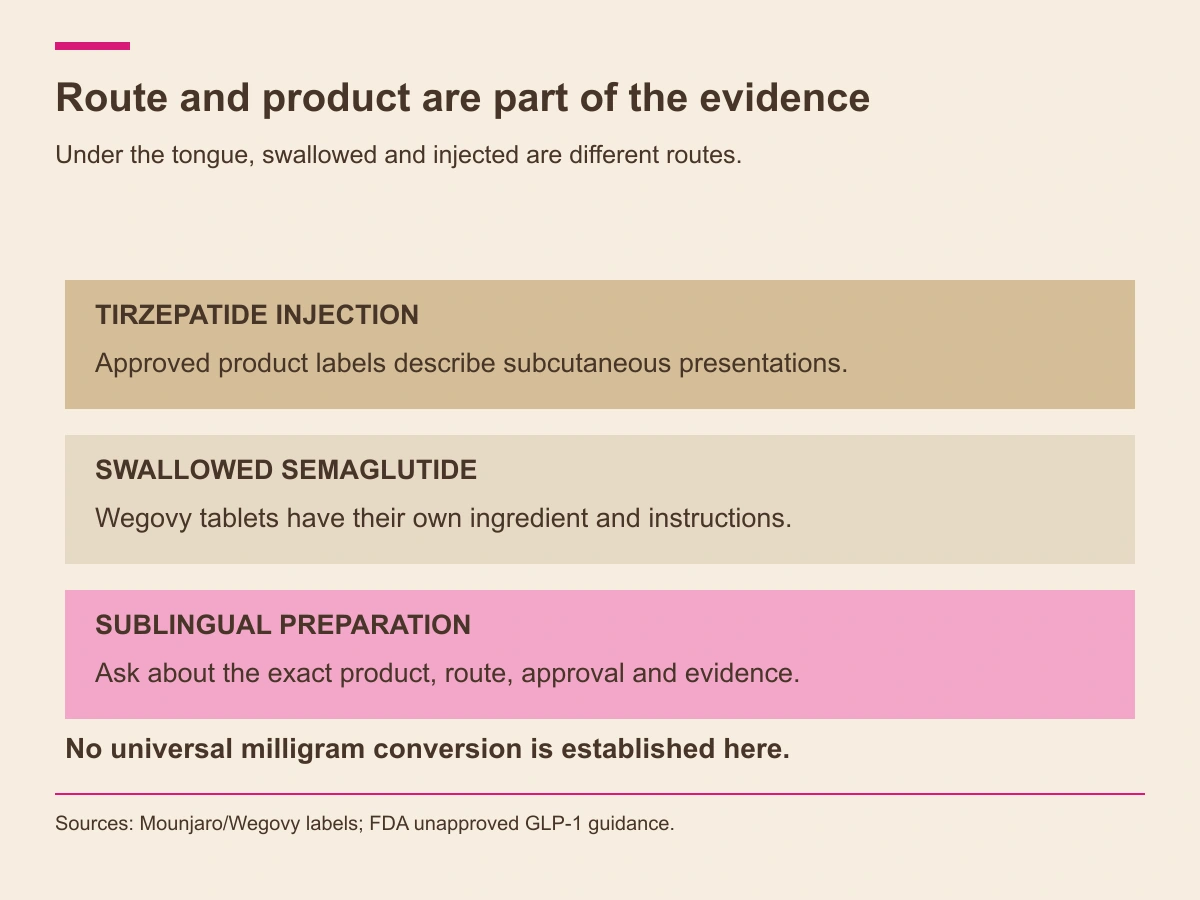
“Sublingual tirzepatide” usually describes a product intended for use under the tongue. It should not be assumed to have the same approval, absorption, dose, or evidence as a tirzepatide injection. The current U.S. prescribing information reviewed for Mounjaro describes subcutaneous injection presentations, not a sublingual product.
An approved oral semaglutide tablet is also a different product. The ingredient, formulation, and route all matter. Before using something advertised as oral or sublingual tirzepatide, ask the prescriber and dispensing pharmacist exactly what it is and what evidence supports that preparation.
What does “sublingual” mean?
Sublingual means under the tongue. It is different from swallowing a tablet, drinking a liquid, or injecting medicine beneath the skin. A product description that uses “oral,” “dissolving,” and “sublingual” interchangeably can leave important questions unanswered.
Ask whether the product is meant to be swallowed or absorbed through the mouth, and what the written instructions actually say. That question identifies the formulation; it is not an invitation to experiment with another route.
The fact that two products contain an ingredient with the same name does not establish comparable delivery. The amount printed on a label is only one part of the picture. A clinical claim needs evidence about the actual formulation and route, not just the ingredient’s general reputation.
What do current approved tirzepatide products describe?
The Mounjaro prescribing information reviewed here lists injection presentations and directs subcutaneous administration. It also emphasizes training for the actual presentation supplied, including changes between devices. Mounjaro prescribing information
Zepbound’s labeling is another source of clinical evidence for a specific tirzepatide product, with its own studied uses and safety information. Evidence from an injection trial should not be treated as a trial of a product dissolved under the tongue. Zepbound prescribing information
The useful question is therefore specific: “What FDA-approved product and route is this?” If the answer is a compounded sublingual preparation, that is different from receiving an approved injection. Our tirzepatide questions guide and tirzepatide vial guide explain why presentation and label details need to be identified accurately.
Is compounded tirzepatide FDA approved?
FDA explains that compounded drugs are not FDA approved and do not undergo its premarket review for safety, effectiveness, and quality. It recommends using compounded drugs only when a patient’s medical needs cannot be met by an approved drug, and obtaining prescriptions through a clinician and a state-licensed pharmacy. FDA concerns with unapproved GLP-1 drugs
This is different from declaring that a specific patient’s prescription is necessarily inappropriate. The medical need and formulation require a real review. It is also different from accepting a marketing claim that a compounded preparation is “the same” as an approved product.
Do not read a pharmacy’s license or a prescription requirement as FDA approval of the particular sublingual product. Ask which fact the seller is claiming and what documentation supports it.
What evidence would support a sublingual claim?
Ask for evidence on the exact formulation, intended route, and intended clinical use. There are several separate questions: whether the medicine reaches the body in a measurable way, how exposure varies, whether meaningful outcomes improve, and what safety findings exist.
Evidence about injection outcomes does not directly answer all those questions for a mouth-dissolving preparation. A laboratory claim about an ingredient or a testimonial about weight change is also different from a well-described human study.
| Evidence question | What a useful answer should identify |
|---|---|
| Was the actual formulation studied? | Product composition and route, rather than tirzepatide in general |
| Were people studied? | Human population, sample size, and study design |
| Was exposure measured? | What was measured, variability, and comparison method |
| Were clinical outcomes assessed? | Duration, comparison group, and relevant health outcomes |
| Was safety evaluated? | Adverse events, follow-up, and limitations |
| Is the marketed product the studied product? | A clear match between the evidence and the prescription supplied |
This article does not claim that no human research on any oral tirzepatide approach exists anywhere. It explains why the approved injection labels and FDA consumer guidance reviewed here do not establish equivalence for an unspecified sublingual preparation.

Is an approved oral semaglutide tablet the same thing?
No. Semaglutide and tirzepatide are different ingredients. The current Wegovy label includes tablets that are swallowed whole and has specific daily administration instructions. It says not to split, crush, chew, or dissolve those tablets. Wegovy prescribing information
An approved swallowed tablet therefore does not provide approval or instructions for using tirzepatide under the tongue. The presence of an oral GLP-1 option does not mean every oral preparation is interchangeable.
Our oral semaglutide versus injections guide covers that product distinction. If avoiding injections is your priority, tell the clinician directly. They can review actual options and their evidence instead of treating “oral” as a single category with one dose and one expected result.
Can you convert an injection dose to a sublingual dose?
There is no universal conversion supplied by the sources reviewed here. Do not use a milligram number from an injection prescription as a formula for a sublingual liquid, lozenge, or tablet.
Milligrams, milliliters, and device units describe different quantities. Knowing one number does not establish the concentration, route-specific exposure, or an appropriate treatment plan. Our semaglutide measurement guide explains this general measurement problem for a different ingredient; it is not a tirzepatide route-conversion chart.
If you have already received a product with confusing directions, contact the prescriber and dispensing pharmacist before using it. Ask them to reconcile the prescription, label, and instructions in plain language. Do not rely on a conversion suggested by someone who has not seen your actual product.
What should you verify before accepting the prescription?
Ask for the exact ingredient, formulation, intended route, concentration or strength, pharmacy identity, storage requirements, and written instructions. The prescriber should also explain the intended benefit, evidence limitations, follow-up, and what to do if problems occur.
FDA identifies warning signs in GLP-1 marketing, including claims that a compounded medicine is the same as an approved drug, missing or confusing instructions, and lack of access to a licensed clinician for questions. FDA concerns with unapproved GLP-1 drugs
If the label and sales page disagree, ask for clarification rather than choosing whichever instruction seems easier. Keep a copy of the information supplied so your care team can review the discrepancy.

Switching products requires a treatment plan
Agree on how progress will be assessed before changing products. A treatment plan should name the intended outcome, when follow-up occurs, and who answers questions about symptoms or unclear instructions. If the proposed preparation has evidence limitations, those should be explained before you receive it.
Keep the old and new products clearly identified during the transition. Ask for written clarification if instructions leave you uncertain about whether either product should still be used. Do not assume that a daily mouth product can be added to a weekly injection because the schedules look different.
Changing a route or product is more than changing the way you take the same milligrams. The clinician needs to consider why you are switching, current treatment, symptoms, other medicines, and the evidence for the proposed option.
If injections are difficult because of technique or device concerns, ask for training and presentation-specific help. If cost or availability is the issue, explain that so the discussion addresses it directly. A product promoted as convenient may not answer the reason your current plan is difficult.
Our switching between semaglutide and tirzepatide guide covers supervised planning. The CoreAge Rx tirzepatide page provides information for a care discussion; it does not establish evidence for an unnamed sublingual formulation.
Common questions about sublingual tirzepatide
Is it just Mounjaro without a needle?
That description assumes equivalence that the approved injection label does not establish. Ask for the actual product, route, approval status, and supporting evidence. A familiar ingredient name does not make a different preparation the same medicine in clinical use.
Is a dissolving product automatically easier on the stomach?
A convenience claim is different from demonstrated tolerability. Ask what safety evidence exists for that exact formulation. Do not assume a route change eliminates gastrointestinal effects or other risks.
Can I put injection liquid under my tongue?
Do not repurpose an injectable product through another route. Its instructions describe the prescribed presentation and administration. Contact the pharmacist or prescriber if you cannot use the product as directed.
Does the same advertised milligram strength mean the same effect?
No equivalence follows from the number alone. Formulation, route, exposure, and clinical evidence are separate questions. A larger or smaller printed dose is not a reliable way to predict the result of an unverified route change.
What if I already started and am unsure what I received?
Gather the package, pharmacy label, prescription, and written instructions. Ask your prescriber and pharmacist to identify the product and explain the plan. Report symptoms and any uncertainty about how it was used. Do not add an injection or change the dose to compensate for an assumed lack of effect.
What should a good consultation accomplish?
You should leave knowing the product’s identity, why it is being considered, what evidence supports it, what remains uncertain, and how follow-up works. That level of clarity is more useful than a broad promise that a product is “oral tirzepatide” or a needle-free equivalent.
Educational information for adults; individual treatment decisions require a qualified clinician. Sources reviewed October 3, 2026. Original AI-generated article images depict fictional people and objects, not patient outcomes. Other editorial images are illustrative. Graphics summarize the cited sources.