Copper peptides and vitamin C can make a layering routine seem more complicated than it needs to be. Online advice often says either that they must never meet or that every combination is safe. Neither statement accounts for the exact ingredients, the way a product is formulated, or the condition of your skin.
The practical approach is to identify the products first, confirm their instructions, and give each a clear purpose. If a pharmacist or prescriber recommends separate application times, follow that plan. If the labels are unclear, ask about the actual formulas rather than relying on an ingredient-pairing chart.
“Vitamin C” does not describe one formula
Vitamin C skin care may use L-ascorbic acid or a derivative with different chemical properties. The ingredient form, concentration, pH, packaging, and vehicle influence stability and delivery. Two products carrying the same large vitamin C lettering on the front can therefore behave differently.
The clinical review of topical vitamin C discusses these formulation issues. Research on one preparation does not establish the performance of every derivative or combination. A percentage is helpful information, but it does not answer all the questions about a finished product.
Copper-peptide products have similar identification issues. GHK-Cu is one studied complex, but a broad copper-peptide description may not reveal the precise ingredient. Before evaluating a pairing, find out what each product actually contains.
Separate three questions that often get mixed together
Stability: Will the ingredients remain in the intended form under the conditions of use and storage? This is a formulation question. It cannot be reliably answered by whether the mixture looks pleasant in your hand.
Skin delivery: Can the active reach a relevant site in skin in a useful amount? The review of topical GHK describes delivery challenges for peptides. Applying more layers does not automatically solve them.
Tolerance: Does your skin remain comfortable when you use the products together? A theoretically compatible combination can still be irritating. Conversely, the absence of irritation does not prove that every ingredient remains stable or provides the expected benefit.
Keeping those questions separate prevents a common mistake: treating a comfortable application as a home chemistry test. Your skin can report symptoms, but it cannot verify the concentration of an active remaining in a product.

A label review is more useful than a universal ban
Place the bottles together and record the exact product names, ingredient lists, and directions. Include cleansers, sunscreen, prescription acne treatments, and exfoliating products. The source of irritation may be a third product rather than the pair you are focusing on.
| Detail to check | Why it matters | Where to get the answer |
|---|---|---|
| Vitamin C form | Different forms have different formulation requirements. | Ingredient list or pharmacy |
| Copper-peptide identity | Research may involve a specific peptide complex. | Product documentation or pharmacy |
| Strengths | The front label may omit individual amounts. | Prescription label or pharmacist |
| Timing and skin condition | Instructions may specify clean, dry skin or separate use. | Dispensed directions |
| Storage and beyond-use date | Stability depends on handling and the supplied preparation. | Container label and pharmacy |
If the public product page leaves a detail out, mark it as unknown. Do not fill the gap with the concentration used by another brand or with a common percentage from a study.
Avoid creating your own combined product
Layering separate products according to directions is different from mixing them in a bottle or jar. Mixing makes the amount of each ingredient less predictable and changes the environment in which the products were formulated. It also makes it harder to identify a source of irritation later.
Do not add vitamin C powder, an acid, or water to a prescription cream. A pharmacy-prepared combination should be used as supplied. If you want fewer steps, ask whether a suitable formulated option exists rather than trying to manufacture one at home.
Likewise, do not assume a cream containing vitamin C is equivalent to applying a separate acidic serum underneath it. A combination’s ingredients have been selected and prepared together; a do-it-yourself stack is a different exposure.

How to simplify the routine discussion
Start with the product that has the clearest role in your treatment plan. If you have a prescription, ask how optional cosmetics should fit around it. A routine built around a diagnosed concern is easier to manage than a collection of products added because each ingredient sounds beneficial.
Then decide whether the second active adds something you actually want to assess. If your main concern is dryness, a tolerated moisturizer may deserve attention before another antioxidant serum. If the concern is persistent pigmentation, diagnosis and sun protection remain central.
You can discuss using products at different times of day, but that is a planning option, not proof that every pairing becomes compatible when separated. The exact instructions and your tolerance still matter. There is no evidence-based universal waiting period that makes all copper-peptide and vitamin C products interchangeable.
Introduce changes in a way you can interpret
Keep the rest of the routine stable when practical. Record the date you begin a new product and any symptoms. If you change the cleanser, sunscreen, treatment cream, and serum simultaneously, you lose the ability to describe which change preceded discomfort.
The first goal is tolerability, not maximizing the number of applications. Follow the prescribed schedule and ask about adjustments if needed. Do not increase use simply because the skin feels fine after one application; delayed reactions and cumulative irritation can complicate early impressions.
A useful note might read: “Started this serum on Monday; tightness began after the third use; no other changes.” That gives the clinician something concrete to review. “The ingredients canceled each other out” is a chemical conclusion that symptoms alone cannot support.
Where CoreAge Rx products fit
Bounce Back lists copper peptide 2%. Smooth Move combines tretinoin, niacinamide, and vitamin C. Time Out lists estriol 0.3%, vitamin C 5%, and hydrolyzed hyaluronic acid 0.5%.
These are different provider-guided formulas. The presence of vitamin C in two of them does not make their instructions the same. Tretinoin and estriol introduce their own treatment and safety considerations. Do not use multiple prescription products together without reviewing the whole regimen with the prescriber.
For more on a deliberately combined formula, see tretinoin, vitamin C, and niacinamide. The Bounce Back product guide explains which details are publicly disclosed and which questions belong with the pharmacy.
Protect the products you already have
Follow the label’s storage instructions and keep the product in its original container. Do not assume that refrigeration is helpful for every formulation. Avoid leaving a treatment in a hot car or transferring it into an unmarked travel pot that separates it from its directions and date.
If the product develops an unexpected change in color, smell, texture, or dispensing behavior, contact the pharmacy or manufacturer. Appearance alone cannot confirm stability, and a lack of visible change cannot guarantee it. The safest way to resolve uncertainty is through the source responsible for the formulation.
Write down when you opened the product if the label uses an after-opening period. For compounded prescriptions, pay attention to the supplied beyond-use date and any specific handling directions.
Sun protection still has its own job
Vitamin C and copper-peptide research sometimes uses language about oxidative stress or ultraviolet exposure. That does not make these creams substitutes for a tested sunscreen. The AAD sunscreen guide recommends broad-spectrum protection with SPF 30 or higher, alongside appropriate sun-protection habits.
Choose a sunscreen you can apply consistently and review any pilling or stinging that makes the routine impractical. Do not dilute it by mixing it with another cream. If layering makes the finish difficult, simplify optional steps and ask about suitable formulations.
When to pause and get help
Stop a newly added product and seek advice for persistent burning, a spreading rash, marked swelling, or blistering. Severe facial swelling or breathing difficulty requires urgent medical attention. A reaction should not be dismissed as proof that vitamin C is working or that copper peptides are repairing the skin.
The aim is a routine with understandable instructions and a manageable number of variables. Once you know the formulas, their purpose, and the plan for monitoring tolerance, layering becomes a practical decision rather than a chemistry puzzle built from social-media rules.
Explore Bounce Back™
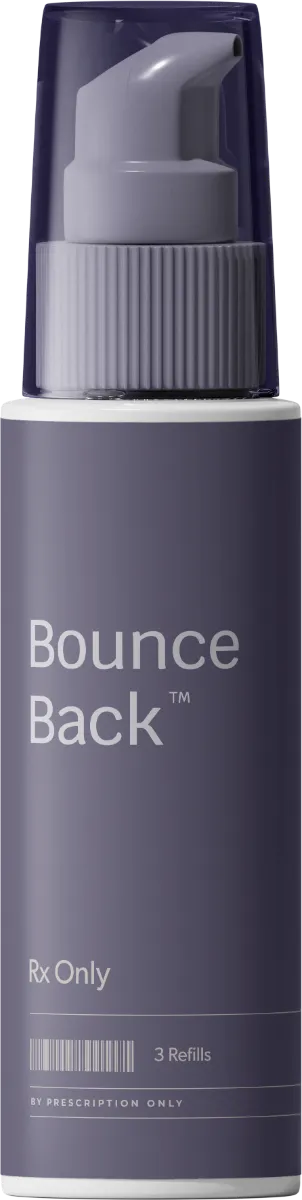
Bounce Back lists copper peptide 2%. Confirm the precise peptide identity, complete formulation, and directions with the dispensing pharmacy and prescribing provider. Review the current Bounce Back™ page and bring your existing skin-care products to the provider discussion.
Related reading
- Copper Peptides for Skin: Evidence, Uses, and Routine Basics
- Copper Peptides vs. Retinoids: Different Roles in Skin Care
- Copper Peptides for Sensitive Skin: Tolerance and Product Questions
- Bounce Back Copper Peptide Cream: A Product and Evidence Guide
- Tretinoin for fine lines: evidence and daily care
Educational information; your prescription and clinician’s instructions guide individual care. Product details and linked sources checked September 15, 2026. Ingredient research does not establish identical results for a finished compounded formula. Photographs are illustrative and do not show treatment outcomes.