
CELSIUS is not a guaranteed fat-loss treatment. Older studies of particular thermogenic beverages reported short-term metabolic or body-composition findings in small groups of healthy adults, but those results do not establish that a current can will produce lasting weight loss for every person.
If you enjoy an energy drink, the practical questions include the exact product, caffeine amount, other drinks you consume, symptoms, sleep and the rest of your eating pattern. Feeling more stimulated is different from having evidence of a sustained weight-management benefit.
What does “burns fat” actually mean?
Marketing language can combine several ideas: feeling energetic, temporarily changing measured energy expenditure, altering fuel use during a test, or losing body fat over time. Those are different outcomes. Evidence for one should not automatically be described as evidence for all of them.
A short laboratory measurement does not show what happens over months in ordinary life. Likewise, a body-composition result in one selected group does not provide a personal forecast for someone with different health conditions, medicines or eating habits.
Ask which outcome a claim actually measured and over what period. A phrase such as “clinically studied” is incomplete unless the study, participants, comparison, duration and limitations are clear. This article reviews two older studies within those boundaries rather than treating the phrase as a product endorsement.
What did the acute study measure?
A 2007 double-blind crossover study involved 20 healthy men and women. Participants received a 12-ounce CELSIUS beverage or Diet Coke on separate occasions, and researchers followed acute metabolic measures for three hours. The abstract reported increased resting metabolic rate after the test beverage but no significant difference in respiratory exchange ratio. Acute study.
That is a short-term laboratory result. It is not evidence that a person lost a defined amount of fat, could skip exercise or meals, or would continue losing weight with daily use. The beverage formulation and study conditions also belong in the interpretation.
The abstract itself distinguished acute findings from questions about chronic body-composition effects. Do not convert a percentage change measured over a few hours into a daily calorie promise or a guaranteed number of pounds lost.
What did the 28-day study add?
A second study involved 60 healthy college-aged adults, with a mean age of about 23. It compared a daily 336-milliliter thermogenic beverage with a noncaloric, noncaffeinated placebo over 28 days. The abstract reported between-group body-composition differences, while some other metabolic measures did not differ significantly. 28-day study.
The study’s disclosures report an unrestricted grant from Celsius to the university, and the investigators described their analysis as independent. Funding is relevant context, but it is not by itself a verdict on a result.
More importantly for a reader, this was a short study in a specific healthy population. It does not establish long-term maintenance, safety for every medical condition, an effect in all age groups, or equivalence to every current product line. Detailed effect-size tables are not used here, and the findings should not be stretched into a universal weight-loss plan.
| Evidence question | What the reviewed research answers | What remains separate |
|---|---|---|
| Acute study | Selected metabolic measurements over three hours in 20 healthy adults | Lasting fat loss and ordinary daily use |
| 28-day study | Short-term outcomes in 60 healthy college-aged adults | Long-term maintenance and broader populations |
| Current product FAQ | Manufacturer caffeine amounts by product line | Individual tolerance or a weight-loss benefit |
How much caffeine is in CELSIUS?
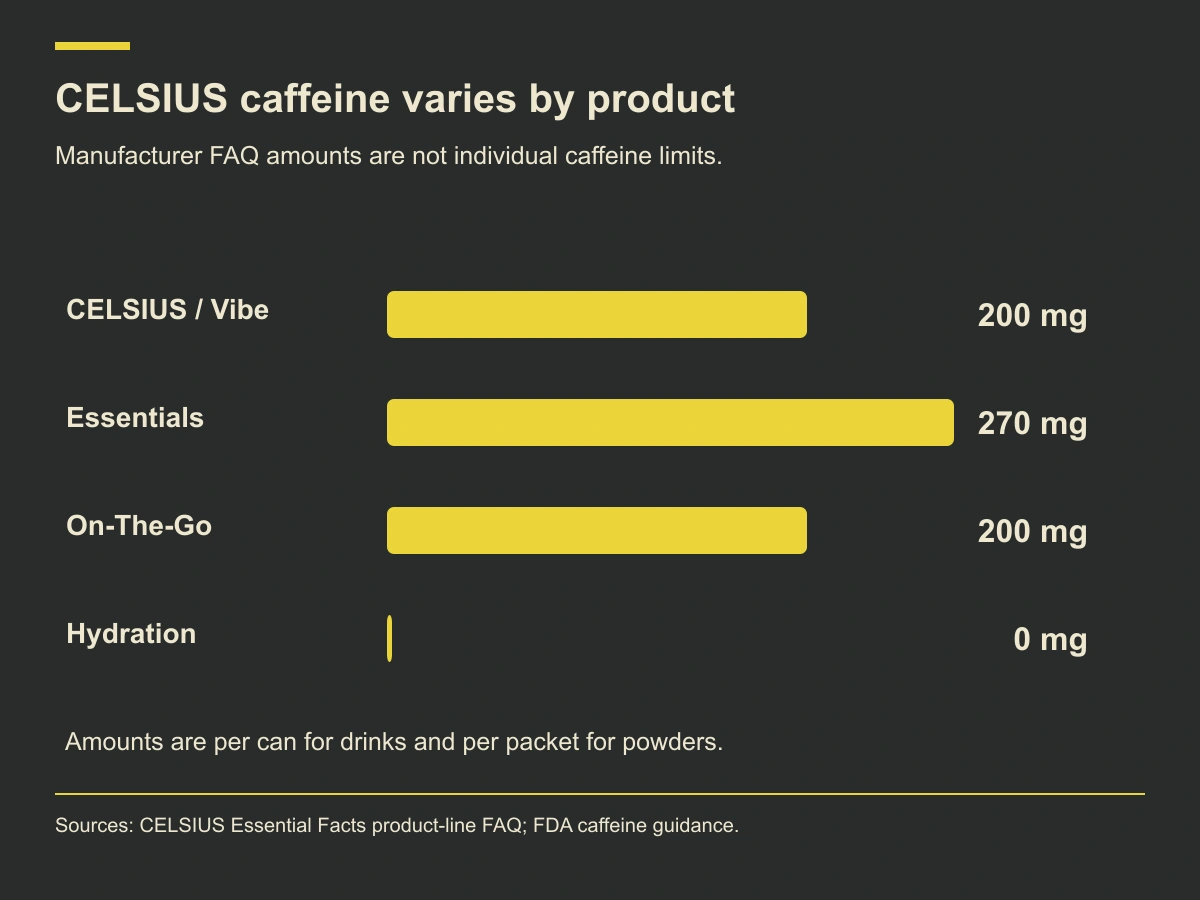
The manufacturer’s current Essential Facts page lists different amounts for different lines. Check the actual package because a familiar brand name does not identify the complete formulation. CELSIUS product FAQ.
| Product line | Manufacturer-stated caffeine |
|---|---|
| CELSIUS and CELSIUS Vibe beverages | 200 mg per can |
| CELSIUS Essentials beverages | 270 mg per can |
| CELSIUS On-The-Go powders | 200 mg per packet |
| CELSIUS Hydration powders | No caffeine |
The powder and drink entries are not interchangeable serving units. Also include coffee, tea, supplements, pre-workout products and any other caffeine sources in the day’s picture. A caffeine amount on one can cannot tell you the total exposure from the whole routine.
Our decaf tea and caffeine guide explains why even beverage labels that sound similar may answer different questions. The Bai drinks article looks at another product family with its own labels and ingredients.

Is 400 mg a safe personal target?
FDA cites 400 milligrams per day as an amount not generally associated with negative effects for most adults. It also emphasizes wide differences in sensitivity, medicines and health conditions, and recommends individual advice during pregnancy, when trying to conceive or while breastfeeding. FDA caffeine guidance.
That reference is not a target to reach or a clearance to drink a particular number of cans. A person can experience unwanted effects below it. Two 200-milligram cans would total 400 milligrams before any other caffeine; that arithmetic does not make the routine appropriate for you.
Manufacturer suggestions about daily consumption should also be kept separate from individualized medical advice. Ask a clinician or pharmacist if you have a condition, medicine or symptom that could affect caffeine tolerance. This adult article is not a recommendation for energy drinks in children or teenagers.
What if I feel jittery, nauseated or my heart races?
FDA lists symptoms of excessive caffeine such as palpitations, increased heart rate, anxiety, sleep disruption, nausea and headache. FDA symptom information. Those symptoms should not be interpreted as proof that the beverage is burning more fat.
Record the exact products and amounts, when you consumed them and what you felt. Include other caffeine sources and medicines. That can make a care conversation more useful than saying that one brand “does not agree with me.”
Chest pain, severe breathing difficulty, fainting or another possible emergency requires emergency assessment. Do not assume caffeine explains the symptom and wait for it to pass. Our chest-pain and palpitations guide addresses why warning signs need attention even when a medicine or drink seems like a plausible trigger.
How does an energy drink fit the rest of the day?
Consider what the drink replaces or adds. Replacing a sugar-containing drink with another product changes the beverage calculation, but the exact labels and portion still matter. Adding an energy drink to an otherwise unchanged routine is a different situation.
Do not rely on the word “energy” to judge nutrition adequacy. A stimulating drink is not a complete meal. If it routinely replaces breakfast or lunch, review what food you can manage and why meals are being missed.
Our balanced-meals guide and protein breakfast ideas offer practical options. The water and drinks guide helps you assess everyday beverage choices without treating any drink as a fat-loss remedy.
Look at the overall routine before purchasing more products: meals, drinks, sleep, symptoms and accessible activity. A short record of ordinary days can reveal whether the main problem is a rushed morning, an afternoon caffeine cycle or uncertainty about portions.
Should I drink it before every workout?
There is no universal pre-workout CELSIUS routine established by this article. The reviewed studies do not prescribe one for every person. Equipment, activity, symptoms, other caffeine and your medical circumstances all matter.
Ask whether you are using the drink for enjoyment, alertness or an expected body-composition effect. Those goals should not be blended into a promise. If a workout is difficult because of dizziness, pain, unusual breathlessness or poor intake, adding caffeine is not a substitute for assessing that difficulty.
Our beginner strength-training guide focuses on function and manageable progression. A beverage is not required to begin an appropriate activity plan, and no product should pressure you to push through a concerning symptom.

Questions if you use semaglutide or tirzepatide
Give the care team a complete account of drinks and supplements, particularly if appetite, sleep, nausea or palpitations have changed. A review should include the exact prescription and the drink formulation rather than only the word “CELSIUS.”
Do not assume an energy drink corrects low intake or makes a medication work better. Our semaglutide questions guide can help organize treatment discussions. Persistent symptoms deserve product-specific assessment, not a new supplement or a higher caffeine amount.
For adults exploring medical weight-management care, the CoreAge Rx tirzepatide page describes the service. Consultation determines eligibility and the exact prescription. An energy drink is not an equivalent treatment or a test of whether medication is needed.
Frequently asked questions
Can CELSIUS make me lose weight without other changes?
The reviewed evidence cannot provide that guarantee. Short laboratory measurements and a small 28-day study do not forecast lasting results in an individual. Assess the drink’s role within the whole routine and avoid converting a marketing claim into a personal treatment expectation.
Is CELSIUS Hydration the same as the caffeinated cans?
The manufacturer’s FAQ lists Hydration powders as caffeine-free, while other lines contain different caffeine amounts. Read the actual product label. Sharing a brand name does not mean the ingredients, serving unit or research context are identical.
Is more caffeine better for weight loss?
No benefit from increasing your caffeine amount is established here. Higher exposure can create unwanted effects, and the FDA adult reference is not a goal. Discuss symptoms and tolerance rather than treating a stronger drink or an extra can as a weight-loss upgrade.
What is a useful first step?
Identify the exact product and count all caffeine sources on a representative day. Then consider whether the drink serves a practical purpose you value and whether it causes symptoms or interferes with meals or sleep. That provides a clearer decision than choosing a drink solely because it promises to burn fat.
Educational information for adults; individual treatment decisions require a qualified clinician. Sources reviewed October 3, 2026. Original AI-generated article images depict fictional people and objects, not patient outcomes. Other editorial images are illustrative. Graphics summarize the cited sources.