
Nosebleeds are not named in the common adult adverse-reaction table in the current Ozempic prescribing information. That is a limited label finding, not proof that a nosebleed during treatment is unrelated to the medicine. The immediate questions are whether the bleeding stops, whether there are warning signs, and what other conditions or medicines could matter.
If bleeding is heavy, you feel weak or dizzy, breathing is difficult, or the bleeding follows a significant head injury, seek emergency care. A symptom should receive appropriate attention before anyone tries to assign it to Ozempic.
What does the Ozempic label actually say?
Ozempic is a semaglutide medicine. Its current label includes a table of common adult reactions from placebo-controlled trials, with nausea, vomiting, diarrhea, abdominal pain and constipation among the listed reactions. Nosebleeds, also called epistaxis, are not named in that specific table. The table describes a defined trial population and reporting threshold; it is not an exhaustive list of everything that can happen to a person using the medicine. Read the current Ozempic prescribing information.
This distinction helps avoid two opposite mistakes. A nosebleed does not automatically establish a new Ozempic side effect. At the same time, a symptom cannot be dismissed simply because it is absent from a common-reaction table. Timing, severity, recurrence, other medicines and the examination all help clinicians assess a possible relationship.
Our Ozempic side-effect guide gives broader treatment context. For this particular question, the nosebleed itself deserves a separate assessment rather than being grouped with routine nausea.
A personal report is different from a measured risk
An online story about bleeding after an injection can be useful as a reason to ask questions, but it cannot tell you how often the event happens, whether the medicine caused it, or whether the same explanation applies to you. People may also use different products under the same conversational name.
Tell the care team the name on your prescription and package. Ozempic, another semaglutide brand and a compounded preparation are different product descriptions. Do not apply a conclusion about one formulation automatically to every injection sold for weight management. Our semaglutide ingredients guide explains why the exact formulation matters.
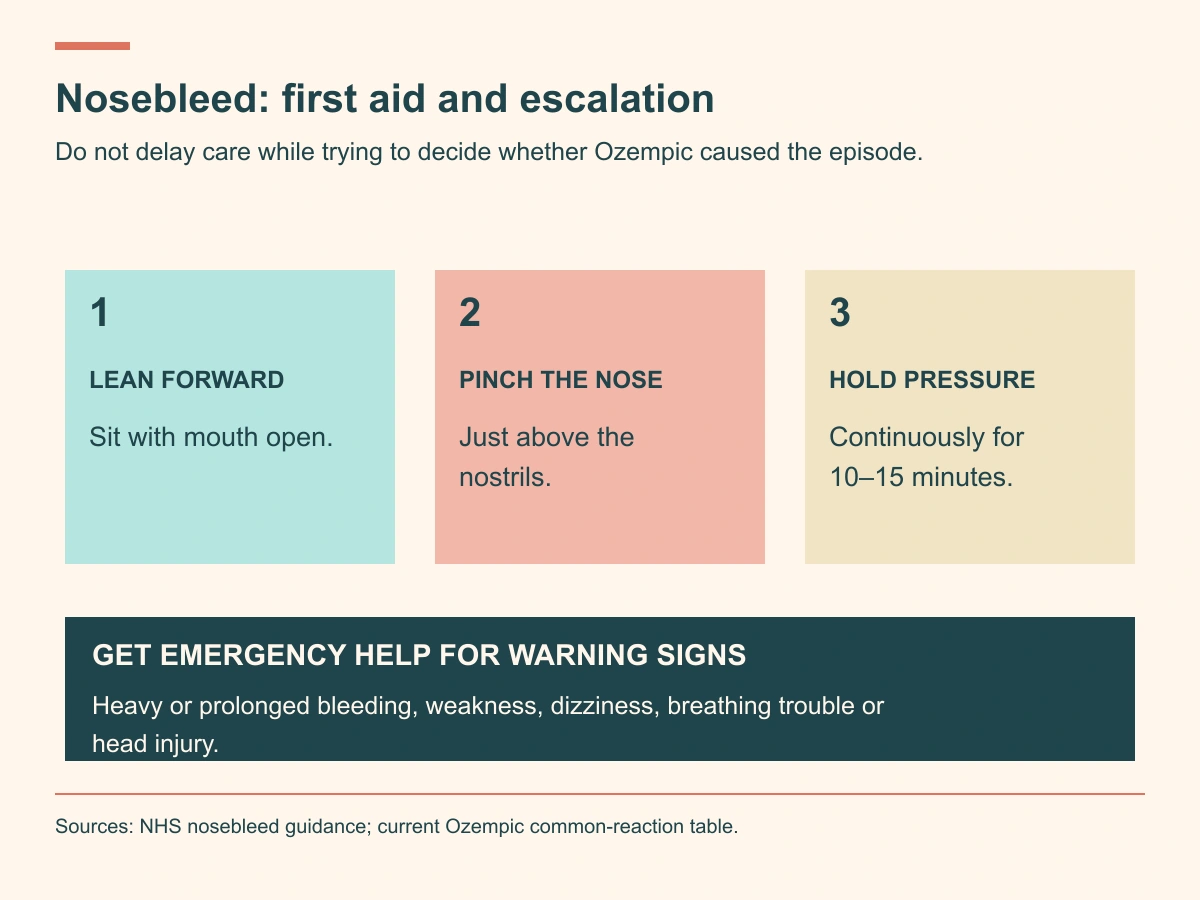
First aid for an active nosebleed
The NHS recommends sitting down, leaning forward with the mouth open, and pinching the nose just above the nostrils for 10 to 15 minutes while breathing through the mouth. Keep the pressure continuous for that interval. Leaning backward is not the recommended position. NHS nosebleed guidance.
These are general first-aid measures, not a substitute for emergency assessment when bleeding is substantial or other concerning symptoms are present. The same guidance recommends emergency evaluation when bleeding lasts longer than 10 to 15 minutes, seems excessive, causes substantial swallowed blood with vomiting, follows a head injury, or occurs with weakness, dizziness or breathing difficulty.
If you are uncertain whether the bleeding is controlled, contact an appropriate urgent-care service. Do not drive yourself when you feel faint. Take your medication list or packages with you if you need assessment, especially when you use a blood thinner.
| What you notice | What to do with that information |
|---|---|
| Active bleeding without an immediate warning sign | Start forward-position first aid and continuous pressure |
| Bleeding beyond the first-aid interval or apparently heavy bleeding | Seek emergency assessment rather than waiting for the next injection visit |
| Weakness, dizziness, trouble breathing or significant head injury | Seek emergency care |
| Repeated episodes that stop | Arrange a clinical review and bring the pattern and medication list |
| Blood thinners or a known clotting problem | Tell the assessing clinician promptly; obtain advice about the actual prescription |
The table organizes care questions. It does not measure blood loss or decide that any episode is harmless.

Common explanations worth discussing
Nosebleeds can occur when the inside of the nose becomes dry, after picking the nose or blowing it forcefully, following injury, or with some medicines and blood-clotting conditions. Sometimes a definite cause is not found. The NHS specifically identifies medicines such as warfarin as relevant to the assessment. General nosebleed causes.
That makes the surrounding circumstances useful. Was the air particularly dry? Had you recently had a cold, irritated the nose or experienced an injury? Does one nostril bleed repeatedly? Have there been new medicines, supplements or nasal products? These details help the care team choose an examination and next steps; none is a diagnosis by itself.
Avoid assuming that every symptom after a treatment change has one shared explanation. Dry nasal tissue and fluid loss from persistent vomiting are different observations. The presence of one does not prove the other caused bleeding. If nausea, vomiting or poor fluid intake is also occurring, report it as an additional problem. Our tirzepatide nausea and reflux guide discusses another medicine and should not be used as an Ozempic-specific treatment instruction.
Review the full medicine list
A clinician or pharmacist needs more than the name of the weekly injection. Include prescribed anticoagulants, antiplatelet medicines, pain relievers, cold medicines, nasal sprays, vitamins, herbal products and any recently changed doses. Bring actual names rather than relying on terms such as “blood thinner” or “allergy pill.”
Do not stop a prescribed blood thinner to see whether bleeding improves without medical direction. The reason it was prescribed may be important, and stopping it introduces a separate decision. Likewise, do not choose a replacement pain reliever solely because a website says it does not interact with a GLP-1 medicine. Our ibuprofen, alcohol and tirzepatide safety guide shows why pain-relief reviews need the broader bleeding and kidney history.
How to document the pattern without delaying care
For an episode that has stopped, a short record is often more useful than a long narrative. Note when it began, approximately how long it lasted, whether one or both nostrils were involved, what first aid you used, and whether you felt weak or unwell. Include the last injection date and any recent prescription change.
Keep estimates clearly labeled as estimates. A photo or description cannot reliably calculate blood loss. If you are actively bleeding or feeling faint, getting help takes priority over making a detailed log.
Useful questions for follow-up include:
- Does the pattern suggest a local nasal problem or a broader bleeding concern?
- Should any medicines or nasal products be reviewed?
- Do the associated symptoms justify tests or an examination?
- What should I do if another episode starts?
- Does this change the plan for my next Ozempic dose?
The clinician may need to distinguish a recurrent mild local problem from a more significant episode. You do not need to establish causation before asking for help.

What should you do about the next Ozempic dose?
There is no universal skip, continue or reduce rule for every nosebleed. A short episode that stops and severe bleeding with weakness are different situations. Contact the prescribing team with the severity, timing, other symptoms and medicine list so it can advise about your actual prescription.
Do not make up a reduced dose using pen clicks or withdraw medicine from a pen with a syringe. If the care team changes the prescription, obtain instructions that match the exact presentation. Our Ozempic pen and prefilled syringe guide explains the device distinctions and why uncertain delivery should be handled with the pharmacist or prescriber.
For people receiving Ozempic for diabetes, a treatment interruption also raises a glucose-management question. Ask what monitoring and replacement plan is needed if a dose is held. A medication change should address the reason for treatment as well as the symptom being investigated.
After the bleeding stops
The NHS advises avoiding nose picking or blowing, hot drinks, alcohol, heavy lifting or strenuous activity, and lying flat for 24 hours after a nosebleed. These are general aftercare recommendations, not a guarantee that the episode will not recur. Nosebleed aftercare.
If dryness or repeated irritation seems relevant, ask which nasal care product is suitable rather than adding multiple sprays. If the bleeding returns regularly, schedule a review even when each episode eventually stops. A recurring problem deserves a plan beyond repeatedly searching whether Ozempic can cause it.
Frequently asked questions
Does Ozempic commonly cause nosebleeds?
Nosebleeds are not listed in the reviewed common adult adverse-reaction table. That supports a precise statement about the table, not a statement that the symptom is impossible. A clinician can assess the episode and whether treatment or another factor may be involved.
Could dehydration explain the bleeding?
Do not assume that explanation from timing alone. Nasal dryness, vomiting, low intake and a bleeding episode are separate observations. Report persistent vomiting, difficulty keeping fluids down, weakness or other concerning symptoms along with the nosebleed so the team can assess the whole situation.
Should I stop Ozempic after one episode?
The answer depends on severity and the clinical situation. Use appropriate first aid and seek urgent help for warning signs. Ask the prescribing team for an explicit next-dose plan rather than choosing a pause or restart yourself.
Is a nosebleed the same as blood in vomit?
No. Swallowed nasal blood can sometimes be involved, but blood in vomit should not automatically be assigned to a nosebleed. Substantial bleeding, vomiting blood or feeling unwell needs medical assessment. Describe what you actually observed instead of deciding the source yourself.
Can I report a suspected medicine reaction?
Yes. Discuss it with the prescriber or pharmacist, who can help document a suspected reaction and explain reporting options. Reporting a concern does not by itself confirm that the medicine caused it. Include the actual product, dates and symptom details.
Where can I compare treatment options after the symptom is reviewed?
Our guide to choosing a GLP-1 medicine helps organize questions about indication, formulation and follow-up. CoreAge Rx also describes its semaglutide service and tirzepatide service. Those are commercial treatment pathways requiring evaluation, not first aid or substitutes for a bleeding assessment. Compounded products are not FDA-approved and should be considered only when an individual medical need cannot be met by an approved drug. FDA compounding guidance.
Educational information for adults; individual treatment decisions require a qualified clinician. Sources reviewed October 2, 2026. Original AI-generated article images depict fictional people and objects, not patient outcomes. Other editorial images are illustrative. Graphics summarize the cited sources.