
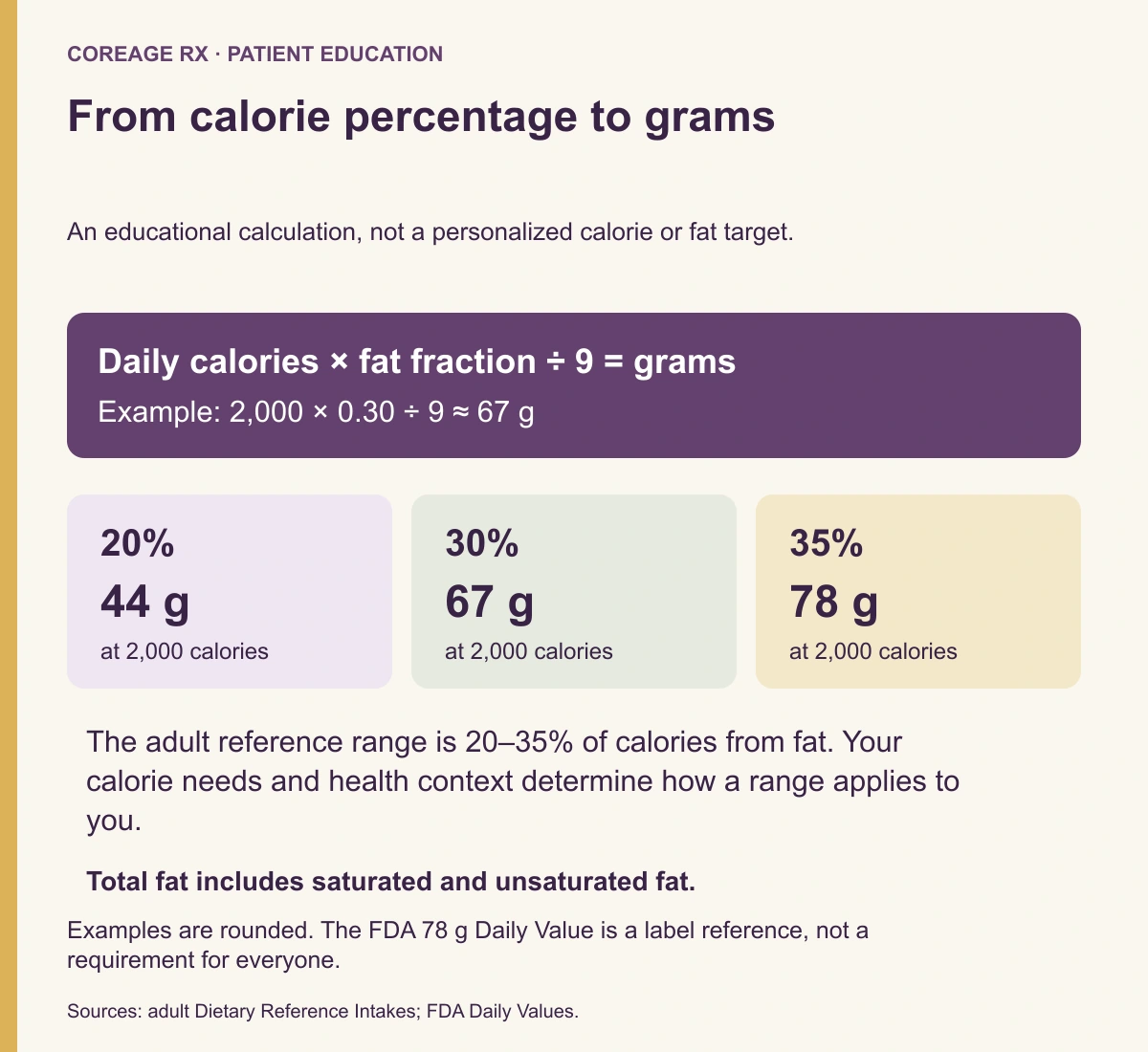
There is no single daily fat target that fits every adult. A commonly used adult reference range is 20% to 35% of total calories from fat. At 2,000 calories, that works out to about 44 to 78 grams per day. This is a broad nutrition-planning range, not a personal prescription or a special fat-loss formula. Dietary reference intake table
The right amount for an individual depends on overall energy needs, food preferences, medical conditions, and the rest of the eating pattern. Fat quality also matters: two menus with the same total fat grams can contain very different amounts of saturated fat, fiber, protein, and other nutrients.
How do you calculate fat grams from calories?
Fat supplies about nine calories per gram. To translate a percentage into grams, multiply the day’s calories by the chosen percentage and divide by nine. The percentage must be written as a decimal for the calculation.
For example, 2,000 calories multiplied by 0.30 equals 600 calories from fat. Dividing 600 by nine gives about 67 grams. This illustrates the arithmetic; it does not establish that 2,000 calories or 30% fat is the right target for you.
| Illustrative daily calories | 20% of calories from fat | 30% of calories from fat | 35% of calories from fat |
|---|---|---|---|
| 1,800 | 40 g | 60 g | 70 g |
| 2,000 | 44 g | 67 g | 78 g |
| 2,400 | 53 g | 80 g | 93 g |
Values are rounded. These are adult planning examples, not calorie recommendations. Children’s reference ranges differ, and clinical circumstances may require a different plan. The National Academies describes the reference range and its development; it is not a promise of an optimal weight-loss outcome at every point in the range. National Academies AMDR discussion
If you do not already have an appropriate calorie estimate, choosing a fat number first can create false precision. Our calorie-intake guide explains why energy estimates need adjustment to real-life needs and response.
Is 78 grams the amount everyone should eat?
No. The FDA Daily Value for total fat is 78 grams, based on a 2,000-calorie reference diet. The Daily Value helps people interpret Nutrition Facts labels; it is not a personalized instruction to eat exactly that amount every day. FDA Daily Values
Likewise, a food with 20% of the Daily Value for fat does not contain 20% fat by weight, and it does not automatically provide 20% of your own daily requirement. It provides that share of the standard label reference for the serving shown.
This distinction is useful when comparing packages. The label gives a common yardstick. Your eating plan determines how a portion of that food fits into the day. You do not need to eat extra fat at bedtime simply to reach the printed reference value.
How much fat should you eat to lose weight?
Weight management does not have one uniquely effective fat-gram target. A practical plan needs to provide adequate nutrition, fit overall energy needs, and remain workable over time. Reducing fat indiscriminately can remove foods you enjoy without addressing the parts of your routine that are actually difficult.
Start by looking at the whole meal. Does it contain an adequate protein source? Are there vegetables, fruit, legumes, or whole grains? Are oils, sauces, nuts, cheese, and other additions contributing more than you expected? Those questions are more informative than classifying every food as “low fat” or “bad.”
An example: a salad with beans, vegetables, and a measured amount of dressing is a different meal from leaves with very little protein and an unmeasured pour of dressing. The issue is the combination and amount, not a rule that salad dressing must disappear.
Our macros for weight loss guide explains how protein, carbohydrate, and fat work together. If tracking numbers makes eating more stressful or rigid, a dietitian can help develop a meal-based approach instead.
Total fat and saturated fat are different targets
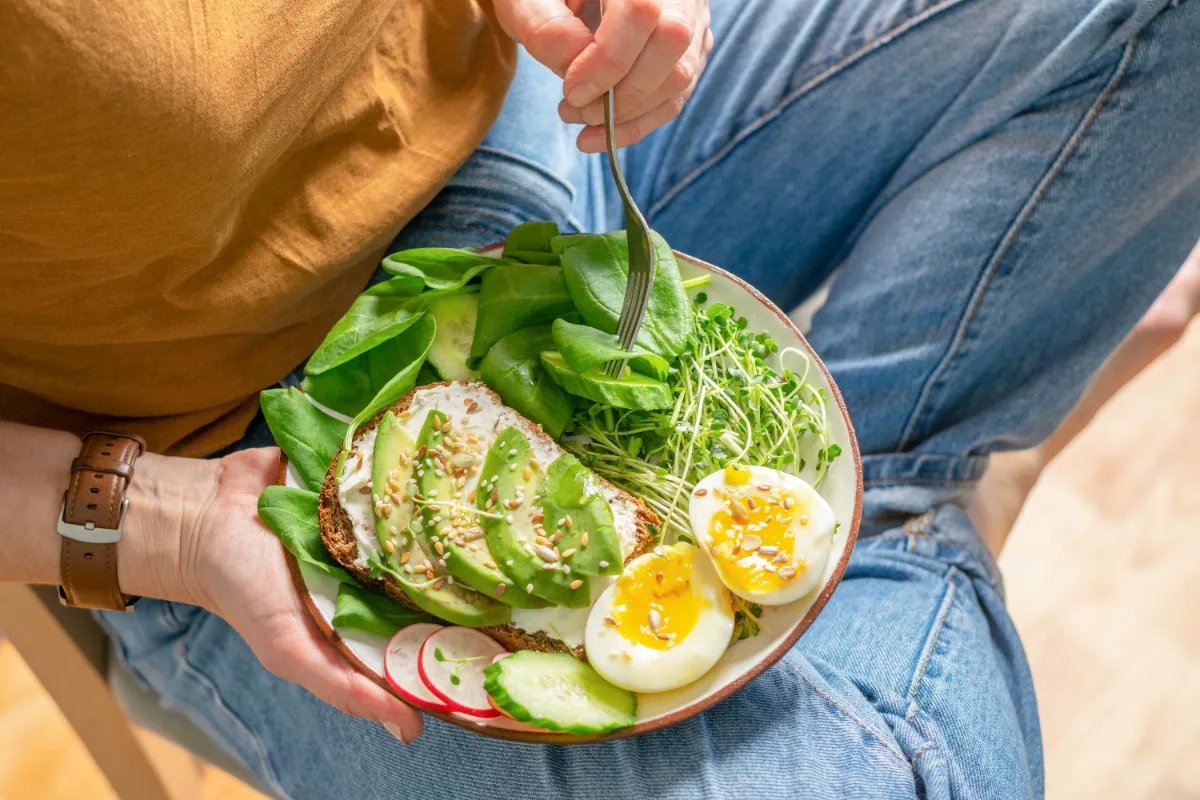
Total fat includes different types of fat. Saturated fat is one part of that total, not a separate allowance to add on top. Unsaturated fats include monounsaturated and polyunsaturated fats.
The 2025–2030 Dietary Guidelines for Americans advise that saturated fat generally should not exceed 10% of daily calories. The American Heart Association uses a stricter recommendation of less than 6%. These are different guidance frameworks; your clinician may recommend a particular approach based on cardiovascular risk and cholesterol. Dietary Guidelines, American Heart Association
At 2,000 calories, 10% is about 22 grams of saturated fat, and 6% is about 13 grams. The FDA’s separate saturated-fat Daily Value is 20 grams. These figures serve different purposes, so they should not be treated as contradictory personal prescriptions. FDA reference values
Rather than trying to fill a saturated-fat allowance, consider what you can substitute. The American Heart Association recommends replacing foods high in saturated or trans fats with foods supplying unsaturated fats, including appropriate plant oils, nuts, seeds, and fish. AHA guidance
What does choosing fat quality look like at meals?
The goal is to make the overall pattern useful and enjoyable. Here are several ways to put the comparison into practice:
- Use a measured amount of olive oil in a dressing rather than pouring until the bowl looks coated.
- Add nuts or seeds to a meal while noticing the portion, instead of treating them as an unlimited garnish.
- Include fish, beans, tofu, or another protein source that suits your preferences.
- Compare saturated fat on labels when choosing between similar sauces, spreads, or packaged foods.
- Keep vegetables and fiber-rich foods in the meal rather than replacing them with additional fat to meet a macro target.
These are meal-building examples, not rules that every person must eat the same foods. Allergies, culture, budget, and access matter. A food can contribute useful nutrients while still being energy-dense, so portion awareness and food quality can belong in the same conversation.
If breakfast is difficult, our protein breakfast ideas offers starting points that can be adapted to your preferences.
How to read fat on a food label
Begin with the serving size and the number of servings in the package. The FDA explains that a labeled serving reflects amounts people typically consume; it is not a recommendation for how much you personally should eat. FDA Nutrition Facts guide
Then check total fat, saturated fat, and the amount you actually use. For example, if a hypothetical sauce lists eight grams of fat per two-tablespoon serving and you use four tablespoons, that portion supplies about 16 grams. The calculation is straightforward once the serving and portion match.
Compare like with like. A teaspoon of one oil and a tablespoon of another are not equivalent portions. A “per package” column and a “per serving” column also answer different questions. This is especially relevant for snacks or prepared meals that look like one portion but contain multiple labeled servings.
Finally, look beyond fat. Protein, fiber, sodium, added sugars, and overall energy may influence the choice. A lower-fat product is not automatically a better fit if the rest of its nutrition profile or portion does not suit your needs.

What changes if you take semaglutide or tirzepatide?
There is no universal fat-gram target created simply by taking a GLP-1 medicine. Treatment may change appetite and tolerance, so the practical goal is adequate nutrition in meals you can manage. The joint advisory on nutritional priorities during GLP-1 treatment emphasizes assessing intake and supporting nutrition during weight reduction. Joint nutritional advisory
If large or rich meals seem to worsen nausea or uncomfortable fullness, discuss portions and preparation methods with the care team. A smaller serving or different meal may be easier to tolerate, but persistent symptoms should not be managed through increasingly restrictive eating alone.
Do not remove whole categories of foods without considering what will replace their nutrients and energy. Our semaglutide protein and muscle guide and GLP-1 nausea guide address common concerns when appetite becomes lower than expected.
Frequently asked questions
Is 30 grams of fat per day enough?
You cannot judge that number without the whole plan. At 2,000 calories, 30 grams provides 270 calories, or 13.5% of energy, below the adult reference range discussed above. That calculation is a reason to review the plan, not proof of a diagnosis. Medical diets may differ and need individual guidance.
Does eating more fat automatically increase body fat?
No single nutrient number tells you how body weight will change. Fat contributes energy, and amounts matter, but so do the rest of the diet and your circumstances. Avoid interpreting one higher-fat meal as evidence that a longer-term plan has failed.
Should I count cooking oil, nuts, and avocado?
If you are tracking total fat, include the foods and ingredients you actually consume. “Healthy” does not mean they contribute no fat or calories. If you are not tracking, consistent portions can still help you understand how a meal is assembled.
Does every day need to match exactly?
Ordinary eating varies. Unless you have a specific medical plan requiring close tracking, useful routines do not depend on hitting one gram-perfect number daily. Review the broader pattern, adequacy, tolerance, and progress with a qualified professional when needed.
Where should I start without an app or calculator?
Build regular meals with protein, produce, a suitable carbohydrate source, and an intentional amount of fat. Read a few labels on foods you use often. Our weight-loss basics guide and food fiber guide can help connect those choices into a sustainable routine.
Educational information for adults; individual treatment decisions require a qualified clinician. Sources checked September 27, 2026. Original AI-generated article illustrations depict fictional people and objects, not patient outcomes. Other editorial images are illustrative. Graphics summarize the cited sources.