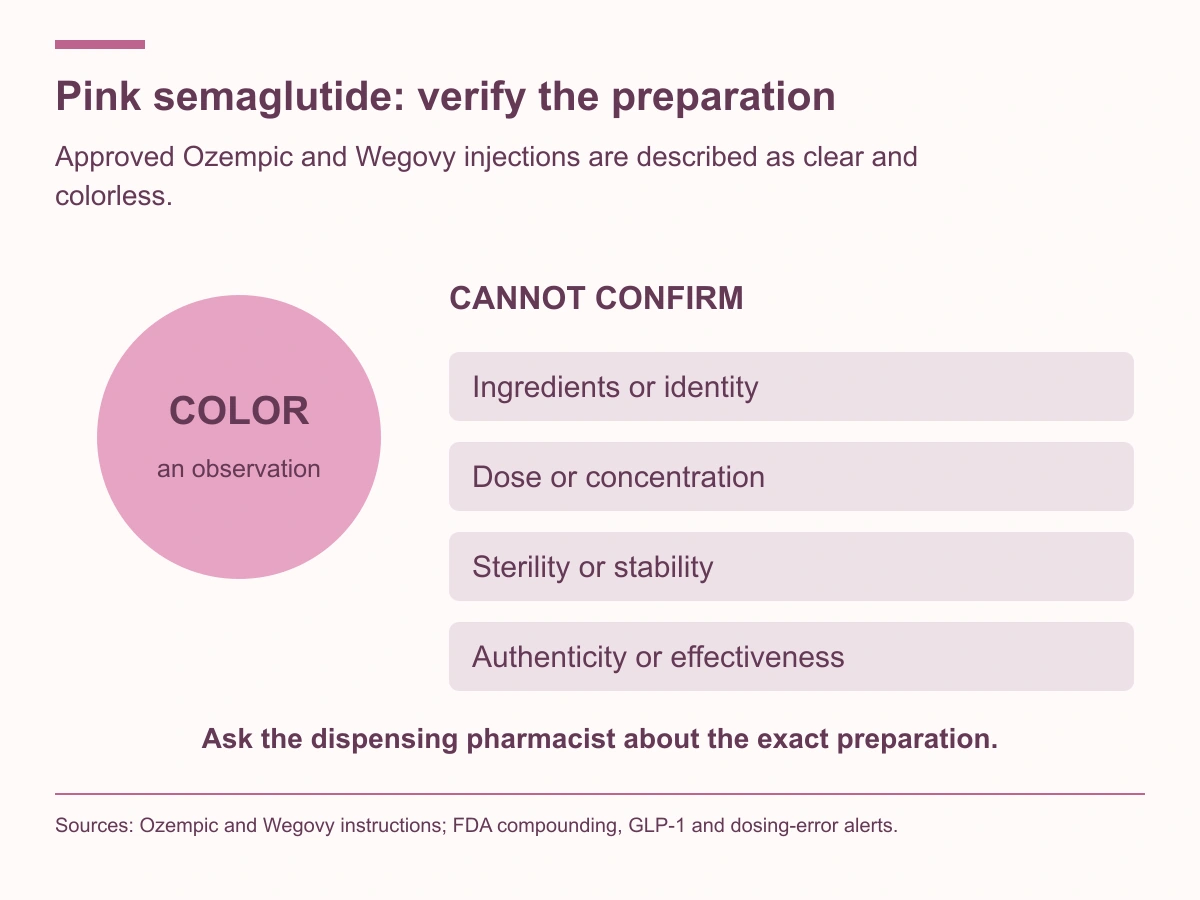
Pink semaglutide is not a separate FDA-approved type of semaglutide. A compounded preparation’s color may relate to an added ingredient, but color alone cannot identify the ingredients, concentration, sterility, or quality. If the appearance is unexpected or has changed, do not inject it while guessing about the explanation; contact the dispensing pharmacist and prescriber.
Approved Ozempic and Wegovy injections are described as clear and colorless. Their appearance instructions should not be replaced by a social-media rule that “pink means vitamins” or “clear means authentic.” This guide explains what to verify and why a visual check has limits.
What color should approved semaglutide injections be?
The U.S. instructions for Ozempic injection say the medicine should be clear and colorless and should not be used when particulate matter or coloration is present. Wegovy injection instructions also describe clear, colorless medicine and direct users not to use a cloudy product. Always follow the instructions for the exact presentation you received. Ozempic prescribing information and instructions, Wegovy prescribing information and instructions
This matters when someone describes a pink product as “Ozempic” even though the vial actually contains a compounded preparation. Brand names refer to specific approved products. A preparation containing semaglutide plus another ingredient is not automatically the branded medicine because the active ingredient’s name appears on the label.
If a device labeled as an approved brand contains an unexpected color, stop and obtain professional guidance. Do not assume a pharmacy added something to a branded device or that a colored batch is a new approved formulation. Keep the packaging and label information available for verification.
The oral versus injectable semaglutide guide explains why the product name, indication, route, and device must remain specific even when semaglutide is shared.
Why might a compounded preparation look pink?
Some compounders include additional ingredients with semaglutide. FDA specifically identifies examples such as cyanocobalamin, a form of vitamin B12, as well as vitamin B6, L-carnitine, and NAD. The agency states that the safety and effectiveness of combining semaglutide with other ingredients have not been established. FDA compounded-semaglutide alert
Cyanocobalamin itself is described in drug labeling as a red crystalline substance. That helps explain why a pharmacist might identify a B12-containing ingredient as relevant to a preparation’s color. It does not allow you to identify a pink vial by sight or infer how much of either ingredient it contains. Cyanocobalamin labeling
The right question is therefore not “Is pink normal for everyone?” It is “What exactly is in my prescribed preparation, what appearance is expected for this formulation, and does this container match the pharmacy’s record?” The answer must come from the actual dispensing source and prescription.
Do not add B12, a diluent, food coloring, or any other substance yourself. Do not mix separate medicines because their ingredients appear together in an advertisement. Compatibility, concentration, stability, and sterile preparation are not established by matching colors.
Compounded does not mean generic or FDA-approved
Compounding can meet a medical need when an available approved medicine cannot meet a particular patient’s needs. Compounded drugs are not FDA-approved, and FDA does not review each compounded preparation for safety, effectiveness, and quality before marketing. They are also different from approved generic drugs. FDA compounding questions and answers
A colored formulation does not bypass those distinctions. An added vitamin does not establish better weight loss, fewer side effects, improved absorption, or regulatory approval of the combination. Ask the prescriber why the specific preparation is medically appropriate for you and what evidence supports any additional ingredient.
Our compounded GLP-1 medication guide covers the broader differences. If the explanation is simply that every customer receives a proprietary blend, ask how that relates to your individual medical need and follow-up.
The pharmacy’s identity also matters. FDA has reported fraudulent compounded GLP-1 labels, including labels naming pharmacies that did not make the product. A real pharmacy name printed on a vial is not independent proof of origin. Verify through contact information you obtain from a reliable source. FDA GLP-1 concerns
What color can and cannot tell you
| Observation | What it may tell you | What it cannot establish |
|---|---|---|
| Pink or reddish appearance | There is visible color requiring a formulation-specific explanation | That the product contains B12 or the prescribed semaglutide amount |
| Clear, colorless appearance | It may match the expected visual description for an approved product | Authenticity, sterility, potency, or correct storage history |
| A new color compared with the last refill | Something about the appearance differs | Whether the reason is harmless, a formula change, or a quality problem |
| Cloudiness or visible particles | A quality concern requiring the applicable instructions and professional review | A safe way to filter, dilute, or salvage the medicine |
| A photo that looks similar to someone else’s vial | The pictures have a similar appearance | That the products, pharmacies, concentrations, or handling are the same |
Lighting, the container, and a photograph can also affect how a color looks. A phone image may help document what you observed, but it does not replace verification or testing. Keep the product closed and safely stored while seeking advice; do not handle a needle merely to obtain a clearer picture.
Questions to ask the dispensing pharmacist
Have the prescription label and packaging available. Ask the pharmacist to confirm the full formulation, the semaglutide concentration, any additional active ingredients, the expected appearance, and whether the lot supplied matches the dispensing record.
Then clarify the directions in the units actually used for your prescription. You should understand the prescribed drug amount, the volume to administer, and the correct syringe or device. Do not copy another person’s “units,” because different concentrations can deliver different amounts in the same volume.
FDA has received reports of serious dosing errors involving compounded semaglutide, including confusion between milligrams, milliliters, and syringe units. The agency advises patients and professionals to clarify measurement and administration with the prescriber or compounder. FDA dosing-error alert
Finally, ask about storage, the pharmacy’s beyond-use date, the first-use date, and what to do after a shipment or appearance problem. If the answer changes what you were previously told, request clear written instructions and have the prescriber reconcile any disagreement before use.
A new color after a refill deserves clarification
A pharmacy may tell you that a formulation or ingredient changed, but do not infer that explanation yourself. Compare the product name, concentration, added ingredients, directions, lot number, and dates with the previous prescription. A similar vial size does not mean the same concentration.
Tell the pharmacist whether the new color was present on arrival or developed after storage. Also report cloudiness, particles, leaking, damaged seals, freezing, or heat exposure. Those details help distinguish a labeling question from a quality or handling concern, although appearance alone cannot settle either one.
If the dispensing pharmacy cannot be identified or cannot confirm that it supplied the product, do not proceed on reassurance from an unrelated seller. Contact the prescriber and use official pharmacy-verification resources. FDA’s current GLP-1 safety page describes these kinds of authenticity concerns. FDA GLP-1 safety information
For a related device question, the Wegovy injection guide emphasizes matching instructions to the exact approved presentation. A vial and a branded pen should not share an assumed technique simply because both are called semaglutide online.
Storage and first-use dates still matter when the color looks unchanged
An unchanged color does not prove that storage conditions were acceptable. Follow the exact product’s requirements, and contact the pharmacy about a warm shipment, inadequate refrigeration, freezing, or another temperature concern. FDA currently advises against using an injectable GLP-1 product that arrives warm or without adequate refrigeration. FDA shipping and storage concerns
For compounded GLP-1 multidose vials, FDA’s current advice is to discard the vial within 28 days after first use even if medicine remains, including when a compounder’s instructions allow longer use. This is a first-use contamination concern, not a promise that every vial is suitable for 28 days. A shorter applicable date or another quality problem still matters.
Mark the first-use date and keep the original label. Ask the pharmacist to reconcile the beyond-use date and first-use instructions with current guidance. Do not extend use because the medicine is expensive, because a dose schedule was stretched, or because the liquid still looks normal.
Different approved pens and vials have their own storage and in-use limits. Do not transfer a rule from one brand or presentation to another. Our oral semaglutide versus injections guide provides a broader reminder that route and formulation change the instructions.
Does B12 make semaglutide work better or prevent nausea?
The presence of a vitamin is not evidence that the combination produces more weight loss or reliably prevents semaglutide side effects. FDA’s statement about the unestablished safety and effectiveness of added-ingredient combinations is directly relevant here. A plausible story about energy or metabolism is not a substitute for a study of the actual formulation. FDA added-ingredient caution
A diagnosed vitamin deficiency can need treatment, but that is a separate clinical question. Ask what problem the added ingredient is intended to address, how the need was established, and how benefit or adverse effects will be assessed. Do not assume fatigue means B12 deficiency or that every person taking a GLP-1 medicine needs a vitamin injection.
If you are exploring care, CoreAge Rx semaglutide information can help you understand its assessment-based service. Confirm the exact preparation and ingredients directly. A service description should not replace a patient-specific explanation of a compounded formulation.

If you already used a questionable product
Contact the prescriber and pharmacist with the product details, amount used, timing, symptoms, and reason for concern. Do not take another dose while trying to compensate for uncertainty. If a dosing error is possible, seek prompt professional advice rather than waiting to see whether a color change has an effect.
Difficulty breathing, facial or throat swelling, collapse, severe confusion, or another serious reaction requires emergency care. Persistent vomiting, severe ongoing abdominal pain, or inability to keep fluids down also needs prompt assessment. Product verification should not delay treatment of significant symptoms.
Medication errors, adverse effects, and quality concerns can be reported to FDA MedWatch. Keep the label and lot details available, but follow safe handling instructions. A report helps document the problem; it does not independently identify what was in the container. FDA MedWatch
Frequently asked questions
Does pink semaglutide always contain B12?
No. Color alone cannot confirm an ingredient. Ask the dispensing pharmacist to verify the actual formula and expected appearance from the prescription and lot record.
Is clear semaglutide automatically safe?
No. Clear appearance cannot prove authenticity, concentration, sterility, or storage quality. Use the exact product’s instructions and verified clinical and pharmacy sources.
Can I use a darker vial if the dose in units is unchanged?
Do not infer concentration from shade or copy a previous unit amount. Confirm the current concentration, prescribed dose, and measurement instructions before use.
Is a colored compounded product the same as Ozempic?
No. Ozempic is a specific approved product. A compounded semaglutide preparation, with or without added ingredients, is not automatically an approved brand or generic equivalent.
What should I do when the appearance differs from the pharmacy’s description?
Pause use and contact the pharmacy and prescriber. Provide the label, lot, storage history, and description of the difference. Do not attempt to fix the appearance or test a small dose yourself.
Educational information for adults; individual treatment decisions require a qualified clinician. Sources reviewed October 6, 2026. Original AI-generated article images depict fictional people and objects, not patient outcomes. Other editorial images are illustrative. Graphics summarize the cited sources.