
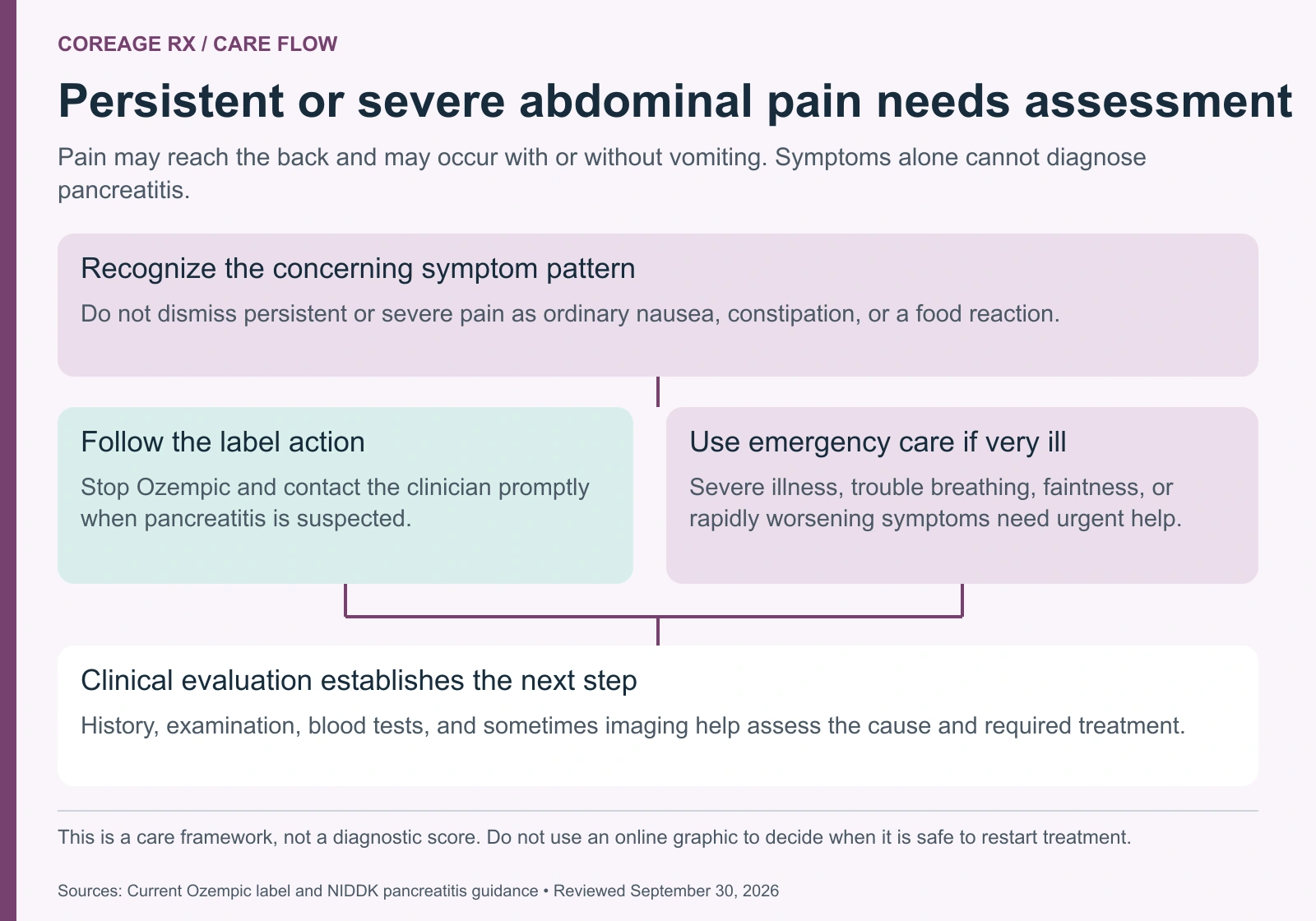
Persistent or severe abdominal pain while taking Ozempic needs prompt medical attention, especially if it extends to the back. Pancreatitis is one possible cause, but symptoms alone cannot diagnose it. Vomiting may occur, yet its absence does not rule the condition out.
The current Ozempic Medication Guide tells patients to stop using the medicine and contact their healthcare provider right away for severe abdominal pain that will not go away, with or without vomiting. If you are severely ill, have worsening severe pain, or have emergency symptoms, seek urgent or emergency care rather than waiting for a routine follow-up.
What is pancreatitis?
Pancreatitis is inflammation of the pancreas, an organ involved in digestion and blood-glucose regulation. Acute pancreatitis develops over a relatively short period; chronic pancreatitis involves ongoing disease and can affect digestion and other functions. They are not interchangeable diagnoses.
NIDDK’s symptom guidance describes upper-abdominal pain that may spread to the back as a main symptom. Acute illness may also involve nausea, vomiting, fever, a fast heartbeat, or a swollen or tender abdomen. Some people develop serious complications.
The aim of recognizing these symptoms is to obtain an assessment, not to identify the organ causing pain from an online diagram. The location or intensity of a symptom can be useful information, but it is only part of a clinical evaluation.
Which symptoms should prompt immediate attention?
Contact a healthcare professional right away for persistent or severe abdominal pain, particularly pain extending to the back. The Ozempic warning applies whether vomiting is present or not. Do not wait for the symptom pattern to match every item in a checklist.
NIDDK also advises prompt care for severe or worsening abdominal pain or tenderness, fever or chills, a fast heartbeat, shortness of breath, or jaundice—a yellow color of the skin or whites of the eyes. These signs may reflect pancreatitis or another serious abdominal problem.
Repeated vomiting or inability to keep fluids down also warrants review. If symptoms are severe, you are becoming very unwell, or you cannot safely wait for a clinician response, seek emergency care. Do not rely on changing meals or moving the next injection site to resolve the concern.
Can you tell pancreatitis from ordinary Ozempic nausea?
Not reliably from symptoms alone. Nausea, vomiting, abdominal discomfort, diarrhea, and constipation are recognized adverse effects of Ozempic, but a symptom occurring during treatment does not automatically make it harmless or establish its cause.
Severity, persistence, accompanying symptoms, medical history, and the examination matter. New severe pain that does not settle should not be categorized as expected nausea merely because treatment started recently. Similarly, having mild nausea does not prove pancreatitis.
Our Ozempic side-effects guide describes common and serious concerns separately. Use it to prepare questions about ordinary symptoms; use prompt clinical care for the warning pattern rather than trying to rule out a serious problem yourself.
Does Ozempic cause pancreatitis in everyone?
No. The label states that acute pancreatitis has been observed in patients treated with GLP-1 receptor agonists, including Ozempic. That warning requires attention, but it is not a prediction that everyone using the medicine will develop pancreatitis.
The prescribing information reports seven adjudicated acute-pancreatitis cases in Ozempic-treated patients in glycemic-control trials, corresponding to 0.3 cases per 100 patient-years, compared with three cases and 0.2 per 100 patient-years in comparator-treated patients. Those are trial-context rates with an exposure denominator.
A patient-year combines the time people were observed. These figures should not be relabeled as the percentage of all current users, applied to every semaglutide formulation, or used to calculate your personal risk. A small numerical difference also does not by itself prove the cause of one person’s illness.
What else can cause pancreatitis or similar pain?
NIDDK describes gallstones and heavy alcohol use among important causes, along with other medicines, genetic factors, and additional conditions. Sometimes the cause is not identified. The evaluation should consider the whole history rather than only the newest prescription.
Other abdominal problems can also produce pain, nausea, or vomiting. A clinician may evaluate gallbladder or bile-duct problems and other possible explanations. The Ozempic label separately discusses gallbladder disease; one warning should not be mistaken for a diagnosis of the other.
If you have a history of gallstones, pancreatitis, or another pancreatic condition, tell the care team before starting or continuing treatment. Bring information about previous episodes and what clinicians determined at the time. An accurate history is more useful than a broad statement that you once had “stomach trouble.”
What will the clinician want to know?
Prepare a short account of when the pain began, whether it is constant or intermittent, where it is felt, and whether it extends elsewhere. Explain vomiting, fever, changes in drinking or urination, jaundice, and other symptoms without waiting to assemble a perfect record before seeking help.
Bring the medicine name, presentation, prescribed dose, date of the last dose, recent changes, and other medicines or supplements. Mention alcohol use, previous pancreatitis or gallstones, and relevant health conditions. If administration may have involved an error, say so clearly.
This information can help the team investigate and manage the situation. It cannot establish the diagnosis by itself. Do not continue taking additional doses while trying to collect more evidence when the medication warning calls for stopping and contacting the clinician.
How is pancreatitis evaluated?
NIDDK’s diagnosis page describes combining medical history, examination, and laboratory or imaging tests. The professional assesses the symptoms, abdominal findings, possible causes, and whether another condition better explains the presentation.
Blood tests may include pancreatic enzymes such as lipase and amylase, along with other tests chosen for the situation. Imaging may help assess the pancreas, gallbladder, and bile ducts. The exact tests and sequence depend on the clinical findings.
An isolated result should not be interpreted as a self-diagnosis. The Ozempic label also describes changes in pancreatic enzyme levels during trials; a test result needs clinical context. Do not order or interpret a single test as a substitute for assessment of severe symptoms.
What does the current label say about stopping treatment?
The prescribing information instructs clinicians to discontinue Ozempic and begin appropriate management when pancreatitis is suspected. The patient instructions likewise call for stopping the medicine and contacting the healthcare provider for the warning symptom pattern.
That action is different from a routine missed-dose question. Do not apply a standard restart schedule to a suspected pancreatic illness or take an extra dose to maintain a calendar while awaiting advice. The clinical team needs to determine what happened and how to manage the underlying condition.
Our semaglutide interruption guide explains ordinary gaps, but suspected serious adverse effects require an individualized plan. If you have diabetes, ask the team how glucose will be managed while treatment is being evaluated.
How is pancreatitis treated?
Treatment depends on whether illness is acute or chronic, its severity, the cause, and complications. NIDDK’s treatment overview describes hydration, pain management, nutrition support, and sometimes hospital care. Procedures may be needed for a specific problem such as a blocked duct or gallstone-related disease.
Antibiotics are not a universal home treatment for every episode; the source discusses them where infection is present. Likewise, deciding to stop eating or follow an extreme diet is not a substitute for professional treatment. Follow the clinical team’s actual fluid and nutrition plan.
Ask what follow-up is needed, which symptoms require returning for care, and how medicines will be reviewed. Discharge from an acute-care visit should be followed by clear instructions rather than an assumption that the previous prescription routine can automatically resume.
What if you had pancreatitis before considering Ozempic?
Tell the prescriber before starting and explain the documented cause, recurrence, complications, and recovery where known. A prior episode creates a specific clinical discussion about the expected benefit, possible risks, alternatives, and uncertainty.
Do not interpret the history as either an automatic assurance of safety or a universal permanent prohibition established by this article. The current label’s listed contraindications and its pancreatitis warning are distinct sections. Your clinician needs to assess the individual situation rather than apply an old internet summary without checking the current product information.
If weight management is part of the discussion, identify the appropriate treatment and approved indication. Our semaglutide product comparison and weight-management assessment guide help organize that broader conversation.
Can you restart Ozempic or switch to another GLP-1 medicine?
Do not restart or switch on your own after suspected or diagnosed pancreatitis. The future plan depends on the assessment, cause, recovery, treatment goals, and product-specific evidence. A smaller dose or another brand is not automatically a way to remove the concern.
Wegovy also contains semaglutide, while Mounjaro and Zepbound contain tirzepatide. Their current Wegovy, Mounjaro, and Zepbound labels also include pancreatitis warnings. A brand change should therefore be evaluated clinically rather than assumed to bypass the issue.
Our GLP-1 introduction explains the category, and the semaglutide-versus-tirzepatide comparison addresses treatment differences. Neither can decide a post-pancreatitis prescription for an individual.
Questions to take to follow-up
Ask whether pancreatitis was confirmed, what caused the episode or remains uncertain, and which medicines should remain stopped. Clarify diabetes or weight-management alternatives, the monitoring plan, and whether specialist input is needed.
Also ask about nutrition, alcohol, smoking, gallstones, and any other cause identified in the evaluation. NIDDK recommends avoiding alcohol and smoking in pancreatitis management; the practical support you need should be discussed with the treating team.
If you are considering CoreAge Rx semaglutide care after a prior illness, disclose the history and provide relevant records for assessment. A service or product page is not an urgent-care pathway or a promise that treatment will be prescribed. Current warning symptoms should be assessed promptly; future treatment belongs in a clear clinician-directed plan.
Educational information for adults; individual treatment decisions require a qualified clinician. Sources reviewed September 30, 2026. Original AI-generated article images depict fictional people and objects, not patient outcomes. Other editorial images are illustrative. Graphics summarize the cited sources.