
Topiramate can cause weight loss, and clinicians sometimes prescribe it off-label for that purpose. Topiramate alone is not FDA-approved as a weight-management medicine. Qsymia, an approved weight-management product, combines phentermine with extended-release topiramate and has its own eligibility, dosing, monitoring, and safety requirements.
That distinction matters before comparing results or looking for a dose online. A generic topiramate tablet is not the same treatment as the approved combination capsule. The decision also involves risks that have little to do with the scale, including pregnancy, cognition, mood, eye symptoms, kidney stones, and changes in blood chemistry.
What is topiramate normally used for?
Topiramate is an antiseizure medicine. The Topamax label includes treatment of specified seizure disorders and prevention of migraine in specified age groups. Weight reduction is not a stand-alone approved indication in that label. See the Topamax prescribing information.
Off-label prescribing means using an approved medicine in a way not included in its approved labeling. It can be part of a clinician’s judgment, but it should come with an explanation of the rationale, available evidence, alternatives, and monitoring. It does not mean there is an FDA-approved topiramate-only weight-loss schedule that applies to everyone.
If you already take topiramate for epilepsy or migraine, do not change the dose to influence your weight. The original condition remains part of the treatment decision, and abrupt changes can create risks.
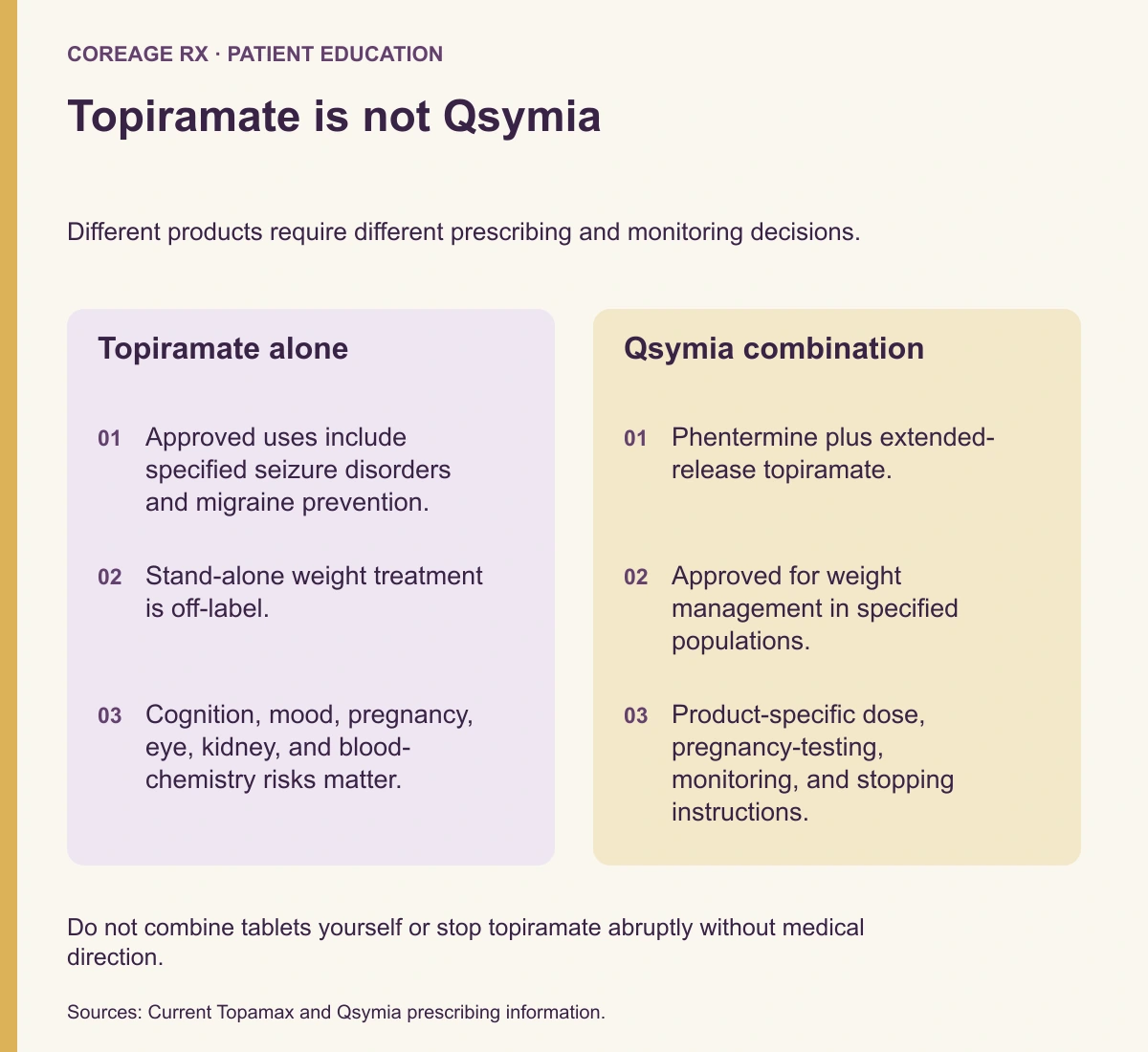
Topiramate alone versus Qsymia
| Question | Topiramate alone | Qsymia |
|---|---|---|
| Ingredients | Topiramate | Phentermine plus extended-release topiramate |
| Approved weight-management indication | No stand-alone indication | Yes, for specified adults and pediatric patients ages 12 and older |
| Weight-treatment dose plan | An individualized off-label decision | Product-specific labeled initiation, reassessment, and discontinuation instructions |
| Safety review | Topiramate risks, medical history, and other medicines | Risks and contraindications of the combination, including phentermine-related considerations |
Qsymia is labeled, with reduced-calorie eating and increased physical activity, for adults and patients ages 12 and older with obesity, and for adults with overweight plus at least one weight-related condition. Its label states that an effect on cardiovascular illness and mortality has not been established. See the Qsymia prescribing information.
The approved combination is not a recipe for combining separate tablets on your own. Release characteristics, doses, contraindications, and follow-up need professional review. This article focuses on adult treatment questions; pediatric care requires its own assessment and monitoring.
What the weight-loss evidence shows
A 2011 meta-analysis combined ten randomized trials involving 3,320 participants. Eligible studies lasted at least 16 weeks. Topiramate-treated participants lost an average of 5.34 kg more than those receiving placebo, with results varying by dose and duration. That is approximately 11.8 pounds of additional average loss, not a promised total loss for a person starting treatment.
The review also found more discontinuation because of adverse effects with topiramate; the reported odds ratio was 1.94 compared with control. Commonly reported effects included tingling, altered taste, and psychomotor problems. These findings come from the Kramer meta-analysis.
This is older pooled evidence across different study regimens. It does not establish the outcome of every lower-dose prescription used in current practice, nor does it directly compare topiramate with a modern GLP-1 treatment. The review’s average should stay attached to its study limitations.
If you are comparing options, our Ozempic alternatives guide organizes choices by treatment goal rather than ranking medicines using unrelated trial averages.
How might it affect appetite and weight?
Topiramate has several effects on nervous-system signaling. Patients may notice changes in appetite or taste, but the precise contribution of each effect to weight reduction is not fully established. A change in how a food tastes does not by itself show that treatment is producing a healthy or sustainable outcome.
It is also important to separate intended benefit from adverse effects. Eating less because you feel confused, nauseated, excessively tired, or unable to function comfortably is not a result to ignore simply because weight is decreasing.
A follow-up discussion should include how you feel, what you are eating, daily function, and the original reason for treatment. The number on the scale cannot capture those tradeoffs on its own.
Why there is no universal topiramate weight-loss dose
The appropriate regimen depends on the indication, formulation, kidney function, other medicines, tolerance, and the clinician’s assessment. Doses used for migraine or seizure control should not be copied into an off-label weight plan, and a trial dose is not a personal prescription.
Topiramate can cause cognitive effects, and the label notes that faster titration and higher initial doses were associated with more cognitive problems in relevant trials. Increasing quickly to chase a scale result can therefore add risk rather than establish a better plan.
Qsymia has a separate labeled process for reviewing response after defined periods at particular doses. Those thresholds and steps apply to that combination product. They should not be transferred wholesale to topiramate alone. Ask the prescriber what improvement would justify continuing your actual prescription and what findings would lead to a change.

Cognitive and mood effects deserve attention
Topiramate can cause difficulty with concentration, memory, language, and word finding, as well as slowing, fatigue, or sleepiness. Some people describe these effects as “brain fog,” but that phrase can hide meaningful problems with work, driving, study, or daily tasks.
Tell the prescriber when these changes start, whether they followed a dose increase, and what activities are affected. Do not assume they must be tolerated indefinitely for weight benefit. Avoid driving or hazardous tasks if your alertness or thinking is impaired, and discuss the medicine’s precautions.
The label also warns about depression, mood changes, and suicidal thoughts or behavior associated with antiseizure medicines. New or worsening symptoms require prompt contact with the treating clinician. If you are in immediate danger of harming yourself, seek emergency help. These warnings are relevant even when topiramate is prescribed for a reason other than epilepsy. See the Topamax safety sections.
Pregnancy and contraception are central to the decision
Topiramate exposure during pregnancy is associated with increased risks including oral clefts and infants being small for gestational age. Pregnancy plans should therefore be discussed before treatment, particularly when the proposed purpose is weight management.
Qsymia is contraindicated during pregnancy. Its label recommends a negative pregnancy test before starting and monthly during treatment for people who can become pregnant, along with effective contraception. Qsymia is distributed through a risk-management program because of fetal risk. Those product-specific requirements should not be reduced to a vague instruction to “be careful.”
Topiramate can also interact with contraceptive treatment, so ask which method is appropriate with the exact prescription and other medicines. If pregnancy occurs or is suspected, contact the prescriber immediately for product-specific instructions. If topiramate is treating epilepsy, changing it requires urgent coordination because seizure control also matters.
Do not assume that switching to another weight medicine automatically solves the pregnancy issue. Pregnancy planning should be part of a broader medication review.
Blood chemistry, kidneys, and heat tolerance
Topiramate can lower bicarbonate in the blood and cause metabolic acidosis, meaning a disturbance in the body’s acid-base balance. The label recommends measuring bicarbonate before and periodically during treatment. Symptoms can be nonspecific, including fatigue or reduced appetite, so a symptom-free period does not necessarily replace laboratory monitoring.
Kidney function, a history of kidney stones, a ketogenic diet, and other medicines can affect the assessment. Do not begin a restrictive ketogenic diet or add another product affecting acid-base balance without discussing it with the clinician. Topiramate can increase kidney-stone risk, and hydration advice should fit your medical circumstances.
Reduced sweating and overheating are additional warnings, particularly noted in children but relevant to counseling about the medicine. Report problems with sweating or heat tolerance, especially during hot weather or exercise. The Topamax label and Qsymia label describe these monitoring concerns in detail.
For ordinary food planning, our balanced meals guide offers a less restrictive starting point for a conversation with a dietitian.
Eye symptoms and other urgent problems
Topiramate can cause acute myopia and secondary angle-closure glaucoma. Sudden blurred vision, reduced vision, or eye pain requires urgent medical assessment. Do not wait for a routine weight-management follow-up to report it.
Serious rash, fever with swelling or other systemic symptoms, and severe allergic reactions also require prompt attention. Trouble breathing or swelling of the face or throat is an emergency. Bring the medication list and timing of recent changes when seeking care.
These warnings explain why a low price or oral route does not make topiramate a simple substitute for another medication. Its risks are different, and the treatment should fit the person and indication.

Do not stop topiramate abruptly on your own
The Topamax label advises gradual withdrawal to reduce the risk of seizures or increased seizure frequency, including in people without a previous seizure history. A prescriber should plan routine discontinuation and explain the steps for the actual formulation and dose.
This does not mean you should delay urgent care for a serious reaction. Some situations require rapid medically directed discontinuation with appropriate monitoring. The clinician treating the urgent problem should make that decision rather than a generic internet taper schedule.
If you run out, miss several doses, or cannot tolerate the medicine, contact the pharmacy and prescriber for instructions. Do not borrow tablets, double doses, or create a restart plan based on another person’s experience.
How to compare treatment options sensibly
Ask why topiramate is being considered, what alternatives fit your diagnosis, which risks are most relevant, and how benefit will be assessed. Include costs, monitoring, pregnancy plans, mental clarity, and the original neurologic condition if applicable.
Our metformin and weight-loss guide and tirzepatide versus semaglutide results guide explain other medication discussions without implying that unrelated trial results form a universal ranking. The semaglutide questions guide covers considerations for that treatment class.
If you want to explore CoreAge Rx’s semaglutide care information, use the assessment to discuss suitability and the exact product. Topiramate and GLP-1 medicines are not interchangeable, and combining weight treatments requires a clinician’s review. The useful goal is a treatment whose benefit, tolerability, and monitoring make sense together.
Educational information for adults; individual treatment decisions require a qualified clinician. Sources checked September 27, 2026. Original AI-generated article illustrations depict fictional people and objects, not patient outcomes. Other editorial images are illustrative. Graphics summarize the cited sources.