
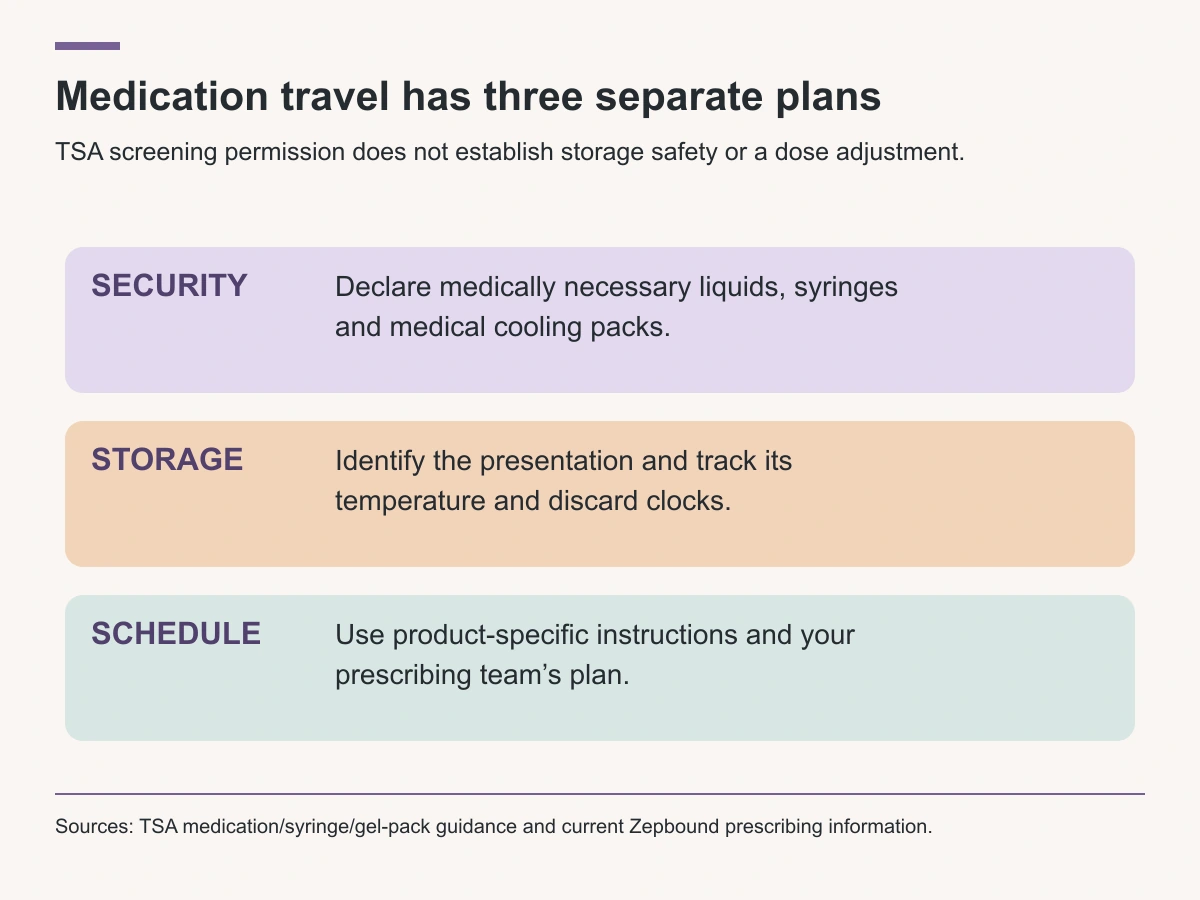
Traveling with medication is easier when you plan three separate things: airport screening, safe storage, and your prescribed schedule. Permission to carry a medicine through security does not establish how it should be stored or whether a time-zone change requires a treatment adjustment.
For Zepbound, identify the actual presentation before packing. A single-dose pen, single-dose vial, multidose vial, and KwikPen do not all have the same storage clocks. The instructions for a branded product also do not automatically apply to compounded tirzepatide.
Start with a product-specific travel plan
Read the dispensing label and current manufacturer instructions. Record the product name, presentation, strength, expiration date, and any first-use or time-out-of-refrigeration dates. Make sure you have enough medicine and supplies for the trip, with a plan for delays that respects the label.
Ask the pharmacist what to do if temperature control is uncertain, the product is damaged, or your luggage is delayed. Ask your prescriber about your schedule before departure if the trip crosses time zones or you have missed doses. Do not wait until you are at the airport to decide whether a different syringe or an extra dose is appropriate.
Our tirzepatide vial guide explains why presentation matters. The compounded GLP-1 guide addresses a separate product category. A familiar active ingredient does not make every container or instruction interchangeable.
TSA rules for medically necessary liquids
TSA allows medically necessary liquids in reasonable quantities for the trip in excess of the usual 3-1-1 liquid limit. Tell the officer about them at the checkpoint so they can be screened. The officer makes the final decision about what is allowed through screening. TSA liquid medication guidance.
This is a security rule, not a storage rule. A medicine may be permitted through screening and still be damaged by heat or freezing. Keep those decisions separate when choosing a travel pouch or cooling arrangement.
Carry useful medication documentation and leave the medicine identifiable. Although requirements can differ outside TSA screening, a pharmacy label can make it easier to explain what you are carrying. Destination laws, airline policies, and border rules deserve their own review, especially for international travel.
Syringes and medical cooling packs
TSA says unused syringes are allowed when accompanied by injectable medication and should be declared for inspection. It recommends labeling medicines, while stating that labeling is not required under that particular screening guidance. Other jurisdictions may have different requirements. TSA unused syringe guidance.
For medically necessary gel ice packs, TSA provides an exception for reasonable quantities even when melted or slushy. Notify the officer for inspection. That exception does not make direct contact with an ice pack safe for a medicine that must not freeze. TSA gel ice pack guidance.
Pack the supplies your actual device requires. A single-dose pen and a vial may need different items. If you receive a different presentation before travel, request appropriate training rather than borrowing the previous device’s instructions.
| Planning area | What to verify | What it does not answer |
|---|---|---|
| TSA screening | Declaration and inspection of medicine and supplies | Storage temperature or dose timing |
| Cooling arrangement | Actual temperature and protection from freezing | Border permission |
| Device supplies | Matching needles, syringes, or other required items | A substitute dose measurement |
| Destination rules | Official import and documentation requirements | Whether your usual schedule should change |
| Prescription plan | Adequate supply and clinician-directed timing | Universal rules for every medicine |
Current Zepbound storage: single-dose products
The current U.S. Zepbound label says to refrigerate single-dose pens and single-dose vials at 36°F to 46°F, or 2°C to 8°C. If needed, they can be stored unrefrigerated at no more than 86°F, or 30°C, for up to a total of 21 days. The label directs disposal after that total room-temperature allowance. Protect the medicine from heat and light, and do not use it if it has frozen. Zepbound storage instructions.
“Total” matters. Record previous unrefrigerated time rather than assuming a new trip starts a new allowance. A car, beach bag, or sunny windowsill may exceed the temperature ceiling even during a short outing. The allowance is not permission to expose the product to any temperature for 21 days.
The Zepbound storage guide provides a focused reference. If the product’s history is uncertain, give the pharmacist the actual dates and temperature information. Appearance alone cannot settle every storage concern.

Current Zepbound storage: multidose vial and KwikPen
The label distinguishes unopened from opened multidose products. Unopened multidose vials and KwikPens can remain refrigerated until their labeled expiration; an unopened product stored at room temperature up to 86°F has a 30-day discard limit. After first use, the label permits refrigeration or room-temperature storage within that ceiling and requires disposal at the earliest applicable limit: 30 total days at room temperature, 30 days after first use, or four weekly doses. Zepbound multidose storage instructions.
Keep the relevant dates together. A first-use date and a room-temperature history describe different clocks. Returning a product to a refrigerator does not erase time already counted or create additional doses from leftover liquid.
Do not use the multidose rules for a single-dose product, or a manufacturer’s rules for a compounded vial. FDA advises discarding compounded sterile multidose GLP-1 vials 28 days after first use, even when a compounder gives a longer interval. Product-specific temperature and beyond-use information still matters. FDA concerns about unapproved GLP-1 drugs.
Choosing a cooling arrangement
A bag described as insulated does not prove that it maintains a required temperature. Think about the entire trip: leaving home, the ride to the airport, queues, the flight, ground transport, and arrival. Decide how you will know whether the medicine stays within its permitted conditions.
Avoid letting the medicine freeze against a frozen pack. Keep it protected from light as directed, and do not place it where it may be crushed or lost among loose belongings. Ask the pharmacist about an appropriate arrangement for the exact product and expected travel conditions.
At the destination, check storage before unpacking. A hotel refrigerator may have very cold areas or unreliable settings. Do not assume that “refrigerated” always means the manufacturer’s specified range. If you cannot maintain appropriate conditions, contact the pharmacist to discuss your options.
For compounded products, the compounded GLP-1 guide addresses why the dispensing instructions and FDA first-use advice must be reviewed separately from branded Zepbound.
Time zones and weekly dosing
Zepbound’s label permits weekly administration at any time of day, with or without meals. If changing the weekly administration day, at least 72 hours must separate doses. Those rules do not authorize extra injections or supply a personal restart plan after a longer interruption. Zepbound administration instructions.
Before travel, write down the date and time of your last actual dose and ask whether your intended schedule needs adjustment. Use the actual product name when asking. Ozempic, Wegovy tablets, insulin, and other medicines have their own instructions and should not inherit Zepbound’s rules.
The tirzepatide missed-dose and restart guide is a useful reference for discussion. If you are unsure after crossing time zones, contact your prescribing team rather than taking another dose “to get back on schedule.”
Daily medicines, especially those with food, fasting, or glucose-related instructions, deserve their own plan. A weekly injection’s flexibility does not establish a safe schedule for everything in your medication bag.
Plan for used sharps
FDA advises placing used needles and other sharps in a proper disposal container immediately after use and carrying a small travel-size container when away from home. Disposal arrangements vary by location, so check the destination’s process rather than leaving used sharps in ordinary trash or loose in luggage. FDA sharps disposal guidance.
Ask the accommodation or local health service where an appropriate container can be disposed of. For flights, check current TSA guidance for used sharps and the airline’s requirements. Do not assume that the policy for unused syringes answers every question about a used device.
Keep the container secure and away from children and pets. Include enough supplies to avoid reusing a needle because one was forgotten. The correct injection training still applies while you are traveling.

International trips need a separate check
Review official information from the destination’s customs authority, health authority, or embassy before departure. Ask whether the medicine is permitted, what documentation is needed, whether there is a quantity limit, and how injectable supplies should be declared. Also check any transit countries when relevant.
TSA permission addresses U.S. airport screening, not entry into another country. A doctor’s letter or original packaging may be helpful, but neither should be presented as a guarantee of admission everywhere.
Keep contact information for your prescriber and pharmacy accessible. Plan what you would do if supplies are lost or damaged, and avoid assuming a replacement product abroad has the same formulation or device.
Frequently asked questions
Can I fly with Zepbound pens?
TSA permits medically necessary medicines subject to screening. Declare the medicine and relevant supplies, and review the current guidance. You also need a storage plan and, for international travel, a destination-specific entry check.
Must my cooling pack be completely frozen?
TSA’s medical exception can permit medically necessary gel packs in reasonable quantities even when melted or slushy. Notify the officer. Separately, protect the medicine from freezing and excessive heat according to its label.
Does every Zepbound product have a 21-day limit?
No. The current label gives different rules for single-dose and multidose presentations. Identify the exact container and track the applicable storage and first-use limits.
Can I put a compounded vial under the same rules?
Do not assume that. Use the dispensing pharmacy’s temperature and beyond-use information alongside FDA’s current advice for compounded sterile multidose GLP-1 vials. Brand instructions do not establish compound equivalence.
Should I change my dose because of the flight?
A flight does not automatically require a dose change. Discuss the last actual dose, intended schedule, and time zones with your prescribing team. Do not add a dose or change a restart plan on your own.
Where can I learn about treatment before planning travel?
CoreAge Rx’s tirzepatide service information and semaglutide service information describe separate care options. Product selection and training should be settled with a qualified clinician before relying on travel instructions.
Educational information for adults; individual treatment decisions require a qualified clinician. Sources reviewed October 2, 2026. Original AI-generated article images depict fictional people and objects, not patient outcomes. Other editorial images are illustrative. Graphics summarize the cited sources.